
A wood deck runs roughly $15–$60 per square foot installed, a composite or Trex deck runs $30–$120+ per square foot, and a stone or paver patio runs $12–$40+ per square foot. For a typical 12x12 project, that means a basic pressure-treated deck costs around $2,200–$4,300, while a natural stone patio lands closer to $2,900–$5,800. For a direct comparison of upfront and lifecycle expenses, see our detailed cost of stone patio vs wood deck. Concrete and paver patios often cost less than either deck type upfront, but the right choice depends on your site, how you plan to use the space, and how much you want to spend maintaining it over 10–30 years.
Deck vs Stone Patio Cost: Compare Prices for Homeowners

Felix Carver
21 Jul 2026
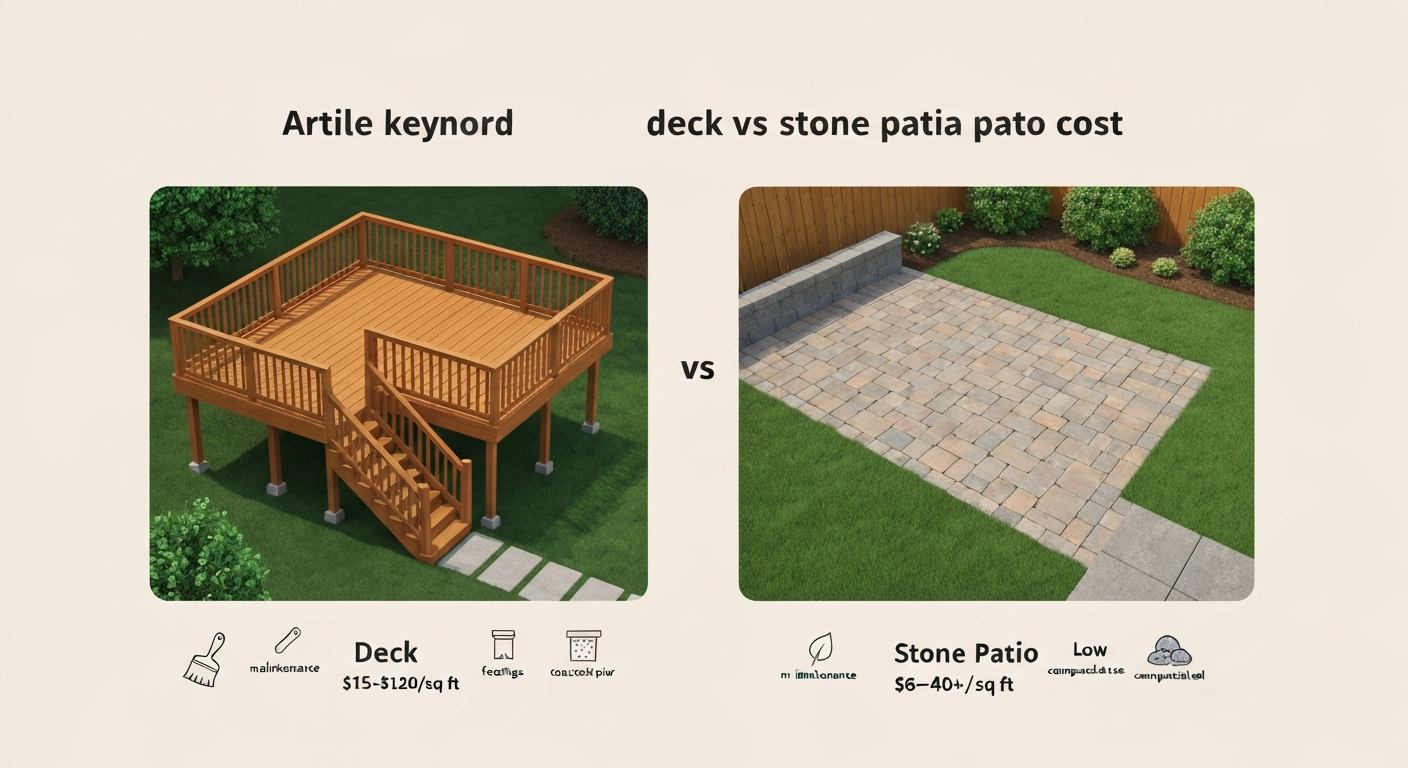
Cost Ranges at a Glance
Before going deep on breakdowns, here are the national installed cost ranges you should have in your head when talking to contractors. These numbers are aggregated from contractor quote data and cover materials, labor, and basic site prep. They do not include permits, railings, lighting, or demolition of an existing structure.
| Option | Cost Per Sq Ft (Installed) | Typical 12x12 Total | Typical 20x20 Total |
|---|---|---|---|
| Pressure-treated wood deck | $15–$30 | $2,160–$4,320 | $6,000–$12,000 |
| Cedar / hardwood deck | $30–$60 | $4,320–$8,640 | $12,000–$24,000 |
| Composite / Trex deck | $30–$60 (mid); $60–$120+ (premium) | $4,320–$8,640+ | $12,000–$24,000+ |
| Plain poured concrete patio | $6–$15 | $864–$2,160 | $2,400–$6,000 |
| Stamped / decorative concrete | $12–$20 | $1,728–$2,880 | $4,800–$8,000 |
| Concrete paver patio | $12–$40 | $1,728–$5,760 | $4,800–$16,000 |
| Natural stone / flagstone patio | $20–$40+ | $2,880–$5,760+ | $8,000–$16,000+ |
One thing that trips people up: decks almost always carry additional costs that patios don't. Railings, stairs, ledger board flashing, and structural footings are standard on any raised deck and can add $5,000–$15,000 to the total depending on height and linear footage. Ground-level patios sidestep most of that, which is why the per-square-foot comparison alone can mislead you.
Side-by-Side: Every Option Compared
Here's how each option stacks up across the factors that matter most to homeowners: upfront cost, lifespan, maintenance, and what you're actually signing up for long-term.
| Option | Installed Cost/Sq Ft | Typical Lifespan | Annual Maintenance Cost | Requires Permits? | Best For |
|---|---|---|---|---|---|
| Pressure-treated wood deck | $15–$30 | 10–15 years | $200–$500 (stain/seal) | Almost always | Budget builds, shorter-term use |
| Cedar deck | $30–$60 | 15–25 years | $150–$400 (seal/stain) | Almost always | Mid-range look with natural feel |
| Composite / Trex deck | $30–$120+ | 25–30+ years | $50–$150 (cleaning only) | Almost always | Low-maintenance, long-term value |
| Plain concrete patio | $6–$15 | 25–50 years | $50–$150 (seal every 3–5 yrs) | Sometimes | Budget-first, functional spaces |
| Stamped concrete patio | $12–$20 | 20–40 years | $100–$300 (reseal, crack repair) | Sometimes | Decorative look on a mid-range budget |
| Paver patio | $12–$40 | 25–50+ years | $100–$250 (resand, weed, reseal) | Rarely | Flexible design, easy repairs |
| Natural stone / flagstone | $20–$40+ | 30–50+ years | $100–$300 (resand, moss, reseal) | Rarely | Premium look, high durability |
If you're comparing a composite deck specifically against a Trex or stone surface, the cost gap between options narrows significantly over a 20-year period once you factor in wood deck maintenance and board replacement. For a focused side-by-side breakdown, see our comparison of the cost of stone patio vs Trex deck for detailed pricing and 20-year lifecycle costs. That comparison is worth doing in detail before you commit to a budget. For a focused comparison of those options, see our guide on the cost of composite deck vs paver patio.
Materials Cost Breakdown
Materials typically make up 40–60% of your total installed project cost. What you're buying varies enormously between a deck and a patio, so let's break it down by category.
Deck Materials
For a pressure-treated wood deck, expect to pay roughly $2–$5 per linear foot for PT lumber (2x6 or 5/4 decking boards), plus framing lumber, joist hangers, lag screws, post bases, and beam stock. A 12x12 deck uses somewhere around 150–175 linear feet of decking boards alone. Add hidden fasteners ($0.50–$1.50 per board) if you want a clean look. Cedar boards run $3–$7 per linear foot, while composite decking boards (Trex Enhance, TimberTech, Fiberon) range from $4–$15 per linear foot depending on the product line and profile. Premium capped composite with variegated color runs toward the top of that range. Don't forget the hardware budget: post caps, structural screws, flashing tape for the ledger, and joist tape for the tops of framing members (this matters for longevity) can easily run $400–$900 on a 200-square-foot deck.
Patio Materials
Concrete is priced by the cubic yard. The national average for ready-mix is around $179.89 per yard (NRMCA 2024 weighted average), though delivered prices quoted locally often run $119–$147 per yard before the pour. A standard 4-inch slab uses about 1.23 cubic yards per 100 square feet, so a 144-square-foot patio needs roughly 1.8 yards. Short-load surcharges (orders under a full 10-yard truck) average around $53 per yard, which makes small pours disproportionately expensive. Concrete pavers (Holland stone, Belgard, Unilock) run $1.50–$6 per square foot for the paver units themselves, not counting base materials. Natural flagstone runs $2–$8 per square foot as raw material, with irregular shapes costing more in labor to fit. Base materials for any ground-level patio include compacted gravel (typically 4–6 inches deep for pedestrian patios per ICPI guidance), 1 inch of bedding sand, and edge restraints. Budget $0.50–$1.50 per square foot for the aggregate base package alone.
Labor Cost Breakdown
Labor is where the sticker shock often hits. Industry estimating guides and municipal cost tables commonly rely on sources such as the blank" rel="noopener noreferrer">Wilsonville Stormwater Master Plan (RSMeans referenced in unit cost tables) and RSMeans construction estimating handbooks to derive labor‑hour and unit‑cost line items for decks and patios. According to BLS OEWS May 2025 data, carpenters earn a mean of $31.55 per hour nationally, and masons/stonemasons come in at roughly $32.36 per hour. Factor in a crew of two to three people plus a lead, and you're looking at a loaded labor rate of $75–$130 per hour for a working crew.
For a basic wood deck, labor typically accounts for 50–60% of the total installed cost. On a 200-square-foot pressure-treated deck running $20 per square foot installed ($4,000 total), expect $2,000–$2,400 of that to be labor. Composite decks with hidden fasteners and custom railing work run closer to 55–65% labor because the board installation is slower and railings are time-intensive.
Patio labor breaks down differently depending on surface type. Basic concrete flatwork (forming, pour, screed, broom finish) runs roughly $5–$8 per square foot in labor alone. Stamped concrete finishing adds $10–$18 per square foot in labor because the stamping, coloring, and sealing require a larger crew working fast before the concrete sets. Paver installation labor runs $6–$15 per square foot, with natural stone flagstone at the high end since each piece has to be cut and fit individually. For paver projects, labor can account for 50–70% of the installed cost, which is why the paver material price alone is always misleading.
| Project Type | Typical Labor Rate ($/sq ft) | Crew Size | Estimated Hours (12x12) |
|---|---|---|---|
| PT wood deck (basic) | $8–$15 | 2–3 | 12–20 hours |
| Composite deck (mid-grade) | $12–$20 | 2–3 | 16–28 hours |
| Concrete patio (plain slab) | $5–$8 | 2–3 | 6–10 hours |
| Stamped concrete | $10–$18 | 3–4 | 10–16 hours |
| Paver patio | $6–$15 | 2–3 | 14–22 hours |
| Natural stone / flagstone | $10–$20+ | 2–3 | 18–30 hours |
Site Prep and Demolition Costs
Site prep is one of the most commonly underestimated line items. If you're starting with a clean, flat, accessible backyard, you're in good shape. If not, costs can jump quickly.
Grading and leveling a sloped or uneven yard typically runs $500–$2,500 depending on how much material needs to move and whether a skid steer can access the site. Tree or brush removal adds $300–$1,500+ per tree depending on size and proximity to the work area. If you're replacing an existing deck or patio, demolition costs matter: tearing out and hauling away an old wood deck generally runs $500–$1,500 for a typical 200–300 square foot structure. Removing an existing concrete slab adds $1,000–$3,000 depending on slab thickness and access for equipment, since concrete disposal is priced by weight.
- Yard grading (minor leveling): $500–$1,500
- Yard grading (significant slope or fill): $1,500–$5,000+
- Tree/brush removal (per tree, medium size): $300–$1,500
- Old deck demolition and haul-away: $500–$1,500
- Concrete slab removal: $1,000–$3,000
- Dumpster rental (if needed separately): $300–$600 per load
One thing contractors often don't mention upfront: if your site has poor drainage or a high clay content, you may need to address that before laying any patio or building footings. Ignoring drainage leads to frost heave for patios and post rot or footing movement for decks. Budget $500–$2,000 for drainage corrections if your yard doesn't drain freely.
Foundation and Sub-Base Costs
Decks and patios handle their foundations completely differently, and the cost gap here is significant.
Deck Footings and Piers
Any attached or elevated deck needs concrete footings that extend below the local frost line, per IRC R507.3 prescriptive requirements. For a single-story residential deck on average soils, that typically means 10–14-inch diameter sonotube piers at depths ranging from 18 inches in mild climates to 48+ inches in northern states. A typical 12x16 deck needs 4–6 footings. Costs run $150–$400 per footing including excavation, tube, concrete, and post hardware. A complete footing package for a mid-size deck adds $600–$2,400 to your project before a single board goes down. Freestanding floating decks sometimes use surface-mounted deck blocks on compacted gravel instead of poured piers, which keeps this cost to $200–$600 for a small structure, but local codes vary on whether this is allowed.
Patio Sub-Base
Paver and stone patios rely on a compacted aggregate base system rather than concrete footings. ICPI guidelines for pedestrian paver patios call for 3–6 inches of compacted gravel base, 1 inch of bedding sand, and perimeter edge restraints. For a 12x12 patio, that's roughly 2–3 tons of gravel and a yard of sand. Material cost for the base package runs $150–$400, plus labor to excavate, compact, and screed the sand bed. Local municipal unit‑cost tables, such as the blank" rel="noopener noreferrer">Wilsonville Stormwater Master Plan (appendix unit cost table referencing RSMeans/ODOT), use ODOT/RSMeans to derive an installed unit cost of about $46 per square foot for permeable paver installation, showing how installed costs can far exceed the raw paver unit price. Proper compaction (with a plate compactor, not just a hand tamper) is critical: improperly compacted base is the number-one cause of paver sinking and settlement. If a contractor skips compaction steps to speed up a job, you'll be releveling pavers in 2–3 years.
Plain concrete slabs need a 4-inch compacted gravel base as well, plus forming boards, wire mesh or rebar, and expansion joint material. Base and forming materials for a 144-square-foot slab typically run $200–$500. Don't skip the base on concrete: a slab poured directly on clay or soft soil will crack within a few years.
Permits, Railings, Stairs, and Other Add-Ons
Most decks require a building permit, and many jurisdictions require them for patios over a certain size too. Permit costs vary widely: expect $100–$500 in rural and smaller municipalities, $300–$1,200 in larger cities or if structural drawings are required. Some jurisdictions require a licensed engineer to stamp the footing design, adding $500–$1,500 to the paperwork alone.
Railings are one of the biggest cost variables in a deck project. Code requires railings on any deck surface 30 inches or more above grade, and they must meet specific height (36–42 inches) and baluster spacing (no gap larger than 4 inches) requirements. Basic pressure-treated railing with 2x2 balusters runs $25–$40 per linear foot installed. Composite railing systems (Trex Transcend, TimberTech) run $60–$120 per linear foot installed. Aluminum or cable railing runs $80–$200+ per linear foot. A 12-foot deck with railing on three sides (36 linear feet) adds $900–$7,200 depending on the system. Stairs are typically $150–$350 per step for a complete staircase (stringer, treads, and landing) on a simple design.
Outdoor lighting, built-in planters, pergolas, and power outlets are common add-ons that rarely appear in the initial quote. Budget $500–$3,000 for a basic lighting package (post cap lights, step lights, string light attachment points). Running electrical to the deck or patio for an outlet box adds $300–$800 for a simple circuit from the panel.
DIY vs. Professional Installation
Doing it yourself can cut total project cost by 40–60% on both decks and patios, since labor makes up that much of most installed prices. But the complexity and risk aren't equal across project types.
| Project Type | DIY Material Cost (12x12) | Pro Installed Cost (12x12) | DIY Savings | DIY Difficulty |
|---|---|---|---|---|
| PT wood deck (basic) | $900–$1,800 | $2,200–$4,300 | $1,300–$2,500 | Moderate (permit, footings, framing) |
| Composite deck | $1,800–$3,600 | $4,300–$8,600 | $2,500–$5,000 | Moderate-High (hidden fasteners, railing) |
| Plain concrete patio | $300–$600 | $860–$2,160 | $500–$1,500 | Moderate (timing-sensitive pour) |
| Paver patio | $600–$1,400 | $1,700–$5,800 | $1,000–$4,400 | Low-Moderate (physically demanding) |
| Natural stone / flagstone | $600–$1,500 | $2,900–$5,800 | $2,000–$4,000 | Moderate (fitting and cutting irregular stone) |
Paver patios are one of the more DIY-friendly projects on this list: the skills are learnable, the work is mostly physical, and mistakes are fixable. Concrete pours are the opposite: once you order the truck, you're on a clock, and bad finishing is permanent. Deck framing and footings are manageable for experienced DIYers, but skip the permit at your own risk. Unpermitted decks can cause real headaches when you sell, and insurance may not cover injuries on an unpermitted structure.
Sample Total Project Costs by Size
These ranges assume professionally installed projects with basic finishes, standard site conditions, and no demolition or major grading. They include materials, labor, base prep, and a basic permit but not railings, stairs, or decorative add-ons for decks.
| Project Size | PT Wood Deck | Composite Deck | Plain Concrete | Paver Patio | Natural Stone |
|---|---|---|---|---|---|
| 10x10 (100 sq ft) | $1,500–$3,000 | $3,000–$7,000 | $600–$1,500 | $1,200–$4,000 | $2,000–$4,500 |
| 12x12 (144 sq ft) | $2,200–$4,300 | $4,300–$8,600 | $865–$2,160 | $1,700–$5,800 | $2,900–$5,800 |
| 20x20 (400 sq ft) | $6,000–$12,000 | $12,000–$24,000 | $2,400–$6,000 | $4,800–$16,000 | $8,000–$16,000 |
| 20x30 (600 sq ft) | $9,000–$18,000 | $18,000–$36,000+ | $3,600–$9,000 | $7,200–$24,000 | $12,000–$24,000+ |
Lifecycle and Maintenance Costs Over 20 Years
Upfront cost is only part of the story. A pressure-treated deck typically needs cleaning and re-staining every 2–3 years ($200–$500 per treatment including materials and your time, or $400–$800 if you hire out). Over 15 years, that adds $1,000–$4,000 in maintenance, plus potential board replacement ($500–$1,500) as boards check, splinter, or rot. A composite deck cuts this dramatically: annual cleaning with soap and water, no staining, ever. Manufacturer-quoted maintenance costs for capped composite run $50–$150 per year.
Stone and paver patios are similarly low-maintenance. Refilling polymeric sand every 5–7 years ($100–$300 for a typical patio), occasional resealing, and pulling weeds from joints is about the full maintenance list. Plain concrete requires resealing every 3–5 years ($100–$250 per application) and may develop cracks over time that need filling. Stamped concrete is the most maintenance-intensive patio surface: the sealer degrades, and a bad crack in a decorative pattern is expensive to repair invisibly.
| Option | Year 1 Cost | Est. 10-Year Maintenance | Est. 20-Year Maintenance | Expected Lifespan |
|---|---|---|---|---|
| PT wood deck | $15–$30/sq ft | $1,500–$4,000 | $3,000–$8,000+ | 10–15 years |
| Composite deck | $30–$120+/sq ft | $500–$1,500 | $1,000–$3,000 | 25–30+ years |
| Plain concrete | $6–$15/sq ft | $300–$800 | $600–$1,500 | 25–50 years |
| Stamped concrete | $12–$20/sq ft | $500–$1,500 | $1,200–$3,000 | 20–40 years |
| Paver patio | $12–$40/sq ft | $400–$1,200 | $800–$2,500 | 25–50+ years |
| Natural stone | $20–$40+/sq ft | $400–$1,200 | $800–$2,500 | 30–50+ years |
Regional Cost Variations
Where you live shifts these numbers significantly. Labor markets in the Northeast (Boston, NYC, DC suburbs), Pacific Coast (Seattle, San Francisco, LA), and parts of Hawaii can push installed costs 30–50% above national averages. The South and Midwest tend to run 10–25% below national averages, with competitive labor markets and lower cost of living keeping contractor rates down. Permafrost and deep frost lines in northern states (Minnesota, Michigan, upstate New York) add meaningfully to footing and concrete costs: deeper excavation, more concrete, and more labor per footing.
Material prices also vary regionally. Natural stone costs less in quarry-rich areas (Pennsylvania bluestone in the mid-Atlantic, Oklahoma flagstone in the South-Central region, Arizona sandstone in the Southwest). Composite decking pricing is more uniform nationally since it ships from large manufacturing facilities, but lumber prices swing with regional supply and demand, especially in areas still seeing post-storm rebuilding activity.
How to Choose: A Practical Decision Framework
Most homeowners don't need a custom decision matrix. They need honest answers to four questions:
- What is my hard budget ceiling, and is it realistic for the surface area I want? Use the per-square-foot ranges above to reality-check your expectations before calling anyone.
- Is my yard flat or sloped? Sloped yards favor decks because building up above grade is often cheaper than excavating and filling to create a level patio area. Flat yards favor patios.
- How much maintenance am I willing to do? If you hate the idea of staining a deck every two years, composite or stone is worth the higher upfront cost. If you're handy and don't mind the work, PT wood or plain concrete holds up fine with attention.
- What does the neighborhood support in resale value? In most markets, a well-built deck or patio adds value, but neither adds dollar-for-dollar ROI. Composite decks tend to recoup 65–75% of their cost at resale; PT wood decks recoup slightly less due to perceived shorter remaining life at time of sale.
If your budget is under $5,000 for a 12x12 space, a plain concrete patio or a basic paver patio is the most realistic choice. If your budget is $8,000–$15,000 and you want low long-term maintenance, a composite deck or a natural stone patio are both viable. Above $20,000, you have room for either a well-appointed composite deck with quality railings or a premium stone patio with good drainage and built-in lighting.
Tips to Lower Cost Without Cutting Corners
- Get at least three itemized quotes, not just total prices. Itemized quotes let you compare apples to apples and spot when one contractor is skipping base prep or using lower-grade materials.
- Schedule in the off-season (late fall or early winter in most regions). Contractor availability improves and you may get 10–15% off labor rates compared to peak spring/summer scheduling.
- Supply your own materials if you have a truck and the time. Buying lumber, pavers, or stone directly from a landscape supply yard and having it delivered to your site can save 15–25% over contractor markup.
- Downsize the structure, not the quality. A well-built 12x12 deck with good materials outlasts a poorly built 16x20 deck. If budget is tight, build the right size for your needs and don't stretch the footprint.
- Choose stamped concrete over natural stone if you want the look on a budget. Stamped concrete runs $12–$20 per square foot installed versus $20–$40+ for stone, and a good contractor can produce a very convincing result.
- Avoid custom railing designs. Stock composite or aluminum railing systems are 30–50% cheaper than custom cable or glass railing and look clean and modern with no real functional tradeoff for most homeowners.
- Reuse existing footings if replacing an old deck. If the concrete footings are sound and properly placed, a good contractor can often reuse them, saving $600–$2,000 on footing work.
Getting an Accurate Contractor Quote
The single biggest mistake homeowners make is accepting a one-page quote with a single total number. A good scope of work should spell out: the exact square footage of the surface, the specific materials and grades being used (not just 'composite decking' but the brand, product line, and color), the base system depth and type, how many footings and to what depth, whether a permit is included and who pulls it, the warranty on labor and materials, and the payment schedule. If a contractor won't provide this level of detail in writing, that's a red flag.
Always ask what is not included. Specifically: Is site grading included? Who is responsible for utility marking? Is haul-away of debris included? Are final cleanup and compaction testing included for paver projects? These exclusions are where quotes diverge by $1,000–$3,000 between contractors who appear to be bidding the same job.
Your Pre-Quote Budget Checklist
- Measure your planned footprint accurately (length x width in square feet).
- Check local frost line depth and permit requirements with your municipality before contacting contractors.
- Note your site conditions: flat or sloped, accessible by equipment, any trees or drainage issues.
- Decide on surface material and grade level (ground-level patio vs. elevated deck) before quotes.
- Set a realistic budget ceiling using the per-square-foot ranges in this article.
- List all desired features: railings, stairs, lighting, built-ins, outlet, pergola attachment points.
- Factor in demolition costs if you're replacing something existing.
- Ask each contractor for an itemized quote covering materials, labor, base prep, permits, and cleanup.
- Request references for at least one recently completed project of the same type in your area.
- Compare total cost of ownership (upfront + 10-year maintenance) not just install price.
FAQ
Headline and meta description for the article — what should they be?
Headline: Deck vs Stone Patio Cost: Realistic Budgets for Homeowners Meta description: Compare installed costs for raised decks (pressure‑treated, cedar, composite) and ground‑level patios (concrete, stamped, pavers, natural stone). Get per‑sq‑ft ranges, sample budgets for common sizes, lifecycle maintenance costs, DIY vs pro estimates, and a decision checklist to pick the right option for your yard and budget.
Short answer: How much does a raised deck vs a ground‑level stone/paver/concrete patio cost including materials, labor, site work, and permits?
Short answer ranges (installed, national aggregated): Basic pressure‑treated wood deck: $15–$30 per sq ft Mid‑range composite/cedar deck: $30–$60 per sq ft Premium composite/hardwood deck: $60–$120+ per sq ft Concrete slab patio (4" broom finish): $6–$15 per sq ft Stamped concrete: $12–$20 per sq ft Concrete pavers/manufactured pavers: $12–$40 per sq ft Natural stone/flagstone patio: $20–$40+ per sq ft These ranges include material, typical labor, basic site prep and standard footings or base; complex site work, heavy demolition, drainage, built‑ins, or steep grades increase costs.
What are the detailed cost components to include when budgeting?
Include these line items when estimating: Materials (decking boards, composite, joists, posts, pavers, stone, concrete) Labor (carpentry, masonry, concrete finishing) Site preparation (grading, stump removal, excavation) Foundations and footings (sonotubes, concrete piers, slab base) Base and drainage (compacted aggregate, geotextile, infiltration layers, drainage piping) Permits and inspections Demolition and removal (old deck, concrete, patio) Railings, stairs, gates Lighting and electrical (low‑voltage or hardwired) Finishes and sealers (stain/seal for wood; jointing sand or polymeric sand for pavers) Landscaping restoration and edging Transport/haul fees Taxes and contractor overhead Include contingency (10–20%) for unknowns.
How do materials break down cost‑wise for decks vs patios?
Deck materials: Pressure‑treated wood (low cost), cedar/redwood (mid), capped composite/ PVC (mid to high), tropical hardwoods (high). Material share often 40–60% of installed deck cost. Patio materials: poured concrete (lowest materials cost per sq ft), stamped concrete (adds color/stamp), concrete pavers (moderate to high), brick pavers, natural flagstone (highest due to stone costs and handling). For patios the subbase (aggregate, compaction) is a significant material cost, especially for pavers and permeable systems.
What are typical labor‑hour benchmarks and labor cost shares?
Labor benchmarks (aggregate guidance): Deck carpentry: expect ~10–18 hours per 100 sq ft for simple raised deck framing, more for railings/stairs and multi‑level features. Composite installs add handling/time; premium finishes add hours. Masonry/paver patio installation: labor can be 50–70% of installed cost; typical crew productivity varies, but installers often plan 8–24 labor hours per 100 sq ft depending on complexity (cutting, fitting, edge details). Concrete flatwork: forming/pour/finish for a simple slab often estimated at ~$5–$8/sq ft in labor; decorative finishes raise labor share. Skilled trades mean carpenters, masons, cement finishers at prevailing wages (BLS mean carpenters ~$31.55/hr; masons ~$32.36/hr — adjust regionally).
Sample installed costs for common sizes (10x10, 12x12, 20x20, 20x30) — what should homeowners expect?
Sample aggregated installed price ranges (national, all‑in): 10 x 10 (100 sq ft): PT wood deck $1,500–$3,000 | Composite deck $3,000–$6,000 | Concrete slab patio $600–$1,500 | Pavers $1,200–$4,000 | Natural stone $2,000–$6,000 12 x 12 (144 sq ft): PT deck $2,160–$4,320 | Composite $4,320–$8,640 | Concrete slab $864–$2,160 | Pavers $1,728–$5,760 | Natural stone $2,880–$5,760+ 20 x 20 (400 sq ft): PT deck $6,000–$12,000 | Composite $12,000–$24,000 | Concrete slab $2,400–$6,000 | Pavers $4,800–$16,000 | Natural stone $8,000–$16,000+ 20 x 30 (600 sq ft): PT deck $9,000–$18,000 | Composite $18,000–$36,000 | Concrete slab $3,600–$9,000 | Pavers $7,200–$24,000 | Natural stone $12,000–$36,000+ Use these samples as ballparks before getting regional contractor quotes.
Next Articles
Cost of Stone Patio vs Wood Deck: Complete Pricing Guide
Compare stone patio vs wood deck costs with size-based pricing, DIY vs pro, maintenance, and add-on estimates.
Concrete Patio vs Wood Deck Cost: Real Price Breakdown
Concrete patio vs wood deck cost with real price ranges, line-item breakdown, and which option is cheaper long term.
How Much Should I Expect to Pay for a Patio
Patio cost guide with real price ranges by size and material, full line-item budget, DIY vs install, and quote checklist