
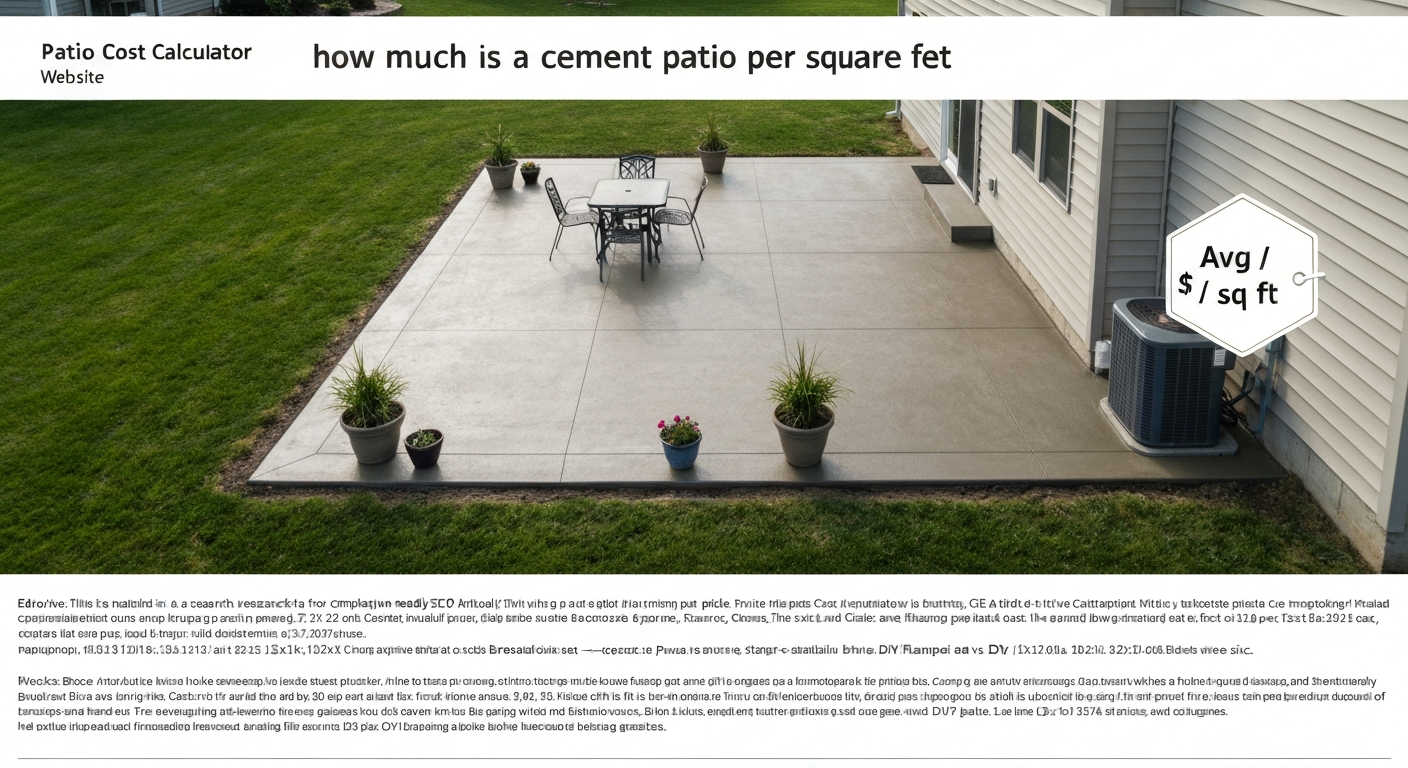
A professionally installed cement patio runs roughly $6 to $15 per square foot for a plain or broom-finish slab, with most homeowners landing around $10 per square foot as a realistic national average. ConcreteNetwork's 2026 benchmark estimates about $11 per sq ft (their 288‑sq‑ft example ≈ $3,200) and notes plain broom/smooth slabs are the least expensive while decorative finishes raise costs materially (updated Jan 2026) ConcreteNetwork's 2026 benchmark estimates about $11 per sq ft (their 288‑sq‑ft example ≈ $3,200) and notes plain broom/smooth slabs are the least expensive while decorative finishes raise costs materially (updated Jan 2026).. Stamped or decorative concrete pushes that range to $10–$25+ per square foot depending on pattern complexity and color work. So a 400 sq ft patio (think 20x20) typically costs somewhere between $2,400 and $6,000 for standard poured concrete, installed. Those numbers assume decent site access, a typical 4-inch slab, and no major grading surprises.
How Much Is a Cement Patio Per Square Foot: Costs & Examples

How to read these price ranges
These figures come from national aggregator data, industry benchmarks from ConcreteNetwork and Angi (updated mid-2026), and contractor rate surveys. They reflect installed costs, meaning a contractor supplies the ready-mix, sets the forms, pours, finishes, and cures the slab. They do not include demolition of an existing patio, major regrading, drainage systems, covered patio roofing, or permits unless noted.
Regional variation is real and significant. Labor markets in the Northeast and West Coast run 20–40% above the national midpoint. States like Texas, the Midwest, and parts of the Southeast tend to come in below average. Concrete material prices also vary: delivered ready-mix averages around $125–$195 per cubic yard nationally in 2026, with the NRMCA reporting a 2024 industry average close to $180 per yard. If you're in a high-cost metro, assume the top of every range. Rural areas with limited contractor competition can actually swing either direction, sometimes lower material costs, sometimes higher labor because crews are scarce.
One more caveat: all per-square-foot figures assume a standard 4-inch slab, which is appropriate for foot traffic and light furniture. A 6-inch slab for vehicle parking or heavy loads adds roughly 50% more concrete volume, which pushes material costs up noticeably. Keep that in mind if your patio doubles as a parking pad.
Per-square-foot cost by concrete finish type
The finish you choose is one of the biggest cost levers. Here's what each option realistically costs installed, based on current contractor and industry pricing.
| Finish Type | Installed Cost per Sq Ft | Notes |
|---|---|---|
| Plain / smooth poured | $6 – $10 | Basic trowel finish, no texture or color |
| Broom finish | $6 – $13 | Most common residential choice; slip-resistant texture |
| Exposed aggregate | $7 – $18 | Cost rises with specialty aggregate selection |
| Integral color (pigmented) | $9 – $16 | Color mixed into the pour; more durable than surface stain |
| Surface stain / acid-etch | $9 – $14 | Applied after cure; cheaper than full integral color |
| Basic stamped pattern | $10 – $14 | Single pattern, one or two colors |
| Complex stamped / decorative | $15 – $25+ | Multi-color, detailed patterns, borders, antiquing |
Plain broom finish is the workhorse of the bunch, it's what most contractors default to when you ask for a 'concrete patio.' It looks clean, holds up well, and keeps costs predictable. Stamped concrete can look impressive, but the labor cost jumps significantly because stamping requires experienced hands, tighter timing windows during the pour, and more finishing passes. If you love the look of stone or brick but want concrete durability, stamped is worth pricing out, just go in knowing you're often doubling the base slab cost.
What actually makes up your patio quote: materials vs. labor
When a contractor gives you a lump-sum number, it's combining several cost components. Understanding those line items helps you evaluate competing bids and spot where one contractor might be cutting corners versus another being thorough.
Materials
Ready-mix concrete is the dominant material cost. For a standard 4-inch slab, you need roughly 1 cubic yard for every 81 square feet (using the formula: square footage times 0.333 feet thick, divided by 27). At $160–$195 per yard delivered, that works out to about $2.00–$2.40 per square foot just for the concrete itself. Add rebar or wire mesh ($0.50–$1.50/sq ft), forms and stakes ($0.30–$0.75/sq ft), and a gravel subbase ($0.50–$1.25/sq ft) and total materials typically land in the $3.50–$6.00 per square foot range for a standard broom-finish slab.
Labor
Labor is the other big chunk. Cement masons earn a national mean wage of around $28.87 per hour (BLS OEWS, May 2025), but you're not paying one person, you're paying a crew, plus the contractor's markup on that labor. For straightforward broom-finish flatwork, contractor labor rates typically run $1.50–$4.00 per square foot. Decorative pours with stamping or exposed aggregate can push that to $6–$12+ per square foot because the work is slower and requires more skilled hands. Crew productivity for standard slabs runs roughly 300–600 square feet per day, which gives you a sense of why a 400-square-foot patio is typically a one-day pour.
The percentage breakdown of a typical installed patio cost
Across residential concrete flatwork projects, the cost components generally break down like this. These are ballpark proportions, they shift based on finish type and site complexity.
| Cost Component | Typical % of Total Cost | Example on $4,000 Project |
|---|---|---|
| Ready-mix concrete | 20 – 28% | $800 – $1,120 |
| Labor (placement, finishing, curing) | 40 – 50% | $1,600 – $2,000 |
| Subbase materials (gravel, compaction) | 8 – 12% | $320 – $480 |
| Reinforcement (rebar / wire mesh) | 5 – 8% | $200 – $320 |
| Forms, stakes, miscellaneous | 3 – 5% | $120 – $200 |
| Contractor overhead and profit | 10 – 20% | $400 – $800 |
Labor's dominant share is why quotes vary so much between contractors. Industry guidance (Concrete Labor Cost in 2026: Contractors and Project Managers guide, FlexCrew) reports labor commonly represents roughly 40–50% of total installed cost for residential concrete flatwork Concrete Labor Cost in 2026: Contractors and Project Managers guide — FlexCrew (industry summary). Two bids with identical material costs can differ by $1,000+ on a 400-square-foot project purely based on crew rates and overhead. When comparing bids, ask each contractor to separate material costs from labor, any reputable contractor can do this, and it tells you a lot about where the difference lies.
Site prep and structural adders
These are the costs that can quietly blow up a budget. Site preparation isn't glamorous, but skipping or skimping on it leads to cracked slabs within a few years. Here's what to watch for.
- Grading and leveling: If your yard has any meaningful slope, grading to create a flat, properly draining base adds $1–$3 per square foot, sometimes more on steep lots.
- Excavation: Standard residential patio excavation (removing 4–6 inches of soil) typically runs $0.50–$1.50 per square foot. Rocky soil or tree root removal can push this higher.
- Gravel subbase: A 4-inch compacted gravel base is standard and costs roughly $0.50–$1.25 per square foot in materials; compaction equipment rental or contractor cost adds more.
- Compaction: Proper mechanical compaction of the subbase is non-negotiable for slab longevity. It's usually included in a contractor's scope but worth confirming explicitly.
- Edging and forms: Contractors set wooden or metal forms to shape the slab. This is typically included in labor quotes but adds cost if the shape is complex or curved.
- Reinforcement: Rebar (typically #3 or #4 at 18-inch spacing) or welded wire mesh adds $0.50–$1.50 per square foot and is strongly recommended for slabs over 10x10 feet.
- Existing patio removal: Demolishing and hauling away an old concrete patio adds $2–$6 per square foot to your project. This is one of the most commonly underestimated line items.
On a flat, clear lot with easy truck access, site prep is a minor cost. On a sloped, wooded, or previously paved lot, it can add $1,500–$4,000 to a mid-size project. Always ask contractors to line-item site prep separately in their quotes so you can see exactly what's included.
Drainage, permits, and inspection fees
Most homeowners don't think about drainage or permits until a contractor brings them up, or worse, until they get a notice from their municipality after the fact.
Drainage
Concrete patios must slope slightly away from the house (typically 1/8 to 1/4 inch per foot) to prevent water pooling against your foundation. A good contractor builds this into the grade automatically. If your site has significant drainage challenges, you may need a channel drain, French drain, or dry well. A simple channel drain installation adds roughly $10–$30 per linear foot. A French drain system can add $1,500–$5,000+ depending on length and complexity. Not every patio needs this, but if you have any existing drainage issues in your yard, address them before the slab goes down.
Permits and inspections
Permit requirements for concrete patios vary widely by municipality. Many jurisdictions require a permit for any hardscape over a certain size (commonly 200 or 400 square feet) or for any work within a setback from property lines. Residential patio permit fees typically run $50–$500 depending on the jurisdiction and project scope. Some areas require an inspection before the pour and again after completion. Skipping a required permit can create problems at resale and may force you to remove or modify the work. Ask your contractor whether permits are required locally, and confirm that pulling the permit is included in their scope. Some contractors pass this cost through at actual cost; others mark it up.
Finishes and surface adders: what each upgrade actually costs
If you're starting with a base broom-finish quote and considering upgrades, here's how much each finish option typically adds per square foot over the plain slab cost.
| Finish / Treatment | Typical Uplift over Plain Slab | Approx. Added Cost per Sq Ft | Key Notes |
|---|---|---|---|
| Broom texture | Minimal | $0 – $1 | Standard on most residential pours |
| Integral color (pigment) | Moderate | $2 – $5 | Mixed into the concrete; more permanent than surface stain |
| Surface stain (water-based) | Low-moderate | $1 – $3 | Applied post-cure; less durable than integral color |
| Acid-etch stain | Moderate | $2 – $4 | Creates variegated, mottled look; requires sealing |
| Basic stamped pattern | Significant | $4 – $8 | Single pattern; adds 40–80% over plain slab cost |
| Complex stamped + multi-color | High | $9 – $15+ | Up to 2-3x the cost of a plain slab |
| Exposed aggregate | Moderate-high | $1 – $8 | Depends heavily on aggregate type (basic vs. specialty stone) |
| Concrete sealer | Low | $0.50 – $2 | Recommended on all patios; protects against stain and freeze-thaw |
A sealer is the one upgrade I'd call non-negotiable on any exterior slab. Without it, concrete absorbs oil, stains from leaves and rust, and is more vulnerable to freeze-thaw cracking in cold climates. Quality penetrating or topical sealers add $0.50–$2 per square foot and extend slab life meaningfully. Reapply every 2–5 years depending on traffic and climate. This is an easy DIY maintenance task with a pump sprayer.
Worked cost examples at common patio sizes
To make these ranges concrete (pun intended), here are realistic installed-cost estimates at common residential patio sizes. These use the mid-range of current national pricing for a plain broom-finish slab with proper subbase and rebar.
| Patio Size | Square Footage | Low Estimate ($6/sq ft) | Mid Estimate ($10/sq ft) | High Estimate ($15/sq ft) |
|---|---|---|---|---|
| 10 x 10 | 100 sq ft | $600 | $1,000 | $1,500 |
| 12 x 12 | 144 sq ft | $864 | $1,440 | $2,160 |
| 16 x 16 | 256 sq ft | $1,536 | $2,560 | $3,840 |
| 20 x 20 | 400 sq ft | $2,400 | $4,000 | $6,000 |
| 20 x 30 | 600 sq ft | $3,600 | $6,000 | $9,000 |
Detailed 400 sq ft (20x20) worked example
A 400-square-foot patio is one of the most common residential sizes and lines up with the 20x20 benchmark Angi cited in their 2026 concrete patio data, which showed a typical installed range of $2,400–$6,400. Here's how a mid-range project at this size actually breaks down line by line.
- Excavation and grading (4 inches deep, easy access): ~$400–$600
- Gravel subbase (4 inches, compacted): ~$300–$500
- Rebar (#3 at 18-inch grid): ~$300–$500
- Ready-mix concrete (approx. 5 yards at 4 inches thick): ~$900–$1,100
- Concrete placement and broom finishing (labor): ~$1,000–$1,600
- Forms, stakes, and miscellaneous supplies: ~$150–$250
- Concrete sealer: ~$150–$300
- Contractor overhead and profit (~15%): ~$450–$720
- Total estimated installed cost: $3,650 – $5,570
If you add stamping and integral color to this same 400-square-foot slab, tack on roughly $3,000–$6,000 more, bringing the total into the $7,000–$11,000 range for a high-end decorative finish. That's a significant jump, but for the right backyard and use case, stamped concrete delivers a look that's hard to match at any price with pavers or natural stone.
How concrete compares to other patio materials
Concrete is usually one of the more affordable installed patio options, but not always the cheapest. Here's how it stacks up against common alternatives.
| Material | Typical Installed Cost per Sq Ft | Durability | Maintenance Level |
|---|---|---|---|
| Plain / broom concrete | $6 – $13 | High (30+ years) | Low (seal every 2–5 yrs) |
| Stamped concrete | $10 – $25+ | High if sealed | Medium (reseal, watch for cracks) |
| Concrete pavers | $10 – $20 | Very high | Low-medium (occasional resetting) |
| Brick pavers | $12 – $22 | Very high | Low (weeding, occasional resetting) |
| Natural flagstone | $15 – $35+ | High | Medium (jointing, sealing) |
| Gravel / decomposed granite | $1 – $4 | Moderate | Medium (raking, replenishing) |
Plain concrete wins on upfront cost and long-term structural durability. Pavers have the edge on repairability, if one unit cracks or settles, you replace just that piece rather than patching an entire slab. Flagstone looks stunning but the installed cost is often 2–3x a standard concrete slab. If budget is the primary driver, a well-poured and sealed broom-finish concrete slab is hard to beat for the money. If aesthetics matter more and budget is flexible, stamped concrete or pavers are worth the extra investment.
DIY vs. hiring a contractor
DIY concrete is genuinely possible for small slabs under about 100 square feet, where you can use bagged premix and avoid ordering a ready-mix truck. An 80-pound premix bag yields roughly 0.6 cubic feet, you'd need about 56 bags just for a 10x10 slab at 4 inches thick, which gets unwieldy fast. At $6–$10 per bag, materials alone run $336–$560 for that small slab, not counting tool rental, gravel, and rebar. Compare that to a contractor's $600–$1,000 installed quote for the same size and the savings narrow quickly.
For anything over 100–150 square feet, ordering a ready-mix delivery makes far more sense. But then you need to work fast, a standard mix has a working window of roughly 45–90 minutes, and you need a crew of at least 2–3 people to screed, float, and finish before it sets. Mistakes on a concrete pour are expensive to fix. If you have no prior experience, I'd strongly recommend leaving anything over a small garden pad to a professional. The labor savings are real but so is the risk of a poorly finished or cracked slab.
Ways to reduce your per-square-foot cost
- Get at least three bids from licensed contractors — price variation on the same project scope is often 20–40% between quotes.
- Schedule in the off-season (late fall or winter in mild climates) when contractor demand is lower and some will negotiate on price.
- Keep the shape simple. Rectangular slabs are faster and cheaper to form than curves or irregular polygons.
- Avoid steep or difficult access sites where possible — truck access problems add cost.
- Skip the decorative finish on the whole slab; consider stamping only a border or accent zone and using broom finish in the field.
- Do your own demo if there's an existing patio to remove — hauling debris yourself can save $500–$2,000 on a mid-size project.
- Ask contractors if they have any upcoming pours in your neighborhood — piggybacking on a concrete truck delivery can lower minimum delivery fees.
- Buy your own sealer and apply it after the contractor finishes — this is a straightforward DIY task that saves $150–$300 on a typical patio.
Budgeting checklist before you contact contractors
Before you call the first contractor, run through these items so you can get accurate, comparable quotes rather than ballpark numbers that don't reflect your actual project.
- Measure your planned patio area precisely — length times width in square feet.
- Determine the intended use: foot traffic only, or will vehicles park on it? (Affects slab thickness.)
- Note the existing site conditions: flat, sloped, wooded, or previously paved?
- Identify any drainage concerns: does water pool near the planned area after rain?
- Decide on your finish preference: plain broom, colored, stamped, or exposed aggregate?
- Check local permit requirements — call your municipality's building department or check their website.
- Clarify whether any existing concrete or structures need to be demolished and removed.
- Set a realistic budget range and identify your firm ceiling before negotiating.
The right questions to ask every contractor you quote
Getting comparable bids requires asking the same questions of every contractor. Here's exactly what to ask.
- What thickness slab are you quoting, and is rebar or wire mesh included?
- What subbase preparation is included — gravel depth, compaction method?
- Is site excavation and grading included, and what's the scope?
- Who pulls the permit, and is that cost included in your quote?
- What ready-mix PSI and mix design are you using?
- What is your cure time before we can use the patio?
- Does the quote include a concrete sealer application?
- What does your warranty cover, and for how long?
- Can you provide references from concrete patio installs in the last 12 months?
- Are you licensed and insured for this type of work in this state?
Putting it all together: what to budget
For a standard broom-finish concrete patio with proper site prep and reinforcement, budget $8–$12 per square foot as your realistic planning number in most US markets in 2026. For metric pricing and conversions, see how much does patio cost per square metre for comparable cost-per-square-metre estimates and local currency guidance. For a quick lookup of national averages and a handy calculator that answers how much does a patio cost per square foot, see our detailed patio cost guide. Use $6–$7 as a floor for ideal conditions in lower-cost regions, and $13–$15 as a ceiling for typical projects in high-cost metros. Decorative finishes like stamping or exposed aggregate should be budgeted at $12–$20+ per square foot. Add 10–15% contingency for any site surprises. If you're also considering covered patios, the roofing structure adds a separate and significant cost on top of the slab itself. For specifics on roofing costs and total pricing for a covered patio, see how much does a covered patio cost per square foot. And if you're comparing concrete to pavers or stone, the per-square-foot comparison shifts depending on the size of your project and how much you value repairability over upfront savings.
FAQ
What is the typical cost per square foot for a poured concrete patio (national US ranges, 2025–2026)?
Plain poured concrete (broom or smooth): commonly $6–$15 per sq ft (typical national average ≈ $8–$12/sq ft). Decorative options increase cost: stamped concrete $10–$25+/sq ft (basic stamped $10–$14; complex $15–$25+), exposed aggregate $7–$18/sq ft, colored or integral‑pigment finishes $9–$16/sq ft. These installed ranges include material, basic finishing, and contractor labor but exclude high site‑prep, demo, or extensive grading.
How do material and labor split out within that per‑sq‑ft cost?
A rule of thumb: labor is roughly 40–50% of total installed cost for standard flatwork. For basic broom finish that often looks like: materials 40–60% (ready‑mix, reinforcement, forms, sealer) and labor 40–60% (excavation, forming, placing, finishing). For decorative finishes the labor share rises (stamping, coloring, hand tooling can push labor to 50–70% of the total).
How do I estimate material-only cost for a 4-inch concrete slab per square foot?
Using typical ready‑mix pricing: 4" slab ≈ 0.01235 cubic yards per sq ft (4/324). If ready‑mix is $160/yd³, material-only concrete ≈ $160 × 0.01235 ≈ $1.98 per sq ft. Add costs for delivery fees, forms, wire/rebar, admixtures, and sealers — those usually add $1–$4/sq ft depending on scope.
Worked example: exactly how much will a 400 sq ft (20×20) plain concrete patio cost?
Using typical installed ranges: low‑end broom finish at $6/sq ft → $2,400. Mid‑range average $10/sq ft → $4,000. Higher end (site‑prep, permits, nicer finish) $15/sq ft → $6,000. A realistic contractor quote for many U.S. markets in 2025–2026 often lands $2,400–$6,400 (matching common industry examples). Material‑only (at $160/yd³) for 400 sq ft × 4": concrete ≈ $1.98 × 400 ≈ $792; remaining costs are forms, reinforcement, labor, finishing, and cleanup.
Worked examples for common sizes (10×10, 12×12, 20×20) — ballpark installed costs by finish
Assumptions: 4" slab, national installed per‑sq‑ft ranges. 10×10 (100 sq ft): plain $600–$1,500; broom/stamped low‑end $1,000–$2,500; stamped/decorative $1,500–$3,500. 12×12 (144 sq ft): plain $864–$2,160; stamped $1,440–$3,600. 20×20 (400 sq ft): plain $2,400–$6,000; stamped/decorative $4,000–$10,000. Exact cost depends on site prep, access, and finish complexity.
Convert these costs to per square metre
1 sq m = 10.764 sq ft. To convert per‑sq‑ft price to per‑sq‑m, multiply by 10.764. Example ranges: plain $6–$15/sq ft → $65–$161 per m² (approx). Stamped $10–$25/sq ft → $108–$269 per m² (approx). Use exact multiplier 10.764 for precise conversions.
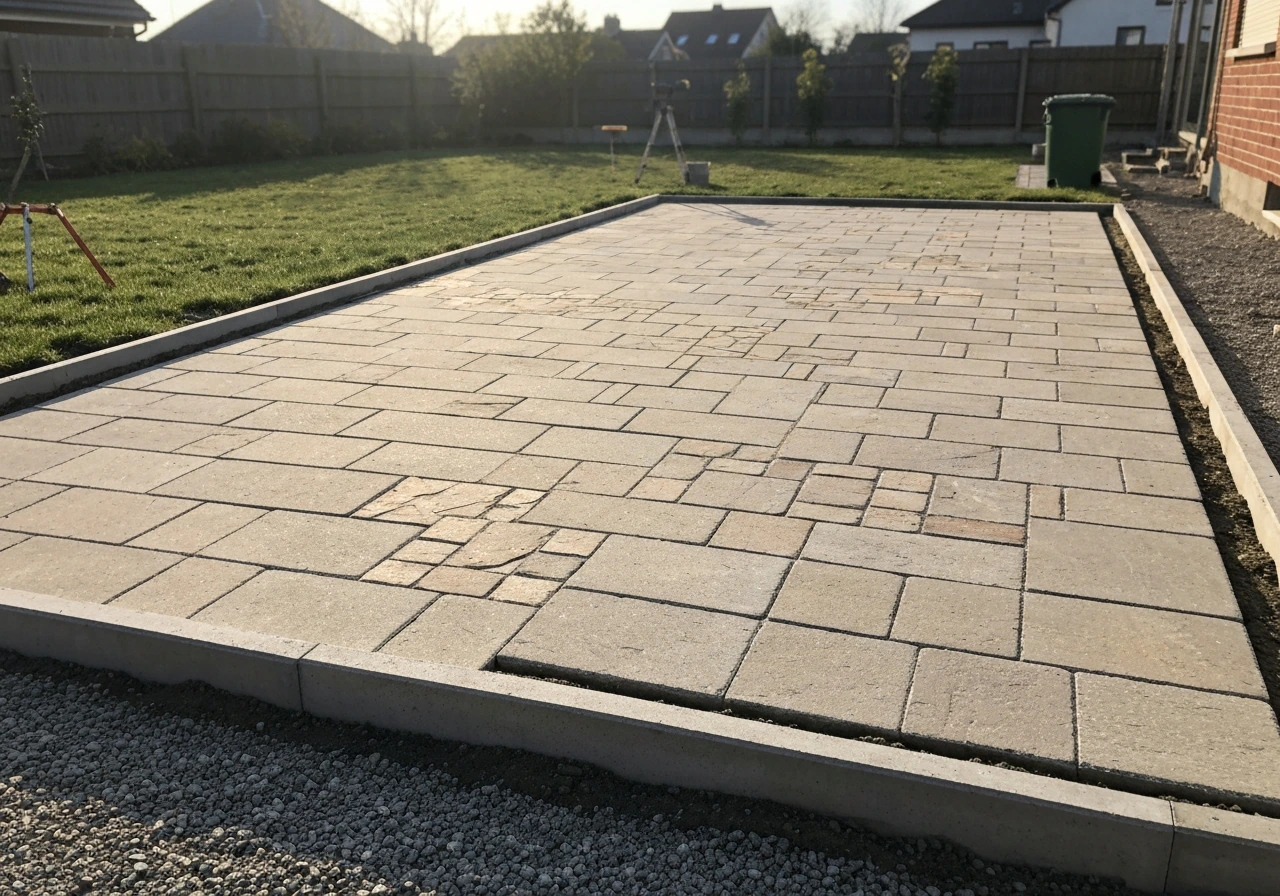
2026 €/m² patio cost guide with all-in ranges for concrete, pavers, stone, brick and flagstone, plus site add-ons and ex
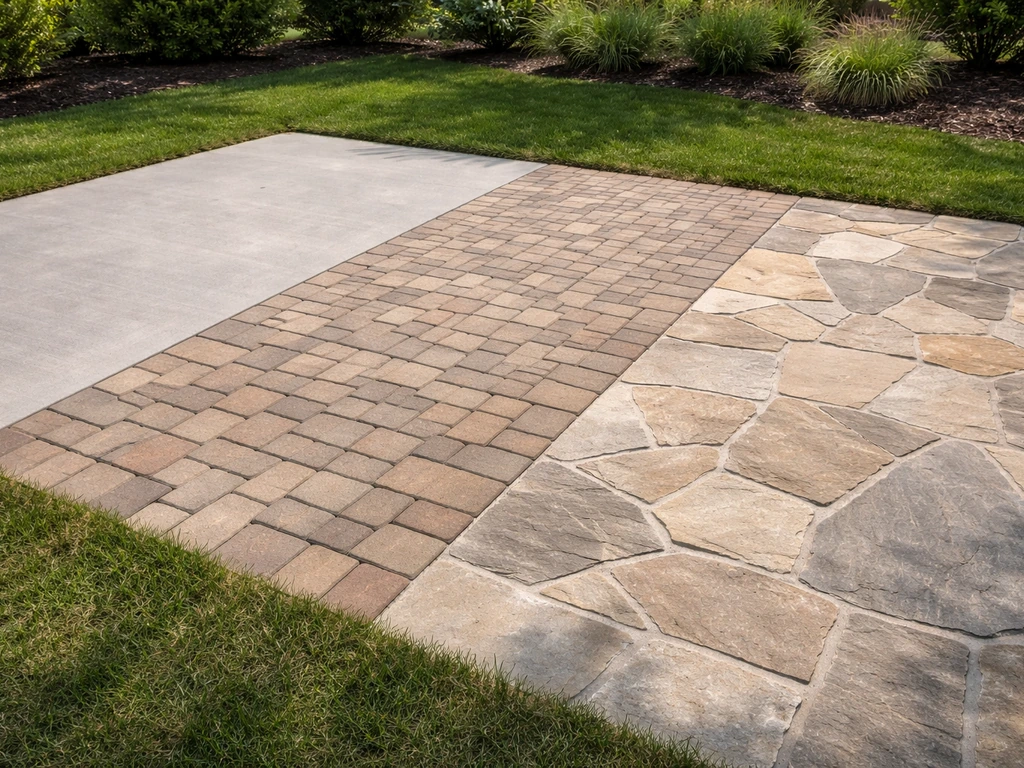
Get patio cost per square foot ranges for concrete, pavers, stone, stamped, brick and more plus budgeting tips and quote
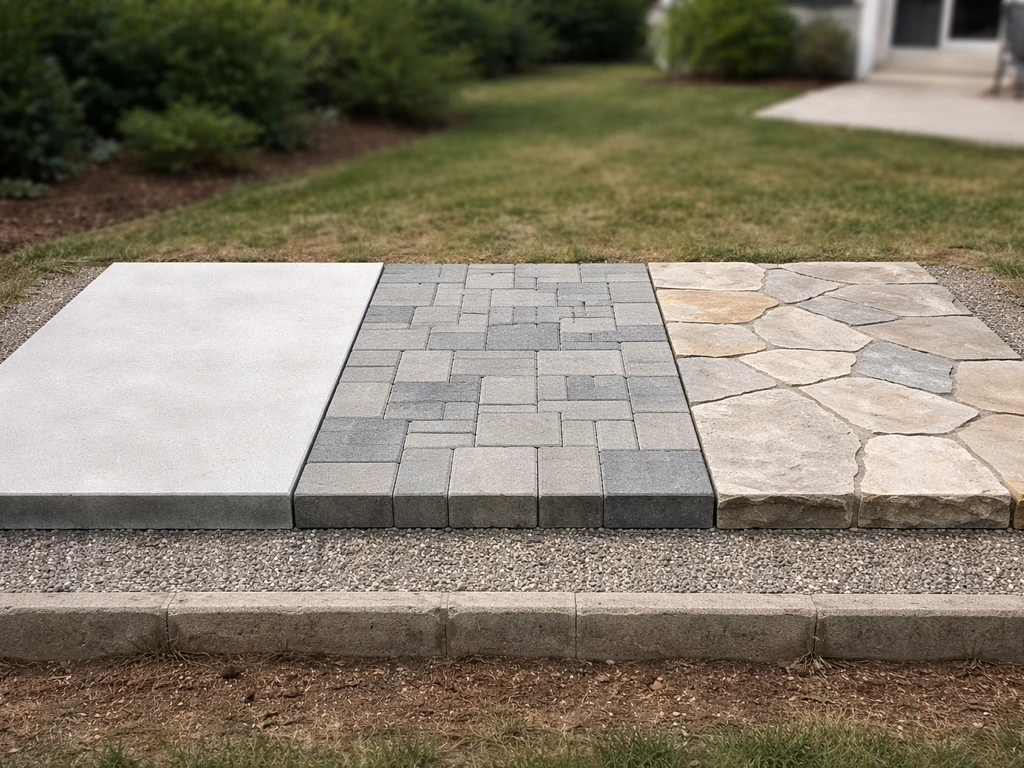
Patio cost guide with real price ranges by size and material, full line-item budget, DIY vs install, and quote checklist