
Hiring a contractor to lay patio tiles or pavers in the U.S. typically costs $8 to $35 per square foot installed, depending on the material you choose. For a mid-size 15x15 patio (225 sq ft), that works out to roughly $1,800 on the low end with basic concrete pavers up to $7,875 or more for natural stone or premium porcelain. The national median for a complete residential patio project lands somewhere around $3,500 to $4,300 once you factor in base prep, labor, and materials, but material choice, site conditions, and your region can push that number significantly in either direction.
How Much to Lay Patio Tiles: Cost per sq ft, Examples

Felix Carver
10 Aug 2026
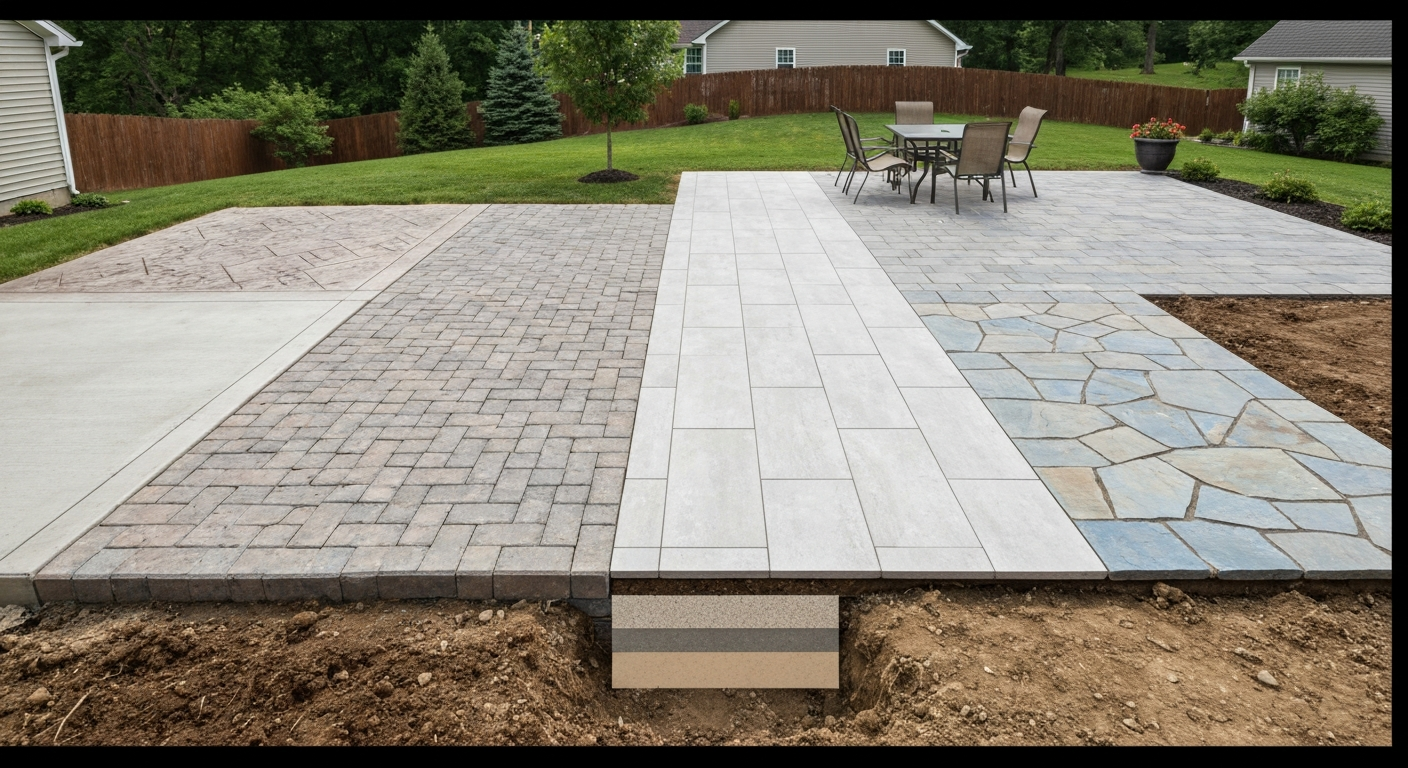
What this guide covers and how to use it
This guide gives you the real numbers behind patio tile and paver installation so you can build a working budget before a contractor shows up with a quote. We cover per-square-foot and per-square-meter ranges for every common patio material, worked examples at popular sizes (10x10, 12x12, 15x15, and 20x20), a full cost breakdown by material type, labor vs. DIY comparisons, removal and relay costs, and the site-prep line items that routinely catch homeowners off guard. Whether you are planning a brand-new install, thinking about relaying an existing patio, or just trying to figure out whether DIY makes sense for your situation, the data here will get you to an accurate ballpark before you spend a dollar.
National cost ranges: per square foot and per square meter
Across all materials and regions, professionally installed patio projects in 2025-2026 run roughly $5 to $50 per square foot, but the vast majority of residential jobs fall in the $8 to $35/ft² band. At the low end you have basic poured concrete slabs. In the middle sit concrete pavers and brick. At the high end you find natural stone, flagstone, bluestone, and large-format porcelain. For metric budgeters, those same ranges translate to approximately $54 to $377 per square meter, with the typical mid-range cluster running $86 to $270/m². Keep in mind these are installed costs including labor and base work. Materials alone are only part of the total.
| Material | Installed cost (per ft²) | Installed cost (per m²) | Notes |
|---|---|---|---|
| Poured concrete slab | $4–$15 | $43–$161 | Lowest entry point; functional but plain |
| Stamped concrete | $8–$22 | $86–$237 | Decorative patterns add cost vs. plain pour |
| Concrete pavers / brick pavers | $8–$25 | $86–$269 | Most popular mid-range option |
| Porcelain / ceramic outdoor tiles | $10–$30 | $108–$323 | Premium look; wide price range by format |
| Natural stone / flagstone / bluestone | $15–$35+ | $161–$377+ | High-end; irregular stone can cost more |
| Brick (traditional clay) | $8–$25 | $86–$269 | Durable; labor-intensive for complex patterns |
A few things to keep in mind when reading these ranges. First, they reflect full installed project costs, not just tile or paver material. Second, the low end of each range assumes a flat, accessible site with minimal excavation. Any slope, drainage work, tree root removal, or retaining wall requirement shifts costs toward the upper band. Third, contractor rates vary considerably by region. Labor in coastal metros (New York, Los Angeles, Seattle) runs 20 to 40 percent higher than in the Midwest or South.
What common patio sizes actually cost
The single fastest way to build a working budget is to apply the per-square-foot range to your target patio size. If you want a quick estimate for how much to lay patio pavers, see our detailed cost breakdown and per-square-foot ranges. The table below uses a realistic blank" rel="noopener noreferrer">mid-band range of $12 to $25 per square foot (concrete pavers to porcelain) alongside a budget concrete band ($5 to $12/ft²) and a premium natural stone band ($20 to $35/ft²). Site prep, demolition, and permit costs are not included in these figures, those are covered in their own sections below.
| Patio size | Square footage | Budget (concrete, $5–$12/ft²) | Mid-range (pavers/porcelain, $12–$25/ft²) | Premium (stone, $20–$35/ft²) |
|---|---|---|---|---|
| 10x10 | 100 ft² | $500–$1,200 | $1,200–$2,500 | $2,000–$3,500 |
| 12x12 | 144 ft² | $720–$1,728 | $1,728–$3,600 | $2,880–$5,040 |
| 15x15 | 225 ft² | $1,125–$2,700 | $2,700–$5,625 | $4,500–$7,875 |
| 20x20 | 400 ft² | $2,000–$4,800 | $4,800–$10,000 | $8,000–$14,000 |
Worked example: 12x12 concrete paver patio
Say you want a 12x12 patio (144 sq ft) with standard concrete pavers on a flat, accessible backyard with no existing surface to remove. Materials at a landscape supplier (Holland Stone or similar) run roughly $5.20 per sq ft, which is $749 in pavers. Add polymeric sand and base aggregate (roughly $3 to $4/ft² bundled) at $432 to $576. A contractor crew typically quotes labor for this size at $4 to $8 per sq ft, so $576 to $1,152. Total estimated range: $1,757 to $2,477. That lines up cleanly with the mid-range column above. Now add $800 to $1,500 for excavation and grading on a real residential site and you see why quotes often come in over $3,000 for what sounds like a small job.
Worked example: 20x20 natural stone patio
A 20x20 (400 sq ft) flagstone or bluestone patio is a serious project. Materials for natural stone commonly run $7 to $16 per sq ft at the yard before delivery, so $2,800 to $6,400 in stone alone. Labor for irregular flagstone is higher than for uniform pavers, often $10 to $15 per sq ft given the cutting, fitting, and grouting time, which adds $4,000 to $6,000 in labor. Combine those and you are at $6,800 to $12,400 before any excavation, drainage work, or edging. On a sloped or poorly draining lot, the full project can easily reach the $14,000 ceiling shown in the table above.
Cost breakdown by material type
Poured concrete slabs
A standard poured concrete slab is the cheapest entry point at $4 to $15 per sq ft installed. Materials are relatively inexpensive, and a skilled crew can pour and finish a large slab quickly. The wide range reflects thickness (4-inch vs. 6-inch), reinforcement (rebar vs. wire mesh vs. none), and finish quality (broom vs. smooth). Plain broom-finish concrete at the low end is purely functional. It is not glamorous, but it is durable, low-maintenance, and good for 20 to 30 years with normal care. The main downside is cracking. Without proper expansion joints and a solid compacted base, you will get cracks.
Stamped concrete
Stamped concrete gives you the visual appeal of pavers or stone at $8 to $22 per sq ft without the individual unit installation time. The premium over plain concrete pays for the stamping tools, color release agents, and the skill required to get consistent results. A well-done stamped concrete patio can look excellent for 10 to 15 years. The catch: when it cracks (and it will crack eventually), repairs are visually obvious. Color fading is also a real issue if sealing is skipped every 2 to 3 years. Reseal costs are typically $0.50 to $1.50 per sq ft, which is easy to overlook in a lifecycle budget.
Concrete pavers and brick pavers
Concrete pavers are the workhorse of the residential patio market at $8 to $25 per sq ft installed. Retail material prices from big-box stores and landscape suppliers range from around $4.70 to $8.15 per sq ft depending on the unit style (basic Holland Stone vs. premium textured products like Belgard Mega Arbel). The installed price difference versus stamped concrete often comes down to labor: placing individual units is more time-consuming than pouring. However, pavers are repairable unit by unit, so a cracked or stained paver can be swapped out without touching the rest of the surface. That is a significant long-term advantage. Clay brick pavers fall in the same installed cost range but tend to be denser, harder-wearing, and more color-stable over decades.
Natural stone, flagstone, and bluestone
Natural stone is the premium tier at $15 to $35+ per sq ft installed. Material costs from the stone yard typically run $7 to $16 per sq ft before delivery and contractor markup. The labor premium reflects the irregular shapes of flagstone that require fitting, cutting, and often dry-set or wet-set mortaring. Bluestone cut in uniform squares installs faster and costs somewhat less in labor than irregular Pennsylvania fieldstone or flagstone. Natural stone looks excellent and can last 50 years or more if the sub-base is well-built, but it is genuinely maintenance-intensive: sealing, repointing mortar joints, and addressing any heave from frost or root movement. If you are comparing patio slabs specifically, pricing for pre-cut natural stone slabs and concrete slabs is a related topic worth exploring separately. For detailed pricing on pre-cut and concrete patio slabs, see how much are patio slabs.
Porcelain and ceramic outdoor tiles
Large-format porcelain outdoor pavers have grown rapidly in popularity because they mimic natural stone very convincingly at a lower material cost. A 24x24 porcelain paver from a big-box retailer (like the Satori 24x24 listed at roughly $20 per piece) works out to about $5 per sq ft at retail. Contractor and distributor pricing varies widely. Installation costs are higher than for concrete pavers because large-format porcelain requires a very flat, rigid base (typically a concrete sub-slab or thick mortar bed) and careful grouting to prevent cracking. Installed costs for porcelain commonly run $10 to $30 per sq ft. The big gotcha here is freeze-thaw performance. Not all porcelain is rated for outdoor freeze-thaw cycles, so verifying the tile's frost rating before purchase in cold climates is critical.
Comparing materials: durability, maintenance, and lifecycle cost
| Material | Lifespan (well-installed) | Maintenance level | Repairability | Lifecycle cost outlook |
|---|---|---|---|---|
| Poured concrete | 20–30 years | Low (sealing every 2–5 yrs) | Poor (cracks visible) | Low upfront, moderate long-term |
| Stamped concrete | 15–25 years | Moderate (sealing every 2–3 yrs) | Poor (color match hard) | Medium upfront, higher long-term |
| Concrete pavers | 25–50 years | Low to moderate | Excellent (unit by unit) | Medium upfront, low long-term |
| Brick (clay) | 50–100 years | Low | Good (individual units) | Medium-high upfront, very low long-term |
| Natural stone / flagstone | 50+ years | Moderate (sealing, repointing) | Good (individual pieces) | High upfront, low long-term if maintained |
| Porcelain / ceramic | 20–40 years | Low (no sealing needed) | Moderate (grout/crack risk) | Medium-high upfront, low ongoing |
For most homeowners, concrete pavers hit the best all-around value: mid-range upfront cost, excellent repairability, and a lifespan that can approach 50 years on a proper base. Stamped concrete is tempting on budget grounds but tends to disappoint over a 15-year horizon when staining, cracking, and color fade are factored in. Natural stone wins on aesthetics and longevity but demands a bigger upfront check and consistent maintenance. Porcelain is worth considering in mild climates or covered patio applications where the rigid base requirement is already met, but freeze-thaw performance concerns rule it out for some northern climates.
Hiring a contractor vs. doing it yourself
How the cost splits between labor and materials
On a typical professionally installed paver patio, labor accounts for roughly 40 to 60 percent of the total project cost. For a $15/ft² installed paver job, you might be looking at $6 to $8/ft² in labor and $7 to $9/ft² in combined materials (pavers, base aggregate, sand, edging). Masonry tradespeople earn national median wages in the mid-to-high $20s per hour at the employee level. By the time a contractor adds overhead, insurance, equipment, and profit margin, crew billing rates commonly run $50 to $80 per hour. A 300 sq ft paver patio requires roughly 35 to 40 labor hours in total including site prep, base compaction, installation, and cleanup. At $65/hr crew rate, that alone is $2,275 to $2,600 in labor for what looks like a straightforward job.
When DIY actually makes sense
DIY makes financial sense for concrete paver and flagstone projects if you are comfortable with physical labor, have two or three weekends available, and can rent or borrow the right tools. A 200 sq ft DIY paver patio can realistically save $1,200 to $2,000 in labor versus a contractor quote. However, the savings evaporate quickly if you underestimate the base work, get the compaction wrong, or have to relay sections due to settling. The jobs where DIY consistently goes wrong are drainage (inadequate slope leads to pooling), edge restraint installation (skipping it causes spreading), and compaction (hand tampers on anything over 100 sq ft are insufficient, and a plate compactor rental runs $60 to $100 per day).
Tools and equipment rental costs for DIY paver installation
- Plate compactor: $60–$100/day or $180–$300/week (essential; do not skip this)
- Sod cutter / sod removal: $80–$150/day rental
- Wet saw or angle grinder with diamond blade: $40–$80/day (required for cuts near edges and obstacles)
- Wheelbarrow, tamper, screeding pipes, levels: often owned or borrowed
- Delivery charges for base aggregate and sand: $50–$150 depending on haul distance
- Polymeric sand (joint filling): $20–$35 per 50 lb bag (covers roughly 25–30 sq ft)
A realistic DIY tool and supply budget for a 200 sq ft paver project, not including the pavers and base material themselves, is $300 to $600. That still leaves meaningful savings compared to labor costs, but it is not as cheap as many first-timers expect. Poured concrete and stamped concrete are generally not good DIY candidates. Getting a proper mix, proper reinforcement, and a consistent finish requires real experience, and the window for corrections is very short once the concrete is down.
Removing, relaying, and re-laying an existing patio
If you already have a patio surface that is uneven, cracked, or deteriorating, you have three realistic options: spot repair, partial relay, or full removal and replacement. For detailed pricing on removal and relay work, see how much to re lay a patio. The right choice depends on how widespread the damage is and what caused it. Frost heave and tree root damage typically require more than spot repair because the problem recurs if the base is not addressed. General aging and loose units can often be fixed with a partial relay.
Patio removal and demolition costs
Removing an existing patio surface typically costs $2 to $6 per sq ft for labor alone, plus haul and disposal. A 200 sq ft concrete slab removal (which requires jackhammering or a demolition saw) with dumpster rental will commonly run $800 to $2,000 all-in depending on thickness and access. Paver removal is cheaper because units can be lifted and stacked rather than broken up, so disposal volume is lower. Dumpster rental nationally averages $220 to $780 per week depending on size, with common 10 to 20-yard dumpsters running $250 to $550. Palmetto (FL) municipal fee schedule lists roll‑off dumpster rental and tipping details, including an example 10‑yard roll‑off pricing Palmetto (FL) municipal fee schedule lists roll‑off dumpster rental and tipping details, including an example 10‑yard roll‑off pricing.. Weight overage fees and local landfill tipping fees are on top of those rental prices.
Partial relay vs. full replacement
Partial relay (lifting affected sections, correcting the base, and resetting pavers) typically costs $5 to $15 per sq ft for the affected area. If the problem is isolated to 20 to 30 percent of the patio, a partial relay almost always pencils out better than full replacement. The complication is matching existing material. If your original pavers have been discontinued or have faded significantly, replacing a section looks obvious. Full relay and re-laying an entire existing paver or tile patio, including removal, base correction, and reinstallation with new or reclaimed materials, generally runs $10 to $25 per sq ft. That is not far from a fresh install quote, which is why full replacement is often competitive when the base has fundamental drainage or compaction issues. The decisions involved in re-laying and relay projects carry their own nuances around salvageability of existing materials and base repair costs.
Site preparation and hidden costs that inflate quotes
Site preparation is the single most common source of budget surprises in patio projects. Most people focus on the tile or paver cost and underestimate what goes underneath. Here is what you can expect.
Excavation and grading
Excavating to the required depth (typically 8 to 12 inches for a paver base: 4 to 6 inches of compacted aggregate, plus 1 inch of bedding sand, plus paver thickness) on a 200 to 400 sq ft patio generates a significant amount of spoil. Excavation and grading for a typical residential patio adds $1,500 to $6,300 to the project cost depending on soil conditions, access for equipment, and how far the spoil needs to be hauled. Hand-dig situations on tight side-yard access cost more per sq ft than open-yard machine work.
Sub-base and bedding materials
Compacted aggregate for the sub-base adds roughly $0.50 to $1.50 per sq ft in material cost for the 4 to 6-inch depth typically required. Combined with bedding sand, polymeric joint sand, and edge restraints, the full material bundle beyond the pavers themselves commonly runs $3 to $9 per sq ft when all base components are included. This is a line item that often gets underestimated or omitted in early ballpark quotes.
Drainage, soakaways, and water management
Any patio with marginal drainage needs a designed drainage solution, not just a slight slope. Channel drains, French drains, and soakaways can add $500 to $3,000+ depending on the system required and whether it ties into an existing drainage network. Installing a patio without addressing drainage in a low-lying or clay-heavy yard is one of the most common causes of premature failure and relay costs down the line.
Edging, retaining walls, and slopes
Retaining walls for sloped yards cost $20 to $60 per linear foot for basic block walls, significantly more for natural stone. Even a modest 20-linear-foot retaining wall adds $400 to $1,200 to the project. Edge restraint for pavers (typically plastic or aluminum spike-down edging) is cheap at $1 to $2 per linear foot, but many DIYers skip it and later watch their patio gradually spread. Contractor quotes should always include edge restraint; if it is missing from a written quote, ask about it.
Tree roots, permits, and other less-obvious costs
- Tree root removal or routing: $200–$1,500+ depending on root mass and proximity to tree
- Building permits (some municipalities require them for patios over a certain size): $50–$400
- Sealing (optional but recommended for pavers and natural stone): $0.50–$1.50/ft² first application
- Leveling sand top-up after first winter settlement: minor but worth budgeting $50–$150
- Delivery fees for materials if you are not near a stone yard or supplier: $50–$250 per delivery
Regional contractor rate variations
Where you live has a real impact on what you pay. Tile setters and masonry workers in high-cost metros (Boston, Seattle, San Francisco, New York) often earn $35 to $45 per hour at the employee level versus $22 to $28 per hour in lower-cost Midwest and Southern markets. That wage difference flows through into contractor billing rates and installed project costs. Practically speaking, a $15/ft² paver patio in the Midwest might quote at $20 to $22/ft² in a coastal market for the same scope of work. If you are getting quotes and they feel high compared to national averages, regional labor costs are the most likely explanation. Always get at least three local contractor quotes rather than relying only on national averages for your final budget.
Hire vs. DIY decision framework
Use this simple framework to decide before committing to either path. If you answer yes to two or more of the following, DIY is a realistic option for a paver project:
- You have a flat or gently sloped site with no significant drainage issues
- The area is under 250 sq ft and accessible to a wheelbarrow
- You have two or three free weekends and a helper
- You are comfortable renting and operating a plate compactor
- The project uses uniform concrete pavers (not irregular stone or large-format porcelain)
Hire a contractor if the site has drainage problems, significant slope, existing surfaces to remove, tree roots to deal with, or if you are working with natural stone, large-format porcelain, or any material requiring a mortar bed. The savings on labor rarely offset the cost of doing base work wrong and having to pay someone to fix it. Poured concrete and stamped concrete are almost always best left to professionals regardless of site conditions.
Getting accurate quotes: a pre-appointment checklist
Before you contact a contractor, having the following information ready will result in faster, more accurate quotes and make it much easier to compare bids apples-to-apples.
- Measure the exact area in square feet (length x width, accounting for irregular shapes)
- Note whether there is an existing surface to remove and what material it is
- Identify any obvious drainage issues, slopes, or standing water areas
- Have a material preference in mind (or a top two to three options with your budget range)
- Know your access situation: can a skid steer or wheelbarrow reach the site?
- Check whether your municipality requires a permit for patios above a certain size
- Clarify whether you want a written, itemized quote (materials, labor, and base work listed separately)
- Ask each contractor specifically about edge restraint, compaction method, and base depth
- Request references or photos of comparable recently completed projects
Once you have measurements and a material preference, using a patio cost calculator to generate a pre-quote estimate gives you a solid anchor number for evaluating contractor bids. Quotes that come in dramatically lower than the calculator range (more than 30 percent below) usually mean something is being left out of scope, most often base preparation or drainage. Quotes well above the range warrant a conversation about what is driving the premium.
FAQ
What is the typical national cost range to lay patio tiles (installed) per square foot and per square meter?
National installed cost ranges for patios (all common materials) typically run about $5–$50 per square foot (≈ $54–$538 per m²). Most residential projects cluster in the $5–$35/ft² band for typical materials and site conditions. Low‑end (simple poured concrete, DIY) can approach $5–$8/ft²; midrange (concrete pavers, porcelain, brick) commonly $8–$25/ft²; high‑end natural stone/complex installs often $15–$50+/ft².
What are example total cost ranges for common patio sizes (10×10, 12×12, 15×15, 20×20)?
Using planning bands, example installed totals (materials + labor, excluding unusual demolition/permit costs): - 10×10 (100 ft²): $500–$5,000 (typical $1,000–$2,500) - 12×12 (144 ft²): $720–$7,200 (typical $1,700–$3,600) - 15×15 (225 ft²): $1,125–$11,250 (typical $2,700–$5,625) - 20×20 (400 ft²): $2,000–$20,000 (typical $4,800–$10,000) Use the lower end for simple poured concrete/DIY and upper end for premium stone, heavy site prep or complex patterns.
How do costs break down by material (concrete, pavers, natural stone, stamped concrete, brick, porcelain/ceramic)?
Typical installed cost bands by material (nationwide planning ranges): - Poured concrete slab: ~$4–$15/ft² - Stamped concrete: ~$8–$22/ft² - Concrete pavers / brick pavers (installed): ~$8–$25/ft² - Natural stone / flagstone / bluestone: ~$15–$35+/ft² - Porcelain/large‑format outdoor tiles/slabs: material retail can be ~$5–$20/ft²; installed commonly ~$12–$30/ft² depending on substrate and adhesive - Brick (installed): ~$10–$30/ft² Notes: material‑only retail prices are lower; installed cost includes base, bedding, labor, cutting and edging. Premium stones or specialty installation techniques can exceed ranges.
What portion of the total cost is labor versus materials?
Labor often represents 35–65% of the installed patio cost depending on material, complexity and site prep. For simple poured concrete or DIY installs, materials dominate; for pavers, natural stone and tile, labor (cutting, laying patterns, precise leveling, edgework) becomes a larger share. Typical installer labor inputs run roughly $4–$11/ft² for pavers (or crew hourly rates $50–$80/hr). Use your local tile/setter or mason hourly wage (mid‑$20s to $40+/hr) and crew productivity to model labor lines.
How much does it cost to remove an existing patio and haul the debris?
Demolition/removal planning range: ~$2–$6/ft² for removing pavers/concrete (plus roll‑off/dumpster rental and landfill fees). Typical homeowner dumpster rental for a patio job runs ~$250–$550 for a common 10–20 yd dumpster; municipal disposal and weight overages can add. Complex removal (large concrete slabs requiring jackhammering/heavy equipment) may cost more.
What does re‑laying or relaying an existing patio cost versus full replacement?
Re‑lay (lift and reset) vs full replacement: - Re‑laying pavers (lift, recompact base, reset, refill joints): typically 25–60% of full replacement cost depending on condition; expect labor‑intensive but material‑savings if pavers reusable. Typical re‑lay job might cost ~$4–$12/ft². - Repair/partial replacement (fixing settlement, replacing edges): smaller jobs often billed hourly or per‑sq‑ft at a premium. - Full replacement (remove, rebuild base, new material): aligns with the installed ranges above ($5–$50/ft²). Decision depends on base condition, drainage and the amount of broken/settling units.
Next Articles
How Much Are Patio Slabs: Costs by Type & Size Guide
How much are patio slabs: clear price ranges, sample estimates, DIY vs pro costs, and budgeting steps.
How Much to Lay Patio Pavers: Costs, Budgets & Quotes
How much to lay patio pavers: realistic $/sq ft ranges, sample budgets, DIY vs pro costs, and budgeting checklist.
How Much to Re Lay a Patio Cost Breakdown by Type
Budget ranges to re-lay a patio by type and size, with full cost breakdown, DIY vs pro, and quote tips.