
Pouring a concrete patio in 2026 typically costs $6 to $12 per square foot installed, with a national average landing around $10 per square foot for a standard 4-inch slab with a broom finish and basic site prep. On that math, a 10x10 patio runs roughly $600 to $2,000, a 12x12 comes in around $864 to $2,880, and a popular 20x20 patio lands between $2,400 and $8,000 depending on your region, contractor, and finish. If you want thicker concrete, decorative finishes, demo of existing hardscape, or drainage work, costs climb quickly, so understanding each line item before you call a contractor is the smartest move you can make.
How Much to Pour Patio: Cost per Sq Ft & Project Estimates

Felix Carver
10 Aug 2026
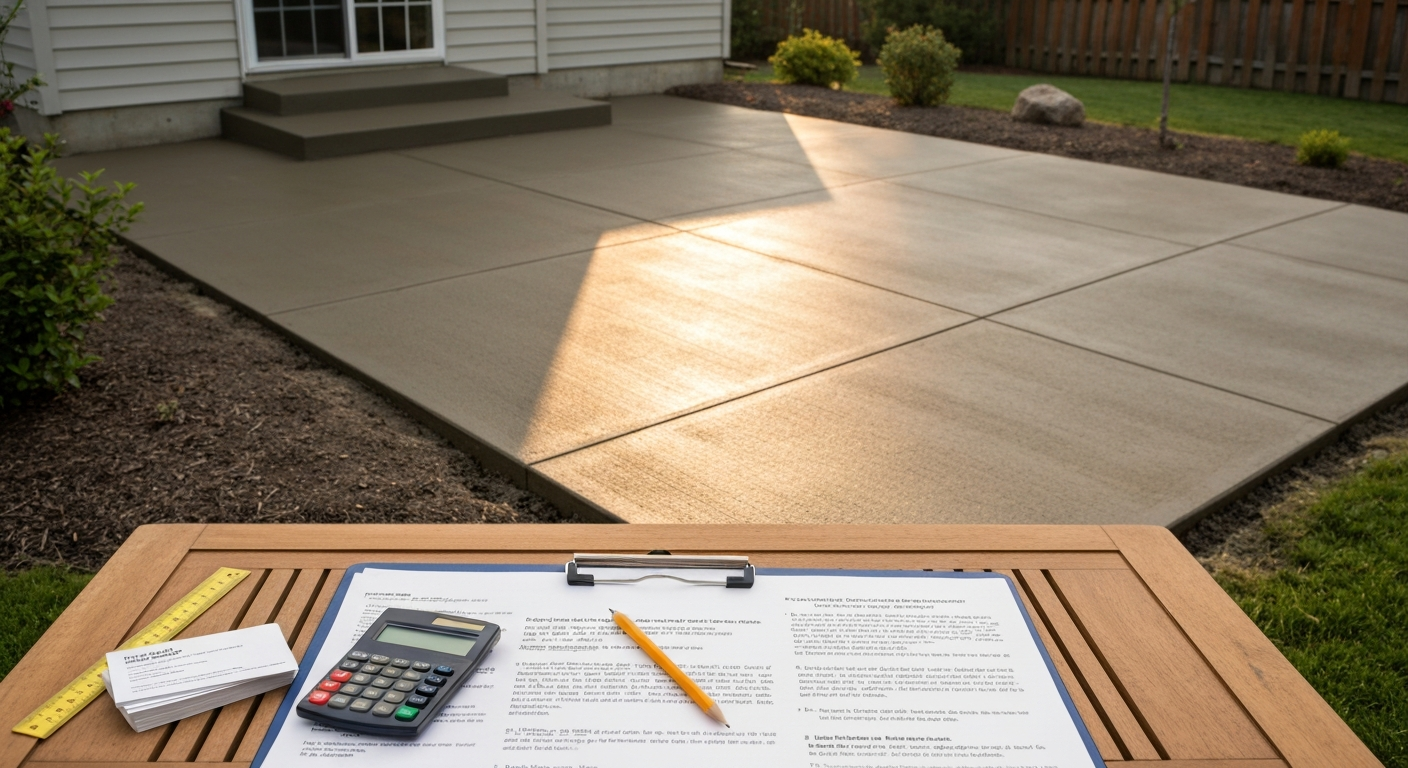
What drives the price of pouring a concrete patio
Concrete patio pricing is more variable than most homeowners expect. The raw ready-mix concrete itself is actually one of the smaller cost items. Delivered ready-mix runs roughly $125 to $185 per cubic yard nationally in 2026, and at 4 inches thick, one cubic yard covers about 81 square feet. Do that math and the concrete material alone costs you roughly $2 to $6 per square foot, the rest of the installed price goes toward labor, base gravel, formwork, reinforcement, finishing, and equipment. Labor is the biggest variable. The BLS reported a national mean hourly wage of $28.87 for cement masons and concrete finishers in May 2025, but contractors bill at $50 to $100 per hour or more once you factor in overhead, payroll burden, insurance, and equipment. Project size matters a lot too: contractors have minimum mobilization fees that make small pours expensive on a per-square-foot basis, while larger jobs get more favorable rates.
Beyond labor and concrete, the site conditions you start with dramatically affect the total. If you are starting from raw dirt, budget for grading and compaction. If you are replacing an old slab, demo and disposal add to the bill. Permits, drainage, and specialty finishes like stamped patterns or epoxy coatings are also real cost drivers that rarely show up in the headline number you see advertised online.
Cost per square foot: what low, mid, and high ranges actually include
| Price Tier | Cost Per Sq Ft | What's Typically Included |
|---|---|---|
| Low end | $6–$7/sq ft | Basic 4" broom-finish slab, minimal grading, wire mesh only, single-pour small crew, competitive local market |
| Mid range | $9–$12/sq ft | 4" slab with proper base prep, wire mesh or #3 rebar, broom or light textured finish, standard formwork, typical contractor markup |
| High end | $15–$20+/sq ft | Thicker slab (5"–6"+), decorative or stamped finish, integral color, heavy reinforcement, complex site prep, high-cost region or premium contractor |
The low-end $6 to $7 range is real, but it usually means a basic crew in a competitive market, minimal site work, no decorative finish, and often a smaller independent contractor rather than a larger company with a full warranty. The mid-range $9 to $12 is what most homeowners in mid-cost regions actually pay for a properly built patio that will hold up for decades. The high end kicks in when you add decorative treatments, work in a high-cost metro like San Francisco or New York, or need significant grading, drainage, or demo work before the pour even starts.
Cost estimates by common patio size
These estimates assume a 4-inch slab, broom finish, standard wire mesh reinforcement, basic base prep on a relatively flat site, and a typical mid-cost regional market. Typical retail price for welded wire fabric (WWF) / wire mesh in the U.S. is about $0.10–$0.50 per sq ft for standard 6×6 welded wire, with installed cost often cited around $0.35–$0.50 per sq ft (see blank" rel="noopener noreferrer">Wire Mesh / Welded Wire Fabric Calculator (AllConcreteCalculator, 2026)). blank" rel="noopener noreferrer">Reinforcement & accessory cost references (ConcreteCalculatorMax, 2026) note that tie wire, rebar chairs, and small consumables (tie wire rolls, clips, plastic chairs and stakes) commonly add $0.05–$0.25 per sq ft to material costs on typical residential slabs. Use them as a planning baseline, not a final quote.
| Patio Size | Square Footage | Low Estimate | Mid Estimate | High Estimate | Concrete Needed (approx.) |
|---|---|---|---|---|---|
| 10x10 | 100 sq ft | $600 | $1,000 | $2,000+ | ~1.25 cu yds |
| 12x12 | 144 sq ft | $864 | $1,440 | $2,880+ | ~1.8 cu yds |
| 16x16 | 256 sq ft | $1,536 | $2,560 | $5,120+ | ~3.2 cu yds |
| 20x20 | 400 sq ft | $2,400 | $4,000 | $8,000+ | ~5 cu yds |
| 20x30 | 600 sq ft | $3,600 | $6,000 | $12,000+ | ~7.5 cu yds |
One thing worth flagging: the 10x10 and 12x12 pours are where contractor minimums hit hardest. Many concrete contractors have a minimum mobilization charge of $500 to $1,500 just to show up, set forms, and bring equipment. On a 100 square foot job, that alone can push your effective per-square-foot cost well above $15 even for plain concrete. If your patio is on the smaller side, ask contractors upfront what their minimum is before you spend time getting multiple bids.
Complete line-item cost breakdown
Here is how the money actually breaks down on a typical mid-range concrete patio installation. These are per-square-foot planning figures based on 2026 material prices and typical contractor billing, your exact numbers will vary by region and project specifics.
| Line Item | Typical Cost Range | Notes |
|---|---|---|
| Ready-mix concrete (material) | $2.00–$6.00/sq ft | Based on $125–$185/yd3 delivered, 4" slab (~81 sq ft/yd) |
| Short-load / delivery fee | $50–$250 flat | Added for orders under ~5–7 yards; hurts small pours |
| Gravel base / subbase | $0.50–$1.50/sq ft | Typically 4" of compacted crusher-run gravel |
| Base compaction (equipment) | $0.25–$0.75/sq ft | Plate compactor rental or contractor equipment charge |
| Formwork (lumber + stakes) | $0.50–$2.00/lin ft of perimeter | 2x6 or 2x8 form boards, $5–$12 per 8-ft board retail |
| Wire mesh reinforcement (WWF) | $0.35–$0.50/sq ft installed | 6x6 welded wire fabric, material + placement |
| Rebar (if used instead of or with mesh) | $0.40–$1.25/lin ft | #4 rebar (1/2"); used for heavier loads or thicker slabs |
| Small consumables (chairs, tie wire) | $0.05–$0.25/sq ft | Rebar chairs, plastic spacers, tie wire |
| Labor (placing, screeding, floating) | $3.00–$7.00/sq ft | Crew billing rate including overhead; BLS wage baseline $28.87/hr |
| Finishing (broom finish) | Included in labor above | Upgrade to exposed aggregate or trowel finish adds $0.50–$2.00/sq ft |
| Curing compound or curing materials | $0.10–$0.30/sq ft | Liquid curing compound or plastic sheeting |
| Contractor overhead and markup | 15%–30% of subtotal | Standard contractor margin on residential flatwork |
A few gotchas worth calling out: the short-load fee for small deliveries can sting badly on a 10x10 or 12x12 project. If a ready-mix plant charges $200 for delivering under 5 yards, that adds $2 per square foot to a 100-square-foot patio before anything else is touched. On larger projects it gets diluted quickly, but on small pours it is one of the most common budget surprises. Similarly, form lumber is often underestimated, a 20x20 patio has 80 linear feet of perimeter, so even at a modest $1.50 per linear foot for boards and stakes, that is $120 in material alone.
Finishes and surface treatments: what they cost and what they look like
Plain broom-finish concrete is durable, slip-resistant, and cost-effective, but it is about as exciting as a sidewalk. If you want something more attractive, you have several good options at a range of price points. Here is how the main finishes compare for a typical 20x20 patio (400 sq ft).
| Finish Type | Added Cost Per Sq Ft | Total Added Cost (20x20) | Notes |
|---|---|---|---|
| Broom finish (standard) | $0 added | $0 | Baseline — included in standard pour price |
| Exposed aggregate | $1–$3/sq ft | $400–$1,200 | Seeded or washed; texture and natural stone look |
| Integral color | $2–$4/sq ft | $800–$1,600 | Pigment mixed throughout; fades less than surface treatments |
| Concrete staining (acid or water-based) | $2–$4/sq ft | $800–$1,600 | Applied after cure; many color options |
| Concrete sealing (clear) | $0.50–$2.00/sq ft | $200–$800 | Protects surface; should be redone every 2–5 years |
| Concrete painting | $1–$3/sq ft | $400–$1,200 | Lowest-cost color option but less durable than stain |
| Stamped concrete | $8–$18/sq ft over base | $3,200–$7,200 | Most decorative option; mimics pavers, slate, wood |
| Epoxy coating | $3–$12/sq ft | $1,200–$4,800 | Garage-grade to decorative chip systems; very durable |
Stamped concrete is the most dramatic upgrade, pushing a 20x20 patio's total installed cost to roughly $5,600 to $15,200 when you add the stamped finish price on top of a mid-range base installation. That overlaps with paver patio pricing, so if you are comparing options, it is worth pricing both. Epoxy coatings are a great value-add on an existing or newly poured slab and are especially popular where people want a clean, durable surface for an outdoor entertaining area. Staining is a popular middle ground, it gives you real color variation and a more premium look than paint for a modest added cost. For detailed pricing on staining, see our guide on how much to stain a concrete patio, which breaks down typical costs and factors. If you are planning to stain, paint, or apply an epoxy coating to a new slab, that work happens after the concrete fully cures, which adds timeline but not complexity. For budgeting details on painting a cured slab, see our guide on how much does it cost to paint concrete patio.
Add-ons and related services that affect your total
The pour itself is only part of the project budget for many homeowners. Depending on your site and what is there now, you may need several of these services before or alongside the concrete work.
| Service | Typical Cost Range | Notes |
|---|---|---|
| Demo and removal of existing concrete slab | $1–$3/sq ft or $500–$2,500 typical job | Depends on slab thickness, accessibility, rebar content |
| Concrete disposal / haul-away | $100–$500+ | Often bundled with demo; landfill fees vary by region |
| Site grading (minor slope correction) | $500–$2,000 | Flat sites cost less; steep or drainage-problem sites more |
| Drainage installation (French drain, etc.) | $1,000–$5,000+ | For sites with water pooling or slope drainage issues |
| Subgrade compaction (if not standard) | $0.25–$0.75/sq ft | Needed where soil is soft, disturbed, or recently backfilled |
| Building permit | $50–$500+ | Varies widely by municipality; some jurisdictions require for all flatwork |
| Mobilization / minimum job fee | $500–$1,500 | Contractor minimum regardless of project size |
| Tree root removal or stump grinding | $150–$600 per stump | If roots or stumps are in the patio footprint |
Demo of an existing concrete slab is probably the most commonly overlooked add-on. If you have a cracked or heaving patio that needs to come out before the new pour, add $1 to $3 per square foot for demo, plus disposal fees on top. On a 20x20 slab that alone could add $400 to $1,200 before any new concrete is ordered. Permits are the other surprise, some cities and counties require permits for any flatwork over a certain size, and fees range from $50 in a rural county to $500 or more in some metro areas. Also budget for your local concrete patio permit cost, which can range from about $50 to $500 or more depending on the city or county. A good contractor will pull the permit (and include it in the bid), but always confirm that in writing.
How your region shifts the numbers
Concrete patio pricing is genuinely national in structure but local in execution. Ready-mix concrete prices, labor wages, and contractor overhead all vary significantly by region. A $10 per square foot average in the Midwest might be $14 to $18 in coastal California or metro New York, and $7 to $9 in parts of the South or rural Mountain West. Use the table below as a rough regional adjustment guide on top of the national mid-range estimate of $10 per square foot.
| Region | Adjustment vs. National Average | Approximate Range (4" broom finish) |
|---|---|---|
| Pacific Coast (CA, WA, OR metros) | +30% to +60% | $13–$18/sq ft |
| Northeast (NY, NJ, CT, MA metros) | +25% to +50% | $12–$17/sq ft |
| Mid-Atlantic (DC, MD, VA suburbs) | +15% to +35% | $11–$15/sq ft |
| Upper Midwest (IL, MI, MN metros) | +5% to +15% | $10–$13/sq ft |
| Midwest / Plains (OH, IN, MO, KS) | -5% to +5% | $8–$12/sq ft |
| Southeast (GA, FL, SC, NC) | -5% to +10% | $7–$11/sq ft |
| Texas and Gulf Coast | -5% to +10% | $7–$11/sq ft |
| Mountain West (CO, UT, AZ metros) | +5% to +20% | $9–$13/sq ft |
| Rural areas nationwide | -15% to -25% | $6–$9/sq ft |
A few factors that drive regional variation beyond just labor wages: local ready-mix plant availability and competition (fewer plants means higher delivered concrete prices), local aggregate costs (crushed stone transport costs vary a lot), building code requirements that affect base depth and reinforcement, and seasonal demand. In warm-weather states, contractors can pour year-round, keeping competition higher and prices somewhat lower. In cold-weather regions, the pouring season is compressed, demand peaks in spring and early summer, and cold-weather concrete protection can add $1 to $3 per square foot in late fall pours.
How contractors actually price this work
Understanding contractor pricing structure helps you evaluate quotes more intelligently. Most concrete flatwork contractors use one of two approaches: a flat per-square-foot bid that bundles all labor and materials, or a cost-plus approach that separates material and labor line items. Per-square-foot bids are more common for residential work and easier to compare across contractors.
On the labor side, contractors billing out concrete crews typically charge $50 to $100 per hour per worker, well above the BLS mean wage of $28.87 per hour, because the crew billing rate covers payroll taxes, workers' comp insurance, liability insurance, equipment depreciation, vehicle costs, and the contractor's own margin. A two-person crew working an 8-hour day might bill $800 to $1,600 in labor alone before materials. For a standard 400-square-foot (20x20) patio, a typical concrete crew can complete the pour and finish in one day, with the base prep potentially adding a second half-day or full day.
Contractor markup on materials typically runs 15 to 30 percent on top of their actual material cost. They buy ready-mix at contractor rates (often $10 to $20 per yard lower than a retail caller would pay), then mark it up to their price. This is standard and expected, it compensates for managing the supply chain, handling delivery logistics, and standing behind the material quality. Mobilization fees of $500 to $1,500 are common and often non-negotiable, especially for smaller contractors who are tying up a full crew and truck for a project. If a contractor waives the mobilization, it is usually built into their per-square-foot rate instead.
DIY vs. hiring a contractor: where the math actually lands
DIY pouring a concrete patio can cut your cost to $3 to $5 per square foot in materials (ready-mix plus gravel, mesh, and form lumber), but it is genuinely hard physical work with a very short finishing window. Concrete does not wait while you figure out what to do next. For a 10x10 or 12x12 patio, an experienced DIYer with help can manage it. For anything over 200 square feet, the speed of a professional crew, and their ability to screed, float, and finish a large slab before it sets, is hard to replicate without experience. The concrete-only material savings on a 20x20 patio might be $2,000 to $3,000 versus a contractor bid, but mistakes in a concrete pour can mean a slab that needs demo and re-pour, which costs more than hiring right the first time.
| Approach | Estimated Cost (20x20 patio) | Best For | Main Risks |
|---|---|---|---|
| DIY with ready-mix | $1,200–$2,000 in materials | Experienced DIYers, smaller pours, flat sites | Finishing errors, ordering wrong volume, physical demands |
| DIY with bagged concrete | $2,500–$4,000+ (higher per-yd cost) | Very small pours only (under ~1 yd3) | Expensive per yard, labor-intensive mixing, inconsistent mix |
| Professional installation | $4,000–$8,000 all-in | Most homeowners, larger pours, sloped or complex sites | Contractor quality varies; get 3 bids minimum |
Getting an accurate quote: practical steps before you call
The more specific you can be when contacting contractors, the more accurate your bids will be. Vague requests lead to vague (and often padded) estimates. Here is a practical checklist for getting apples-to-apples quotes.
- Measure your desired patio footprint in feet and calculate the square footage (length x width).
- Note the current site condition: bare dirt, existing concrete or pavers, slope issues, drainage problems.
- Decide on your slab thickness (4 inches is standard for foot traffic; 5–6 inches if you park vehicles on it).
- Choose your finish type before getting quotes: broom finish, exposed aggregate, stamped, or plain with post-pour staining.
- Ask each contractor to break out material and labor separately in their bid, not just a single total.
- Ask explicitly whether the bid includes: subbase gravel and compaction, form lumber and removal, wire mesh or rebar, curing compound, and site cleanup.
- Ask whether you need a permit and whether they will pull it (and if so, what it costs).
- Ask about their minimum job fee and what the mobilization charge covers.
- Get at least three bids from licensed, insured contractors. Concrete flatwork quality varies more than most trades.
- Ask for references from patio pours they completed in the last 12 months and actually call them.
One more thing worth budgeting for: plan for a 10 to 15 percent contingency on top of your contractor bid. Unexpected site conditions, soil issues found during grading, concrete price adjustments between bid and pour date, or small scope changes are common. A contractor who bids $4,500 for your 20x20 patio may come back with a legitimate change order if they hit groundwater at 8 inches or find the existing subgrade needs more work than expected. Having that buffer keeps the project from stalling.
FAQ
How much does it cost per square foot to pour a basic 4" concrete patio in 2026?
Typical installed ranges for a basic 4" poured concrete patio (broom finish, standard site prep) are roughly $6–$12 per square foot nationwide in 2026. Many consumer guides cite an average near $10/sq ft that includes materials and labor for common residential markets.
What are realistic total costs for common patio sizes (10×10, 12×12, 20×20) at 4" thickness?
Assuming a 4" slab with a broom finish and typical prep: - 10×10 (100 sq ft): about $600 (low) — $1,000 (typical) — $2,000+ (high) - 12×12 (144 sq ft): about $864 — $1,440 — $2,880+ - 20×20 (400 sq ft): about $2,400 — $4,000 — $8,000+ High-end totals reflect thicker slabs, difficult access, heavy formwork, stamped/stained finishes, or high local labor/material prices.
How does slab thickness affect cost per square foot?
Thickness increases material volume and some labor/formwork effort. Typical installed per‑sq‑ft bands (2026 guidance): - 4" plain slab: ~$6–$12/sq ft - 6" heavier‑use slab: ~$7–$15/sq ft - 8" vehicle or heavy slab: ~$8–$20+/sq ft Expect material (ready‑mix) needs to rise proportionally: one cubic yard covers ~81 sq ft at 4", ~54 sq ft at 6", ~40 sq ft at 8".
What is a complete line‑item cost breakdown I should expect on a contractor estimate?
Common line items and typical ranges (per residential job): - Ready‑mix concrete (material): $125–$185 per cubic yard delivered; material‑only ≈ $2–$6/sq ft depending on yard price and thickness - Delivery / short‑load fees (small orders): $50–$250 - Subbase (gravel/crusher‑run) and compaction: $0.50–$3.00/sq ft depending on depth and import - Formwork (lumber & stakes, setup/strip): $0.50–$4.00/sq ft - Reinforcement (wire mesh or rebar): $0.35–$1.50/sq ft installed depending on method - Labor (excavation, placement, finishing): commonly 40–60% of installed cost; contractor crew rates vary, but expect labor of several hundred to a few thousand dollars on small jobs—BLS trade wages average ~$29/hr as a baseline, with contractor billing higher to cover overhead - Finishing (broom, trowel, power‑float): often included; specialty finishes add costs (see finishes) - Control/expansion joints & seal: $0.50–$2.00/sq ft - Cleanup, disposal, small consumables (chairs, tie wire): $0.05–$0.25/sq ft - Permits/inspections: $0–$300+ depending on jurisdiction - Demolition/removal of old slab (if required): $2–$6/sq ft or $200–$2,000+ depending on size and difficulty These items will be combined into a per‑sq‑ft installed price on most estimates.
How much of the per‑square‑foot cost is materials vs labor?
Split varies by region and job complexity but a reasonable planning assumption: materials 25–45% of installed cost, labor 35–60%, and the remainder for equipment, formwork, subbase, overhead, and profit. For a $10/sq ft installed basic slab, materials might be $2–$4/sq ft and labor+equipment roughly $4–$6/sq ft.
What regional price variations should I expect?
Expect 10–40% variation by region due to labor markets, local ready‑mix pricing, delivery distances, and permit costs. Higher‑cost metro areas and regions with higher contractor demand can be toward the upper band of the national ranges; rural or lower‑cost regions will trend lower. Ready‑mix price examples in 2026 ranged roughly $125–$185/yd3 nationally, which directly affects material portions of estimates.
Next Articles
Concrete Patio Permit Cost: Typical Fees, Tips & Timeline Guide
Concrete patio permit cost: typical fees, permit types, sample ranges for 10x10–20x20 patios, and budgeting steps.
How Much Does It Cost to Epoxy a Patio? Installed Pricing
Installed cost of epoxy patio floors, per sq ft ranges, prep and epoxy system factors, and example budgets for common si
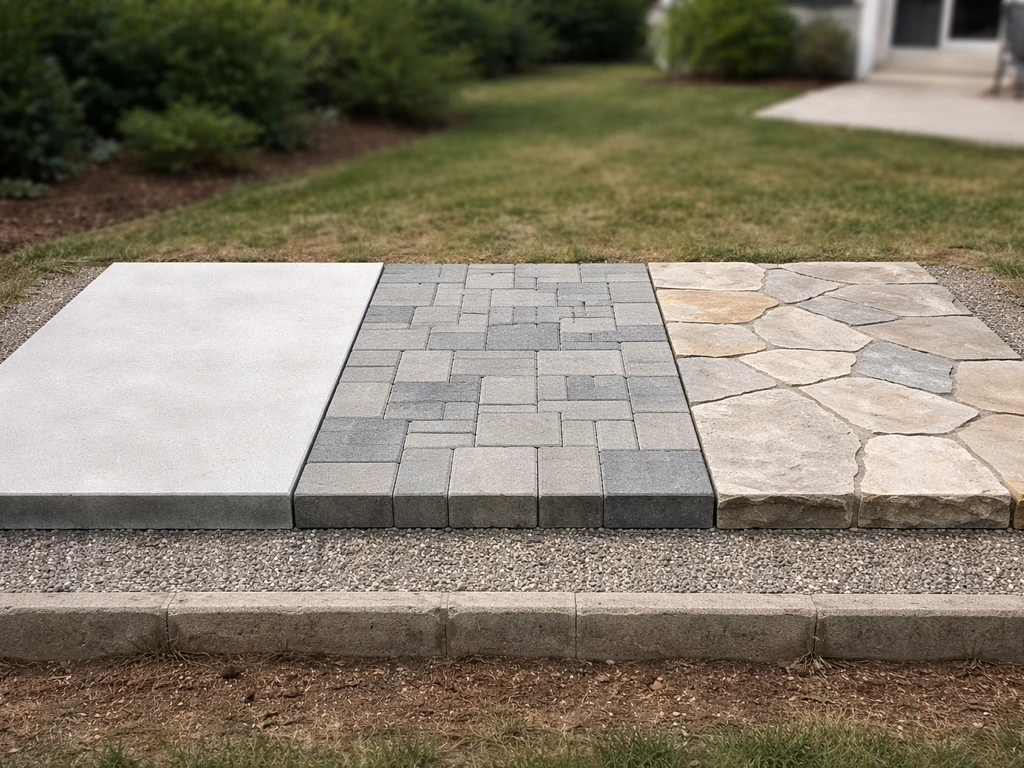
How Much Should I Expect to Pay for a Patio
Patio cost guide with real price ranges by size and material, full line-item budget, DIY vs install, and quote checklist