
Staining a concrete patio typically costs $2 to $10 per square foot installed, with most homeowners paying somewhere in the $3 to $6 range for a straightforward single-color acid or water-based stain with standard prep and a sealer coat. A basic 10x10 patio (100 sq ft) runs roughly $200 to $600 professionally done, a 12x12 (144 sq ft) lands around $290 to $865, and a 20x20 (400 sq ft) comes in at $800 to $2,400 for mid-range work. Custom multi-color designs, heavy surface repairs, or decorative scoring can push costs to $12 to $25 per sq ft for high-end projects.
How Much to Stain a Concrete Patio: Cost per sq ft & Budgets

Felix Carver
12 Aug 2026
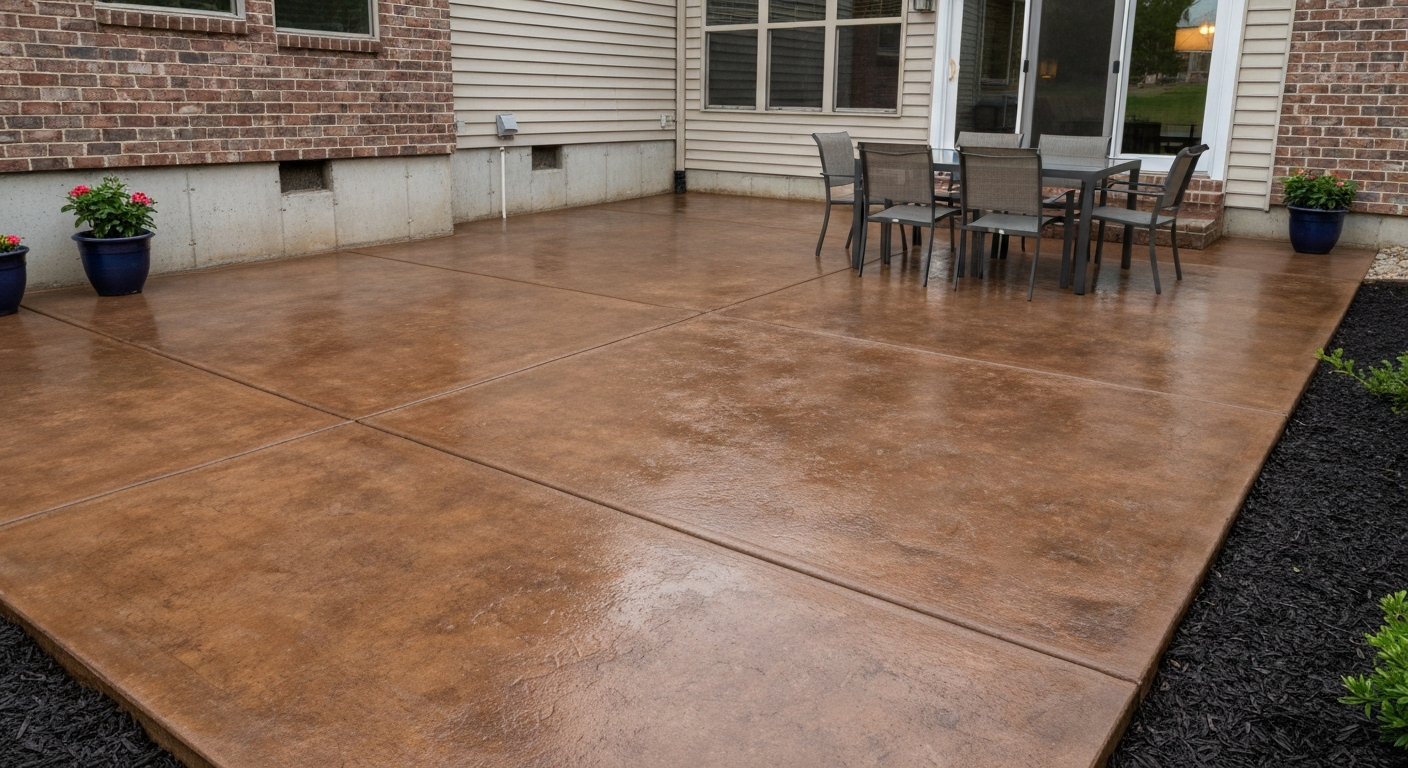
What this guide covers and how to use it
This guide breaks down the full cost of staining a concrete patio, from the stain itself to surface prep, sealing, and cleanup. You'll find per-square-foot ranges and sample budgets for the most common patio sizes, a side-by-side look at DIY versus hiring a contractor, and a regional pricing section so you can adjust those numbers for where you live. I'll also flag the hidden costs that trip up a lot of first-time DIYers, like acid-etching supplies, crack patching, and sealer recoat cycles. If you're still deciding whether to stain, paint, epoxy, or just start fresh with a new pour, I'll point out where those comparisons live so you can build a complete picture before you call anyone for a quote.
Quick cost answer: what you'll actually pay
Here's the fast version before we get into the details. These numbers assume a contractor-installed job on a patio in decent condition (no major cracking, no existing coating to remove), with one stain color, one coat of sealer, and standard pressure-wash prep. DIY costs are materials only and assume you're renting equipment you don't already own.
| Patio Size | Sq Ft | DIY Materials Est. | Pro Install (Basic) | Pro Install (Mid-Range) |
|---|---|---|---|---|
| 10x10 | 100 | $60–$150 | $200–$400 | $400–$700 |
| 12x12 | 144 | $85–$200 | $290–$575 | $575–$1,000 |
| 16x16 | 256 | $150–$350 | $510–$1,025 | $1,025–$1,800 |
| 20x20 | 400 | $230–$550 | $800–$1,600 | $1,600–$2,800 |
| 25x25 | 625 | $360–$850 | $1,250–$2,500 | $2,500–$4,400 |
These ranges use $2 to $4 per sq ft for basic professional work and $4 to $7 per sq ft for mid-range (multi-step prep, quality sealer, contractor labor at market rates). Aggregator data at Cost of Concrete Floor Coating (Fixr) report stain costs ranging broadly from $2 to $25 per sq ft depending on stain type, prep, and design. DIY estimates cover stain, sealer, and etching supplies but not a pressure washer rental, which typically adds $45 to $95 per day. Complex designs, heavily damaged slabs, or premium stain products can exceed these numbers significantly.
Full line-item cost breakdown
Understanding where the money actually goes helps you evaluate contractor quotes and identify where to cut if you're over budget. Here's what each line item typically costs and why.
Stain type and material cost
The stain itself is often one of the smaller line items in a professional job, but it varies a lot by product type. Water-based acrylic stains are the most budget-friendly, commonly running $20 to $40 per gallon at retail. Acid (reactive) stains produce that classic variegated, almost marbled look and cost more, with professional-grade products from manufacturers like Westcoat ranging from roughly $68 to $91 per gallon. Water-based dyes sit in the middle and offer the widest color range. At a typical coverage of 200 to 400 sq ft per gallon (varies with slab porosity), a 400 sq ft patio needs 1 to 2 gallons of stain, so material cost for the stain alone is roughly $40 to $180 depending on product.
| Stain Type | Typical Retail Price/Gal | Coverage (sq ft/gal) | Look/Result | Skill Level |
|---|---|---|---|---|
| Water-based acrylic | $20–$40 | 200–400 | Uniform, consistent color | Beginner-friendly |
| Acid (reactive) stain | $40–$91 | 150–400 | Variegated, marbled, earthy tones | Moderate |
| Water-based dye | $30–$60 | 200–350 | Broad color range, consistent | Moderate |
| Solid-color stain/tint | $25–$50 | 150–300 | Opaque, hides flaws | Beginner-friendly |
Surface prep: pressure washing and acid etching
Surface prep is where a lot of DIY projects go wrong and where professional costs add up fast. At minimum, the slab needs a thorough pressure wash to remove dirt, oils, and old residue. Contractors typically charge $0.25 to $0.45 per sq ft for pressure-wash work alone, or about $100 to $180 for a 400 sq ft patio. If you're renting a machine yourself, expect to pay $45 to $95 for a half-day or full-day residential unit.
Acid etching opens up the concrete's pores so the stain penetrates evenly. Muriatic acid solution or a phosphoric acid substitute runs $15 to $30 for a small patio. If the slab has an existing coating, paint, or heavy contamination, mechanical grinding is necessary. Handheld grinder rentals run $60 to $150 per day; walk-behind grinders rent for $95 to $250 per day. If a contractor handles mechanical profiling, budget an extra $1.50 to $6.00 per sq ft depending on the condition of the slab.
Crack patching and surface repair
Hairline cracks are common in outdoor concrete and most contractors will route and fill them before staining. Expect to pay $1 to $3 per linear foot for crack repair on top of the base staining price. Concrete patch products at retail run $10 to $25 per bag, but labor to properly prepare and fill cracks, feather edges, and let them cure adds time and cost. If your patio has significant structural cracking or spalling, get a realistic repair estimate before you commit to staining. Cosmetic staining won't hide a slab that needs major work.
Sealer cost
A sealer is not optional on an outdoor stained patio. Without it, the stain fades fast and the concrete absorbs moisture, stains from leaves, and damage from freeze-thaw cycles. Acrylic film-forming sealers like BEHR Premium Wet-Look (a 5-gallon pail runs about $189, or roughly $37.80 per gallon) provide a glossy appearance and cover around 200 to 300 sq ft per gallon on porous concrete. Penetrating silane/siloxane sealers like Foundation Armor SX5000 run about $65 per gallon or around $50 per gallon in a 5-gallon pail, with coverage of 175 to 400 sq ft per gallon. Penetrating sealers last 5 to 10 years outdoors; acrylic film sealers typically need recoating every 1 to 3 years, which matters a lot for your long-term maintenance budget.
Cleanup, masking, and disposal
Professional crews spend real time masking off house foundations, planters, and adjacent surfaces before applying acid stain or sealer, and neutralizing and disposing of acid rinse water properly. This is baked into contractor quotes but often surprises DIYers. Neutralizing solution (baking soda or a commercial neutralizer), extra plastic sheeting, and disposal of spent etching solution add a modest $20 to $60 in materials. Some municipalities require proper disposal of acid waste rather than rinsing it into storm drains, so check local rules before you start.
Primers
Most exterior acid and water-based stains don't require a primer, but water-based solid-color stains sometimes call for a concrete primer coat to improve adhesion, especially on slabs that have been previously sealed or painted. Primers run $20 to $45 per gallon and cover 200 to 400 sq ft per gallon. If your contractor's quote includes a primer line, ask whether it's genuinely needed for your slab condition.
Summary of line-item costs
| Line Item | DIY Cost (400 sq ft) | Pro Cost (400 sq ft) | Notes |
|---|---|---|---|
| Stain materials | $40–$180 | $40–$180 (materials) | Contractor markup may apply |
| Pressure washing | $45–$95 rental | $100–$180 labor | Or included in base price |
| Acid etching supplies | $15–$30 | $25–$60 labor+materials | More for mechanical grinding |
| Crack patching | $10–$50 | $50–$300+ | Depends on severity |
| Primer (if needed) | $20–$90 | $50–$150 | Not always required |
| Sealer materials | $45–$190 | $75–$200 (materials) | Type affects long-term cost |
| Sealer application labor | $0 (DIY) | $100–$400 | Per contractor quote |
| Cleanup and disposal | $20–$60 | Included in quote | Acid disposal rules vary |
| Tool/equipment rental | $60–$300 | N/A | Grinder, sprayer, roller |
Coverage rates and how to calculate how much stain you need
Getting the quantity right before you buy saves you a return trip and ensures you don't run out mid-project with a half-stained patio drying in the sun. The basic formula is simple: divide your square footage by the coverage rate on the product's TDS (technical data sheet), then round up to the next full gallon.
- Measure your patio length x width. Subtract any sections that won't be stained (built-in planters, fire pit pads, etc.).
- Find the coverage rate on your specific product's label or TDS, not a generic average. Acid stains typically cover 150 to 400 sq ft per gallon; water-based acrylics cover 200 to 400 sq ft per gallon depending on how porous your slab is.
- Divide your sq ft by the lower end of coverage to be safe. For a 400 sq ft patio at 200 sq ft/gal: 400 / 200 = 2 gallons minimum.
- For two coats (recommended with acid stain), double that figure: 4 gallons.
- Apply the same math to your sealer. A 5-gallon pail of acrylic sealer covering 1,000 sq ft handles a 400 sq ft patio in one coat with material left over. Two coats = two pails for large patios.
- Add 10% overage for irregular shapes, texture absorption, and small touch-ups.
Here's a practical example. You have a 20x20 patio (400 sq ft) and you've chosen a professional-grade acid stain rated at 200 sq ft per gallon. You plan two coats: 400 / 200 x 2 = 4 gallons of stain. At $70 per gallon, that's $280 in stain alone. For sealer, using a product with 250 sq ft/gal coverage for two coats: 400 / 250 x 2 = 3.2 gallons, round up to 4 gallons, costing roughly $140 to $220 depending on product. Total materials for stain and sealer: approximately $420 to $500 before prep supplies.
Cost examples by patio size
The table below shows realistic budget ranges for three common patio sizes. Assumptions: single stain color, standard slab in decent condition (minor cracking only), pressure wash and acid etch prep, one acrylic film sealer coat. Labor rates reflect national mid-range contractor pricing. DIY totals include stain, sealer, etching supplies, and one day of equipment rental but not your time.
| Patio Size | Sq Ft | DIY Materials + Rental | Pro Basic ($2–$4/sq ft) | Pro Mid-Range ($4–$7/sq ft) | Pro High-End ($12–$25/sq ft) |
|---|---|---|---|---|---|
| 10x10 | 100 | $75–$175 | $200–$400 | $400–$700 | $1,200–$2,500 |
| 12x12 | 144 | $100–$230 | $290–$575 | $575–$1,010 | $1,730–$3,600 |
| 20x20 | 400 | $230–$550 | $800–$1,600 | $1,600–$2,800 | $4,800–$10,000 |
| Per sq ft math | — | $0.75–$1.40/sq ft | $2.00–$4.00/sq ft | $4.00–$7.00/sq ft | $12.00–$25.00/sq ft |
High-end pricing applies to multi-color designs, decorative scoring or sawcut patterns, hand-applied antiquing effects, or slabs requiring significant mechanical prep and patching. For most homeowners refreshing a plain patio, the basic to mid-range column is the realistic target. Keep in mind that a 10x10 patio often has a higher effective per-square-foot rate than a 20x20 because setup, mobilization, and equipment costs are spread over fewer square feet.
Hiring a contractor vs. doing it yourself
What contractors charge and why
Labor is the dominant cost driver in a professionally stained patio. According to BLS occupational wage data, cement masons and concrete finishers earn median hourly wages ranging from roughly $23 per hour in lower-cost metros like Dallas-Fort Worth to $38 to $39 per hour in higher-cost markets like New York, Chicago, and San Francisco. When you add employer overhead, insurance, fuel, and markup, an installed labor rate of $35 to $75 per hour is common. For a straightforward 400 sq ft patio, a two-person crew can typically complete prep, stain, and seal in 6 to 10 hours total, translating to $420 to $1,500 in labor alone before materials.
Industry guidance from sources like This Old House shows that for a 500 sq ft patio, professional staining and sealing ranges from roughly $1,500 to $14,500 depending on complexity, which aligns with the per-square-foot bands above. Labor typically accounts for more than half of the total installed cost on decorative concrete jobs, which is why getting a couple of quotes matters more than trying to pinch pennies on stain product selection.
DIY cost and realistic time estimates
A DIY stain job on a 400 sq ft patio can realistically be done for $230 to $550 in materials and rentals, compared to $800 to $2,800 for a contractor. That's real savings, but the honest caveat is that acid staining is a one-way process. Once you apply it, you can't remove it if the result looks uneven or splotchy, which happens when prep is rushed or coverage is inconsistent. Water-based acrylic stains are more forgiving and better suited to a first-timer.
In terms of time, plan for two days minimum for a 400 sq ft patio: half a day for pressure washing and etching (with dry time), and a full day for staining, drying, and sealing. Factor in cure time before foot traffic, typically 24 to 48 hours for the sealer. If you hit a snag, like a slab that's absorbing stain unevenly, you'll need extra time to address it.
| Cost Category | DIY (400 sq ft) | Contractor (400 sq ft) | Notes |
|---|---|---|---|
| Stain material | $40–$180 | Included in sq ft price | Pro may use higher-end product |
| Sealer material | $45–$190 | Included in sq ft price | |
| Prep supplies (acid, neutralizer) | $25–$55 | Included | |
| Pressure washer rental | $45–$95 | N/A | Contractor owns equipment |
| Grinder rental (if needed) | $95–$250 | N/A | $1.50–$6.00/sq ft if contracted |
| Sprayer/roller/brushes | $20–$60 | N/A | |
| Labor cost | $0 (your time) | $420–$1,500+ | 6–10 hrs for 2-person crew |
| Total estimated | $230–$550 | $800–$2,800 | Basic to mid-range |
When to hire a pro vs. DIY
- Hire a contractor if your slab has significant cracks, spalling, or an existing coating that needs mechanical removal. A bad prep job ruins the final result and you can't undo it.
- DIY is realistic for water-based acrylic stains on a clean, uncoated slab in reasonable condition. The process is beginner-friendly compared to reactive acid staining.
- If you're going for an acid-stained look with multiple colors or decorative patterns, pay for a pro. The margin for error is low and an experienced applicator's results will look dramatically better.
- Always do a test patch in an inconspicuous corner first. Concrete slabs absorb stain differently in different sections due to mix variations, aggregate, and prior repairs.
Regional cost variations: why your quote might be higher or lower
Location is one of the biggest factors in your final cost and it's often underestimated. BLS occupational wage data for cement masons shows hourly mean wages ranging from roughly $22.86 per hour in the Dallas-Fort Worth metro to $38.63 per hour in New York and $37.76 per hour in San Francisco. When you convert those wages to fully loaded contractor rates including overhead and profit, the spread between a quote in Phoenix and one in Chicago or New York can easily be 30 to 60 percent for the same job.
| Region / Metro | BLS Hourly Wage (Cement Masons) | Approximate Loaded Labor Rate | Typical Per Sq Ft Adjustment vs. National Avg |
|---|---|---|---|
| Dallas-Fort Worth, TX | $22.86 | $40–$55/hr | 10–20% below national avg |
| Phoenix, AZ | $26.78 | $45–$62/hr | Near national avg |
| Chicago, IL | $36.97 | $60–$85/hr | 20–35% above national avg |
| Los Angeles, CA | $32.69 | $55–$75/hr | 15–25% above national avg |
| San Francisco, CA | $37.76 | $65–$90/hr | 30–45% above national avg |
| New York, NY | $38.63 | $65–$95/hr | 35–50% above national avg |
| Rural / small market | Varies (often lower) | $35–$50/hr | 15–30% below national avg |
Beyond wages, urban areas tend to have higher material delivery costs, stricter permit requirements, and more expensive insurance for contractors, all of which flow through to your quote. In some municipalities, a decorative concrete coating project can require a permit, particularly if it's connected to larger work like a new patio installation. If you're budgeting from scratch, check what local permitting might add before you get quotes.
Seasonality also plays a role. In colder climates, concrete staining is a spring-through-fall project, and demand peaks in late spring and early summer when contractors are busiest. Scheduling work in late summer or early fall can sometimes yield 10 to 15 percent lower pricing simply because crews have more availability. In hot, dry climates like the Southwest, avoid staining in peak summer heat: direct sun and high temperatures cause stain to dry too quickly and unevenly, causing lap marks that are very hard to fix.
Staining vs. other concrete patio finishes
Staining isn't your only option for refreshing a concrete patio, and whether it's the right call depends on your slab's condition and what look you're after. Painting concrete is cheaper upfront, often $1 to $3 per sq ft DIY, but concrete paint tends to peel, chip, and fade on outdoor surfaces faster than penetrating stains. For a direct comparison and budget guidance, see our guide on how much does it cost to paint a concrete patio which covers DIY and contractor pricing and long-term maintenance differences. Epoxy coatings are more durable and chemical-resistant, but they cost more, typically $3 to $12 per sq ft installed, and require meticulous surface prep to avoid delamination. If you're weighing epoxy, see our guide on how much does it cost to epoxy a patio for typical installed price ranges, prep requirements, and durability trade-offs. If your slab is in rough shape, it may be worth pricing out demolition and a new pour rather than spending money on a finish that will highlight the underlying problems. If your slab is in rough shape, it may be worth pricing out demolition and a new pour rather than spending money on a finish that will highlight the underlying problems, see our guide on how much to demo concrete patio for typical teardown and disposal costs. If you're considering replacement, see how much to pour patio for current pour-and-finish cost estimates.
Maintenance, lifespan, and long-term costs
One thing most homeowners don't factor in is the ongoing cost of maintaining a stained patio. The stain itself, once cured and sealed, is relatively permanent as long as the sealer holds up. The sealer is what degrades. Acrylic film-forming sealers used outdoors typically need recoating every 1 to 3 years depending on UV exposure, traffic, and climate. At roughly $37 to $55 per gallon for quality acrylic or penetrating sealers and a coverage rate of 200 to 300 sq ft per gallon, resealing a 400 sq ft patio yourself costs $60 to $150 in materials every year or two. Having a contractor do it adds labor of roughly $100 to $400 depending on the job.
Penetrating silane/siloxane sealers are worth the higher upfront cost (roughly $50 to $65 per gallon) if your patio is in a freeze-thaw climate or gets road salt exposure. They won't give you that wet-look gloss, but they protect the concrete itself for 5 to 10 years per application and you won't be resealing every spring. Factor resealing into your total cost of ownership when comparing staining to other finish options.
What to ask before you hire a contractor
A good quote should be itemized, not just a lump sum per square foot. Here are the questions worth asking every contractor before you sign anything.
- What does your surface prep process include, and is mechanical grinding or acid etching in the quote?
- What specific stain product and sealer are you using, and can I see the TDS for both?
- How do you handle cracks and chips? Is patching included or billed separately?
- How many coats of stain and sealer are included?
- What's the warranty on the work, and what voids it?
- Are you licensed and insured for decorative concrete work in this state?
- How do you handle cleanup of acid etching solution and sealer waste?
- Can I see photos or references for similar outdoor staining projects you've done in the last year?
Money-saving tips that actually work
- Get at least three quotes. Pricing for decorative concrete work varies more than most trades, and a 30 to 40 percent spread between quotes on the same project is not unusual.
- Do your own pressure washing. If you can clean the slab yourself the day before the contractor arrives, some crews will reduce the quote. Ask upfront.
- Choose water-based acrylic stain if you're DIYing. It's significantly more forgiving than acid stain and the color range has improved substantially in recent years.
- Buy a penetrating sealer even if it costs more upfront. Resealing every 1 to 2 years with an acrylic adds up faster than the one-time premium for a 7-year penetrating sealer.
- Bundle work if you can. If you're also having a contractor do other concrete work (a walkway, a garage floor), ask for a combined price. Setup and mobilization costs get spread across more square footage.
- Schedule in the off-peak season. Late August through October in most northern markets tends to be less competitive for contractor time.
- Don't skip the test patch, especially with acid stain. A $10 test in a hidden corner can save you from an expensive outcome on the full patio.
FAQ
What is a search‑friendly title and meta description for an article about staining a concrete patio?
Title: "How Much to Stain a Concrete Patio: Cost Per Sq Ft, Sample Budgets & DIY vs Contractor". Meta description (<=160 chars): "Estimate staining costs—per sq ft and by patio size—with materials, labor, regional variations, DIY vs pro, and maintenance expectations."
How much does it typically cost to stain a concrete patio per square foot?
Typical installed cost ranges reported by trade and consumer cost guides: low/basic jobs $2–$4/sq ft, mid‑range $4–$10/sq ft, and high‑end/custom decorative work $12–$25+/sq ft. These ranges reflect differences in surface prep, stain type (acid vs water‑based), design complexity, sealing, and local labor. Sources: Angi, HomeAdvisor, Concrete Network, Fixr.
What are example total costs for common patio sizes (10x10, 12x12, 20x20)?
Assumptions: patio square footage is width×length; cost bands as above. Example cost table (installed, includes prep and sealer): - 10×10 (100 sq ft): Low $200–$400, Mid $400–$1,000, High $1,200–$2,500+ - 12×12 (144 sq ft): Low $288–$576, Mid $576–$1,440, High $1,728–$3,600+ - 20×20 (400 sq ft): Low $800–$1,600, Mid $1,600–$4,000, High $4,800–$10,000+ Notes: Use these ranges to budget before getting quotes; actual bids will itemize prep, repairs, and sealer separately. Ranges based on aggregated consumer/trade guides (Angi/HomeAdvisor/Concrete Network/Fixr).
What line items should be in a stain‑a‑patio estimate (materials and labor)?
Typical contractor estimate line items: 1) Site protection/masking; 2) Pressure‑wash cleaning; 3) Mechanical profiling (grinding) or acid‑etching; 4) Crack/patch repairs and leveling (patch compounds, polymer-modified repair); 5) Stain materials (acid stains, water‑based, acrylic dyes) and primers if required; 6) Stain labor (application, drying time); 7) Sealer (type and coats) and sealer labor; 8) Cleanup and waste disposal; 9) Mobilization/travel. Labor often represents more than half of total installed cost for many jobs.
How do stain types, primers/etching, surface prep, sealing, and repairs affect cost?
Cost drivers and typical impacts: - Stain type: Acid/reactive stains and professional multi‑component systems cost more (materials $50–$120/gal for pro acid stains) and often require more labor for application than box‑store water‑based dyes ($10–$40/gal). Coverage varies (see coverage item). - Primers/etching: Acid‑etch or chemical prepare adds small material cost but can add labor/time; mechanical profiling (grinding) is pricier—budget ~$1.50–$6.00/sq ft for contractor grinding vs $0.25–$0.75/sq ft for acid‑etching if performed by pro. - Surface prep: Pressure washing rental $45–$95/day; contractor cleaning often charged per sq ft (~$0.15–$0.50/sq ft) or rolled into prep line item. - Sealing: Acrylic film sealers cost less upfront but need more frequent re‑application (every 1–3 years); penetrating silane/siloxane sealers cost more but last 5–10 years. Sealer material installed can range from ~$0.85–$7.00/sq ft depending on product and coats. - Repairs: Crack filling and patching vary—small hairline crack work may be $50–$200; larger leveling or significant spall repair can add hundreds to thousands depending on square footage and materials.
How many gallons of stain and sealer will I need (coverage & material quantities)?
Coverage varies by product and slab porosity. Manufacturer ranges: transparent/semi‑transparent acrylic stains ~200–400 sq ft/gal; acid/reactive stains commonly 150–400 sq ft/gal. Example conversions: - 100 sq ft: ~0.25–0.7 gal stain (round up to 1 gal for mixing/color consistency) - 400 sq ft: ~1–2.5 gal stain (2–3 gal recommended) Sealer coverage: acrylics and penetrating sealers list 175–1,500 sq ft per container depending on product and film vs penetrating type—consult TDS. Practical purchasing tip: always buy a little extra for test patches and touchups and to ensure batch/color consistency.
Next Articles
How Much to Pour Patio: Cost per Sq Ft & Project Estimates
Concrete patio costs: per sq ft and 10x10–20x20 ranges, full material & labor breakdown, DIY vs pro and regional tips.
Concrete Patio Permit Cost: Typical Fees, Tips & Timeline Guide
Concrete patio permit cost: typical fees, permit types, sample ranges for 10x10–20x20 patios, and budgeting steps.
How Much Does It Cost to Epoxy a Patio? Installed Pricing
Installed cost of epoxy patio floors, per sq ft ranges, prep and epoxy system factors, and example budgets for common si