
Laying patio slabs in the UK typically costs between £50 and £130 per m² fully installed, depending on the material you choose and your site conditions. For a straightforward 20 m² patio using concrete paving slabs, expect to pay roughly £1,000 to £1,500 all-in. Go for natural stone or slate and that same area can push £1,400 to £2,600 or more. Labour alone usually runs £30 to £50 per m² for a competent contractor, so the slabs themselves make up a meaningful chunk of your bill.
How Much Does It Cost to Lay Patio Slabs: Real UK Prices

Felix Carver
12 Jul 2026
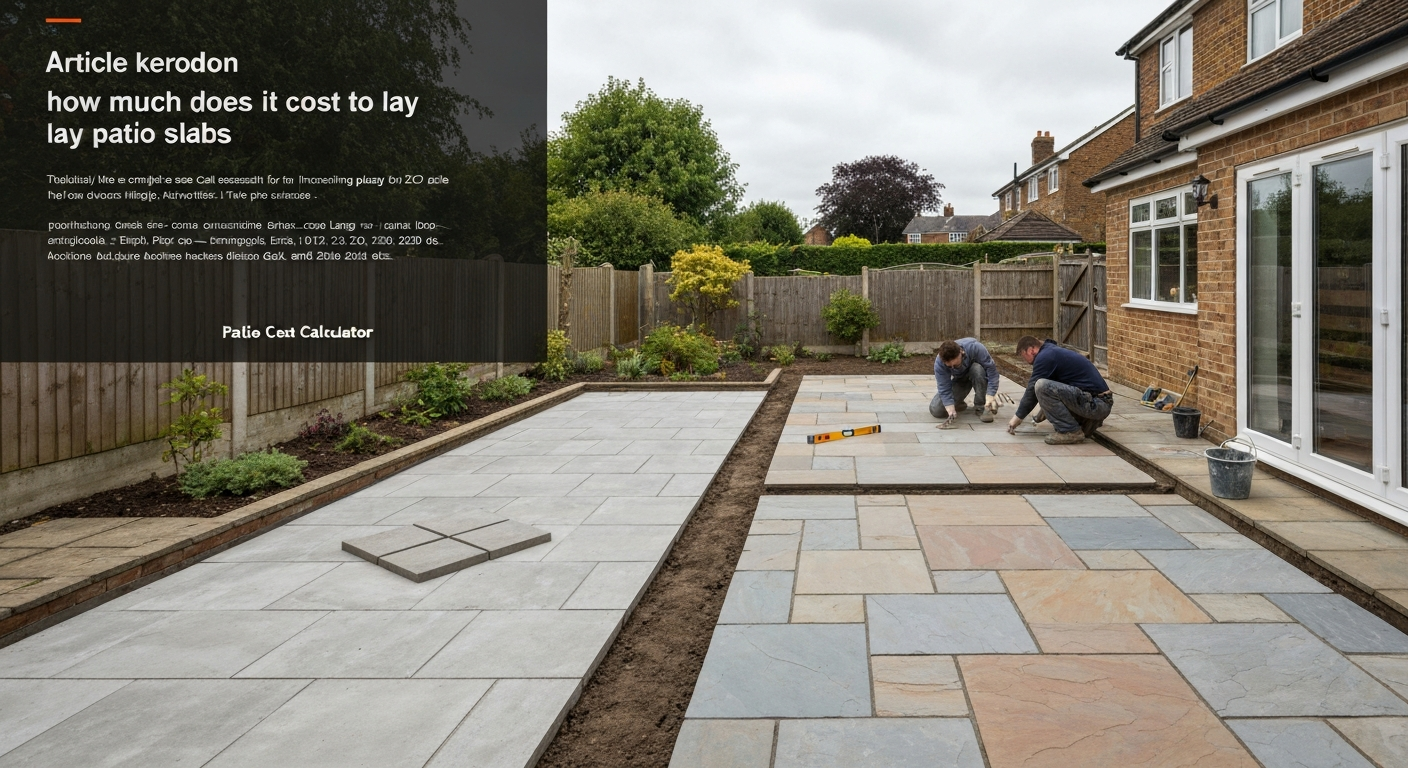
At a glance: what homeowners actually pay
Before diving into the detail, here is a quick snapshot of what different budgets get you. These are fully installed prices including excavation, sub-base, laying and pointing in typical UK conditions.
| Budget level | Material | Typical installed cost (per m²) | What to expect |
|---|---|---|---|
| Entry | Concrete paving slabs | £50–£75/m² | Solid, practical finish; wide colour/size choice |
| Mid-range | Porcelain patio slabs | £80–£120/m² | Low maintenance, great durability, premium look |
| Mid-range | Indian sandstone | £70–£110/m² | Natural look, popular choice; quality varies by grade |
| Premium | Natural slate / granite flagstone | £110–£170/m² | High-end finish; requires skilled installation |
| Premium | Stamped concrete | £90–£150/m² | Decorative, seamless surface; specialist installer needed |
Labour-only rates (where you supply the slabs yourself) sit at roughly £30–£50 per m² for straightforward work, rising to £35–£100 per m² for complex or premium materials. If you are comparing quotes and one contractor is significantly below these bands, ask them exactly what is included. Sub-base preparation, waste disposal and pointing are frequently left out of low headline prices.
Cost by material and patio size
The table below combines typical supply-only material costs with installed labour to give you realistic fully installed budgets across common patio sizes. All figures assume standard site conditions: reasonably level ground, no major drainage issues, and straightforward access. Slate is called out separately because supply costs are noticeably higher than other natural stones.
| Material | Supply only (per m²) | Installed total (per m²) | 10×10 ft (~9 m²) | 12×12 ft (~13 m²) | 20×20 ft (~37 m²) |
|---|---|---|---|---|---|
| Concrete slabs | £24–£30 | £50–£75 | £450–£675 | £650–£975 | £1,850–£2,775 |
| Porcelain slabs | £22–£29 | £80–£120 | £720–£1,080 | £1,040–£1,560 | £2,960–£4,440 |
| Indian sandstone | £19–£35 | £70–£110 | £630–£990 | £910–£1,430 | £2,590–£4,070 |
| Brick / clay paver | £25–£45 | £75–£120 | £675–£1,080 | £975–£1,560 | £2,775–£4,440 |
| Flagstone / granite | £30–£55 | £90–£140 | £810–£1,260 | £1,170–£1,820 | £3,330–£5,180 |
| Natural slate | £36–£55 | £110–£170 | £990–£1,530 | £1,430–£2,210 | £4,070–£6,290 |
| Stamped concrete | N/A (poured) | £90–£150 | £810–£1,350 | £1,170–£1,950 | £3,330–£5,550 |
A few notes on these numbers. The 10×10 ft and 12×12 ft sizes are common for smaller gardens and side returns. The 20×20 ft size is a popular full garden patio or entertaining area. All installed figures include a standard 100mm compacted Type 1 sub-base, mortar bedding and basic pointing. They do not include drainage works, removal of existing hard landscaping or unusually difficult ground conditions, which are dealt with separately below.
What each material actually costs per m²
Concrete paving slabs
Concrete slabs are the budget-friendly workhorse. Supply-only prices start at around £24 per m² for reconstituted paving at a retailer like B&Q, rising to £30 per m² for better-quality mid-range packs. Fully installed with labour, excavation and sub-base, budget £50–£75 per m². These slabs are easy to lay uniformly, which keeps labour time down. They fade over time and can look cheaper than natural stone, but for a practical back garden they do the job very well.
Concrete pavers and porcelain
Large-format porcelain patio slabs from retailers like B&Q typically cost £22–£29 per m² in supply-only packs, but the installation cost is higher than concrete because porcelain is brittle, needs precise bedding and cuts require a specialist blade. Fully installed, expect £80–£120 per m². Porcelain is genuinely low maintenance, frost-resistant and looks sharp, so the extra spend can be worth it if you want a clean modern aesthetic.
Indian sandstone and natural stone
Indian sandstone is arguably the most popular natural stone choice in the UK right now. Supply-only packs from online specialists start at around £19–£20 per m² for entry-grade stone, but quality varies enormously. Better-grade calibrated sandstone (consistent thickness, which makes laying faster and more accurate) runs £28–£40 per m² supply-only. Fully installed, budget £70–£110 per m² depending on grade and the complexity of the laying pattern.
Brick and clay pavers
Brick and clay pavers sit in the £25–£45 per m² supply range and are labour-intensive to lay because of their small individual format. You are placing far more units per square metre than with a large-format slab, which pushes labour time up. Fully installed expect £75–£120 per m². They are extremely durable and individual bricks can be replaced easily, which is a genuine long-term advantage.
Flagstone and granite
Premium flagstone and granite materials run £30–£55 per m² supply-only, with fully installed costs landing at £90–£140 per m². These tend to be heavy materials requiring careful handling and skilled laying, particularly for irregular flagstone where fitting and cutting takes significant time.
Natural slate
Slate is the most expensive option in this group. Brazilian slate supply-only runs around £36 per m² from specialist suppliers, with higher-grade products pushing £55 per m² or more. The Marshalls natural stone product range starts from about £30 per m² for entry-level products and rises to over £60 per m² for premium lines. Installed costs typically land between £110 and £170 per m² once you account for skilled labour, careful bedding and the higher wastage that comes with natural cleft material. For more detail on slate-specific pricing, the slate patio cost guide on this site covers it in depth.
Stamped concrete
Stamped concrete is a poured and textured surface rather than individual slabs. It requires a specialist installer with the right tools and experience. Fully installed costs typically run £90–£150 per m². It is seamless and can mimic stone or brick patterns convincingly, but repairs are harder to disguise than with slabs if cracking occurs later.
Labour costs: what you pay a contractor
Labour is often the part of a quote homeowners have the least visibility on. Here is how the numbers actually break down in 2026.
Landscaper and groundworker hourly rates in the UK currently sit at roughly £25–£45 per hour, which translates to day rates of around £180–£340 per day. Most contractors will quote per square metre rather than per day for patio work, because it makes their risk more predictable. Labour-only rates for straightforward slab-laying run £30–£50 per m². For complex materials like natural slate, irregular flagstone or intricate brick patterns, labour-only can reach £50–£100 per m² because of the additional time, skill and cutting involved.
| Work type | Labour-only rate | Typical day rate basis |
|---|---|---|
| Concrete slab laying (standard) | £30–£45/m² | 1 installer can lay ~8–12 m²/day |
| Porcelain slab laying | £40–£55/m² | Slower cutting, precision bedding |
| Natural stone (Indian sandstone) | £40–£60/m² | Calibration and cutting add time |
| Slate / premium irregular stone | £50–£100/m² | Skilled work, higher wastage |
| Brick / small-format paver laying | £45–£65/m² | High unit count per m² |
| Full install (all-in: prep + lay + point) | £65–£130/m² | Includes sub-base and waste removal |
If you are comparing labour-only quotes, the patio labour-only guide on this site goes into detail on what that contract should and should not include. For a focused breakdown of labour-only prices and what to include, see our how much to lay a patio labour only guide. For full UK pricing context including what different regions charge, the how much to lay a patio UK guide has worked regional examples. See the how much to lay a patio UK guide for regional price examples and detailed nationwide cost breakdowns. For full UK pricing, regional examples and step-by-step cost breakdowns, see our guide on how much does it cost to lay a patio.
Regional price differences across the UK
Where you live has a genuine impact on what you pay. London and the South East consistently run 25–35% above national average rates for landscaping labour. That means a job priced at £60 per m² installed in the Midlands or North could easily be quoted at £75–£80 per m² in London. Waste disposal also costs significantly more in London: a builders skip that might cost £190–£280 per week in the North or Midlands can run £350–£450 per week in Greater London.
| Region | Labour rate adjustment vs. national average | Full install (concrete slabs) indicative range |
|---|---|---|
| London and South East | +25–35% | £65–£100/m² |
| South West | +5–15% | £55–£85/m² |
| Midlands | Broadly average | £50–£75/m² |
| North West / North East | -5–10% | £45–£70/m² |
| Scotland / Wales | -5–10% | £45–£70/m² |
These are indicative adjustments. Rural areas can sometimes see higher prices not because labour rates are elevated but because travel time and minimum job costs push totals up. Always get at least three local quotes before committing, since regional competition and contractor workload affect pricing more than any table can capture.
Every cost driver explained
The per-m² figures above cover standard conditions. Here is what can push your project beyond those ranges, with typical unit costs for each element.
Site clearance and topsoil strip
Clearing vegetation, removing turf and stripping topsoil typically costs £4–£14 per m² depending on how much material needs to go and how it will be removed. Build‑Estimate's Groundworks Cost Ranges UK 2026 | Build‑Estimate (groundworks estimator) lists site clearance/topsoil strip at ~£4–£14/m², bulk excavation at ~£18–£40/m³ and underground drainage pipework at £55–£130 per linear metre. If the contractor is hand-digging a small area it is usually bundled into the day rate. For larger areas where a mini-digger is needed, digger hire runs £80–£240 per day for machine-only, or £220–£320 per day extra if you need an operator included.
Excavation depth
For a domestic patio you need to excavate for the sub-base, bedding layer and slab thickness. The typical total excavation depth is 150–200mm. Bulk excavation by machine is typically benchmarked at £18–£40 per m³ for contractor rates, but on most domestic jobs this cost is wrapped into the overall quote rather than broken out separately.
Sub-base (MOT Type 1)
A properly compacted sub-base is non-negotiable for a patio that does not sink or rock. The standard for domestic patios is 100mm of compacted MOT Type 1 crushed aggregate, sometimes increased to 150mm on softer ground. MOT Type 1 currently costs roughly £35–£55 per tonne in trade supply. At 100mm compacted depth, one tonne covers approximately 5–6 m², so a 20 m² patio needs around 3.5–4 tonnes just for the sub-base, at a material cost of roughly £125–£220. This is a real cost that cheap quotes sometimes skip or underspecify.
Edging and restraints
Edging prevents slabs from creeping over time. Simple concrete haunching (poured behind the edge slabs) is inexpensive and usually included in a standard quote. If you want visible kerb stones or a formal edging detail, professionally installed precast kerb runs are typically budgeted at £60–£100 per linear metre installed. Simple haunch-only edging runs £10–£25 per linear metre.
Drainage
Patios must drain away from the house. A standard fall of 1:60 (roughly 15mm drop per metre) is usually achievable with careful grading and is included in a competent install. If you need channel drainage, soakaway installations or underground pipework, costs jump significantly. Underground drainage pipework is typically priced at £55–£130 per linear metre installed, so even a short drainage run adds several hundred pounds to the budget.
Levelling and ground conditions
Sloping ground, soft spots, clay subsoil or tree root intrusion all add time and cost. If your garden slopes significantly, you may need retaining elements or extra fill, which contractors typically quote as a variation once they have seen the site. This is one of the most common reasons an initial quote increases once work starts.
Removal and disposal of spoil
Excavation creates spoil that has to go somewhere. A skip hire for a builders 6–8 yard skip runs £190–£450 per week in 2026 depending on region, with London at the top of that range. Checkatrade's Skip Hire Prices: Cost Breakdown 2026 | Checkatrade (skip guide) lists typical weekly UK prices for a builders (6–8 yd) skip at about £190–£450, with higher rates in London and the South East. A 20 m² patio excavation to 150mm depth generates roughly 3 m³ of spoil, which typically fills one midi skip. Factor this in from the start; it is often excluded from low headline quotes.
Waste allowance on materials
Always order 10–15% more material than your net area measurement. Cutting at edges, breakages and pattern offcuts mean you will lose material. With irregular natural stone like slate or flagstone, bump that to 15–20%. Contractors will factor this into their material cost, but if you are supplying slabs yourself make sure you have ordered enough before work starts.
Sealing
Not all slabs need sealing, but natural stone and sandstone benefit from it to prevent staining and algae. Sealing a patio as part of the install typically adds £3–£8 per m² to the cost, depending on the sealer used and the number of coats. Some contractors include one coat in their price; others quote it separately.
Pointing and mortar
Joints between slabs need to be filled to prevent weed growth, water ingress and slab movement. Standard sand and cement pointing is usually included in a full-install quote. Brush-in polymeric jointing compound (more durable and weed-resistant) costs more: budget an extra £2–£5 per m² if you want this upgrade. If a quote does not mention pointing, ask specifically what they are planning to use.
Access and complexity
Difficult access (narrow side gates, steps down to the garden, long wheelbarrow runs) adds time and therefore cost. Most contractors add a 10–20% complexity uplift for difficult-access sites. Intricate laying patterns (herringbone, diagonal, circular) also take longer and will be reflected in higher per-m² rates.
How contractors calculate your quote
Understanding how a quote is built helps you evaluate whether one is complete or suspiciously cheap. Here is the typical process a contractor goes through.
- Measurement: the installer measures the net area in m², then adds a waste allowance (typically 10–15% for regular slabs, 15–20% for irregular stone or complex patterns) to get the gross material quantity to order.
- Material cost: supply-only cost per m² multiplied by the gross quantity, plus delivery charges if not included.
- Labour time estimate: based on m² per day productivity for that specific material and pattern. Standard concrete slabs allow 8–12 m² per installer per day. Complex natural stone or intricate patterns might be 4–6 m² per day.
- Sub-base and prep materials: MOT Type 1 quantity calculated from area and depth, plus sharp sand for bedding, cement for mortar and jointing materials.
- Waste disposal: skip size and hire duration estimated based on excavation volume.
- Overheads and margin: most small contractors add 15–25% for business costs, insurance, tools and profit margin.
- Contingency: a reputable contractor will flag potential extras upfront (drainage, unusual ground conditions, access difficulties) and either include an allowance or note them as possible variations to be agreed if encountered.
When you receive a quote, check it explicitly mentions: excavation and disposal, sub-base specification (depth and material), bedding method, pointing material, any edging, and what happens if unexpected ground conditions are found. A quote missing any of these is incomplete, even if the headline price looks attractive.
What to ask before accepting a quote
- Does the price include excavation and spoil removal, or is skip hire separate?
- What depth and material is the sub-base? (100mm compacted Type 1 is the minimum standard for a domestic patio)
- Is the mortar bed included, and what mix specification will you use?
- What jointing/pointing method and material will you use?
- Is edging/restraint haunching included?
- How will the patio drain, and is a fall incorporated into the design?
- Does the price include sealing, or is that a separate cost?
- What is your policy if you encounter unexpected ground conditions or obstructions?
- Are you insured for public liability, and can I see evidence?
- What is the payment schedule, and do you offer a defects period or workmanship guarantee?
DIY vs. hiring a contractor
If you have the time and confidence, DIY patio laying can save you £30–£50 per m² in labour. On a 20 m² patio that is a £600–£1,000 saving. But the savings come with real trade-offs. Getting the sub-base compaction right requires plate-compactor hire (around £60–£100 per day). Setting accurate falls for drainage takes patience and the right tools. Natural stone in particular requires precise bedding to avoid lippage (edges that catch your feet). If you are tackling concrete or reconstituted slabs on a flat, well-prepared area, a competent DIYer can achieve a good result. For porcelain (which chips if improperly supported) or irregular stone, most people find the cost of a professional re-lay after a failed attempt exceeds the original labour saving.
One often-overlooked point: professional installers can sometimes source materials at trade prices 10–20% below retail, which partially offsets the labour cost if you supply materials yourself from a retail source.
Patio slabs vs. a deck: a quick cost comparison
Homeowners sometimes weigh up a paved patio against a timber or composite deck. As a rough guide, a standard softwood deck costs £80–£130 per m² installed, which overlaps with mid-range patio slab pricing. Composite decking sits higher at £120–£200 per m² installed. The key differences are ongoing maintenance (timber decks need annual treatment; stone patios need very little), longevity (stone patios routinely last 20–30 years with minimal attention) and suitability (decks work well on sloping ground where excavation for a level patio would be very expensive). If your ground is reasonably level, a stone patio almost always offers better long-term value per pound spent.
Your pre-quote budgeting checklist
Before you request quotes, work through these steps so you can compare what contractors are actually offering rather than comparing apples with oranges.
- Measure your intended patio area accurately in m² and note the shape (rectangular areas are quickest to quote; irregular shapes add cutting time).
- Decide on your material shortlist: pick two or three options you would be happy with so contractors can quote like-for-like.
- Check your site: note access constraints, any slope, proximity to the house, and whether any existing hard landscaping needs removing.
- Use the Patio Cost Calculator on this site to generate a benchmark budget for your area and material choice before any contractor visit.
- Request at least three written quotes, all specifying the same scope (material, sub-base depth, pointing type, waste disposal).
- Add a 10–15% contingency to your budget for unforeseen groundworks or material overruns.
- Confirm whether you need planning permission or building regulations sign-off (patios under 5 m² or using permeable materials generally do not require permission, but check for listed buildings or conservation areas).
FAQ
How much does it typically cost to lay patio slabs per square metre (installed)?
Installed cost ranges vary by material and complexity. Typical UK full-installed ranges (including excavation, Type 1 sub-base, laying and pointing) in 2026: concrete paving slabs £50–£75/m²; porcelain £80–£120/m²; Indian sandstone/natural stone £70–£130/m²; premium slate/granite flagstone £110–£170/m². Lower-end figures assume straightforward access and minimal groundworks; upper-end figures include harder-to-lay natural stone, heavy groundwork or specialist finishes.
What are realistic supply-only material costs per m² for common patio materials?
Supply-only retail examples (UK, 2026) give approximate material bands: concrete/reconstituted paving slabs ≈ £22–£30/m²; mid-range porcelain ≈ £22–£29/m²; entry-level Indian sandstone ≈ £19–£30/m²; natural stone ranges ≈ £30–£63+/m² depending on product; Brazilian/quality slate ≈ £36+/m². These are merchant retail pack prices; premium or rare stones cost more.
What are typical labour-only rates for laying patios?
UK labour-only benchmarks (2026): most landscapers/groundworkers quote roughly £30–£50/m² for straightforward laying only. Day and hourly profiles: landscaper rates ≈ £25–£45/hr or ≈ £180–£340/day; London/South East commonly 25–35% higher. Some installers quote labour combined with consumables — always check what’s included.
How do installers calculate a patio quote (main components)?
Installers generally break a quote into: site preparation (clearance, excavations), sub-base supply & compaction (Type 1), bedding layer (sand/cement or mortar), laying/levelling slabs, pointing/sealing, edging/restraint, drainage works (if needed), waste removal/skip hire, and labour. Quotes often show per-m² line items plus fixed costs (access charges, machine hire). Suppliers convert volumes (excavation m³) into material quantities (tonnes of Type 1) and add labour/day rates.
What are the primary cost drivers I should expect?
Main cost drivers: material type and quality (concrete, porcelain, sandstone, slate), ground condition (soft/poor ground increases excavation), sub-base depth required (100mm typical minimum), site accessibility (narrow access raises labour and time), drainage needs, slope/levels and levelling, edging/restraint type, removal and disposal of existing surface, skip/plant hire, and local labour rates (region).
Can you give worked examples for common patio sizes (10x10, 12x12, 20x20 ft) including installed cost bands?
Worked UK examples (rounded) — assume typical suburban conditions, standard Type 1 sub-base (100mm), standard edging and straightforward access: - 10ft x 10ft (≈9.3 m²): Concrete slabs installed ≈ £470–£700 total; Porcelain ≈ £750–£1,120; Natural stone ≈ £650–£1,210; Slate/premium ≈ £1,020–£1,580. - 12ft x 12ft (≈13.3 m²): Concrete ≈ £665–£1,000; Porcelain ≈ £1,060–£1,600; Natural stone ≈ £930–£1,730; Slate ≈ £1,460–£2,270. - 20ft x 20ft (≈37.2 m²): Concrete ≈ £1,860–£2,790; Porcelain ≈ £2,980–£4,460; Natural stone ≈ £2,600–£4,840; Slate ≈ £4,100–£6,320. Notes: ranges reflect variation in material, labour and extra works (drainage, steep gradients). Smaller projects often have higher per‑m² fixed-cost impact.
Next Articles
How Much to Lay a Patio in the UK Cost Guide
UK patio cost guide with labour, base, materials and extras, plus prices per m², size examples and quote questions.
How Much to Lay a Patio Labour Only Cost Guide
Labour only patio costs, what’s included, typical rates by patio type and size, plus quote tips to avoid hidden charges.
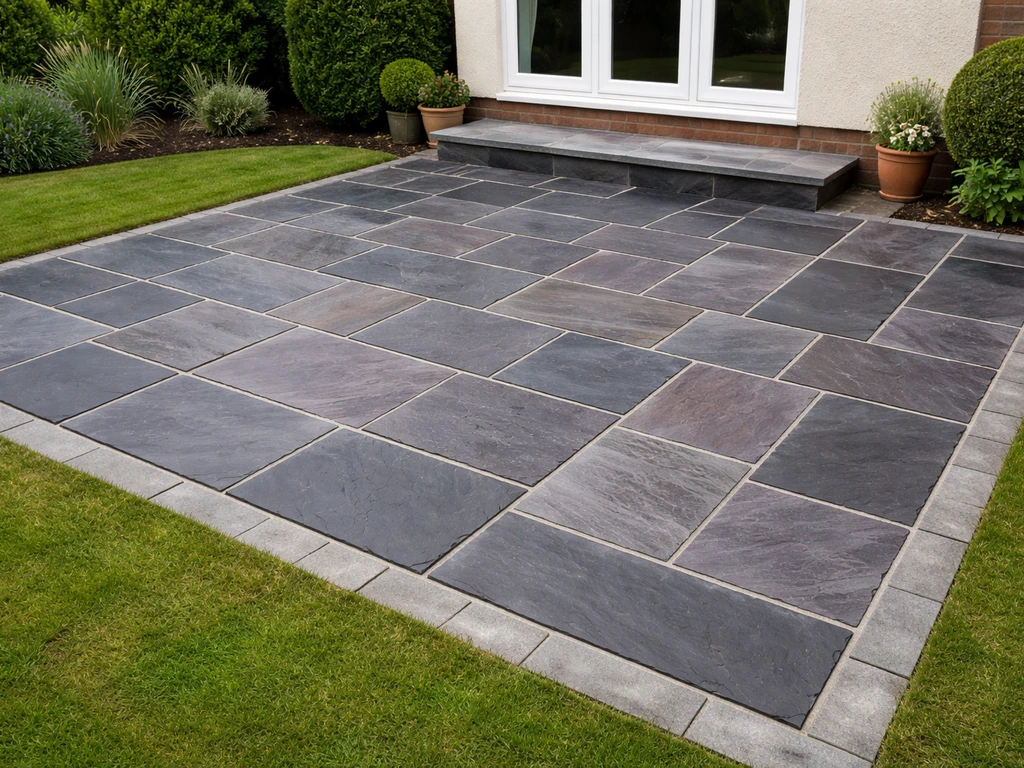
How Much Does a Slate Patio Cost? Installed Prices by Size
Installed slate patio cost guide with per-sq-ft ranges, example budgets, and checklist to compare materials and quotes.