
For most standard backyard projects, a paver patio is cheaper to build than a deck. For a focused cost comparison, see is it cheaper to lay a patio or decking. Installed paver patios typically run $8–$25 per square foot, while a pressure-treated wood deck usually costs $15–$45 per square foot installed, and composite decks can hit $35–$80 per square foot. On a common 12x12 (144 sf) project, that gap can mean $1,150–$3,600 for a basic paver patio versus $2,160–$6,480 for a pressure-treated deck before railings, stairs, or permits are added. The delta widens considerably at larger sizes. That said, your actual cheapest option depends on your site, local labor rates, the materials you choose, and whether you DIY any portion of the work.
Is It Cheaper to Build a Deck or Paver Patio? Cost Guide

Felix Carver
14 Jul 2026
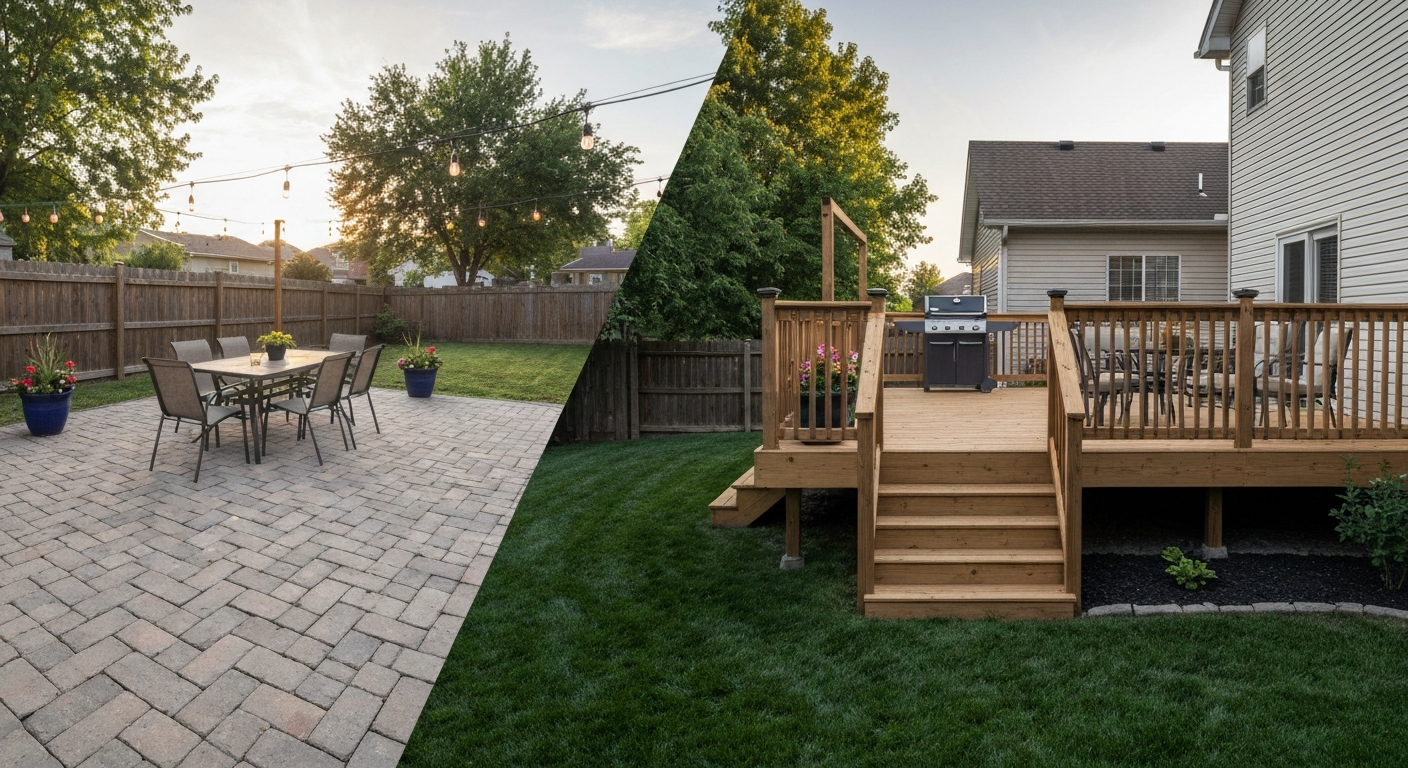
What affects the final cost: the key factors to consider
The price difference between a deck and a paver patio is not fixed. Several variables move the needle significantly, and understanding them before you get quotes saves you from sticker shock later.
- Site conditions: Flat, level ground dramatically reduces both paver and deck costs. A sloped yard typically requires more base excavation for a patio or taller posts and beams for a deck, both adding labor and material costs.
- Material choice: Pressure-treated wood, composite, concrete pavers, clay brick, natural flagstone, and gravel all carry very different per-square-foot price tags.
- Size: Larger projects lower your per-square-foot cost through labor efficiency, but the total bill rises quickly.
- Elevation: A ground-level deck is far cheaper than a raised deck requiring footings, posts, beams, and code-required railings.
- Frost depth: In northern states, deck footings must reach 48–60 inches below grade. That excavation and concrete cost adds up fast and does not apply to paver patios.
- Permits: Most jurisdictions require permits for decks attached to the house. Many ground-level patios skip the permit step entirely, saving $100–$500 or more.
- Complexity: Curves, multiple levels, built-in seating, lighting, and drainage features all add cost to either option.
- Labor market: Contractor rates vary by 30–50% between rural Midwest markets and coastal metros. Seasonal demand also affects pricing.
Head-to-head comparison: decks vs. paver patios
Before diving into specific price tables, here is a broad side-by-side comparison across the dimensions that matter most to a homeowner making a budget decision.
| Factor | Paver Patio | Wood Deck (PT) | Composite Deck |
|---|---|---|---|
| Typical installed cost (per sf) | $8–$25 | $15–$45 | $35–$80 |
| Material-only cost (per sf) | $3–$12 (concrete pavers) | $2–$5 | $12–$22+ |
| Labor-only cost (per sf) | $5–$20 | $15–$35 | $15–$35 |
| Permit usually required? | Often not (ground-level) | Yes (attached/raised) | Yes (attached/raised) |
| Frost footings required? | No | Yes (frost-depth dependent) | Yes (frost-depth dependent) |
| Typical lifespan | 25–50+ years | 10–20 years | 25–30+ years |
| Annual maintenance cost | $0–$200 (re-sanding/sealing) | $200–$600 (staining/sealing) | $50–$150 (cleaning) |
| Best for sloped yards? | Moderate slope only | Yes (elevated options) | Yes (elevated options) |
| DIY-friendly? | Yes (base prep is key) | Moderate (framing skill needed) | Moderate (framing skill needed) |
| Resale value (Cost vs. Value 2025) | Good | Wood deck recoups ~65–70% | Composite recoups ~68–73% |
Paver patios hold a clear cost advantage at the install stage for flat or gently sloped sites. Decks earn their higher price tag when the yard is significantly elevated above grade, or when you need the space beneath the deck for storage or drainage clearance. Composite decks close some of the long-term maintenance cost gap with pavers, but their higher upfront price rarely makes them the budget-conscious choice.
Real-world price ranges by material and size
The tables below use the installed cost ranges drawn from national contractor and aggregator data for 2025–2026. These assume professional installation on a relatively flat site, no major drainage issues, and standard complexity. Your actual quotes may fall anywhere within these ranges depending on region and contractor.
Paver patio installed cost by size and material
| Size (sf) | Concrete Pavers ($8–$18/sf) | Clay Brick Pavers ($12–$22/sf) | Natural Flagstone ($20–$50/sf) |
|---|---|---|---|
| 10x10 (100 sf) | $800–$1,800 | $1,200–$2,200 | $2,000–$5,000 |
| 12x12 (144 sf) | $1,150–$2,590 | $1,730–$3,170 | $2,880–$7,200 |
| 16x20 (320 sf) | $2,560–$5,760 | $3,840–$7,040 | $6,400–$16,000 |
| 20x20 (400 sf) | $3,200–$7,200 | $4,800–$8,800 | $8,000–$20,000 |
Deck installed cost by size and material
| Size (sf) | Pressure-Treated Wood ($15–$45/sf) | Composite ($35–$80/sf) |
|---|---|---|
| 10x10 (100 sf) | $1,500–$4,500 | $3,500–$8,000 |
| 12x12 (144 sf) | $2,160–$6,480 | $5,040–$11,520 |
| 16x20 (320 sf) | $4,800–$14,400 | $11,200–$25,600 |
| 20x20 (400 sf) | $6,000–$18,000 | $14,000–$32,000 |
For a 16x20 project, Remodeling Magazine's 2025 Cost vs. Value data puts the national median professionally installed wood deck addition at $18,263 and a composite deck at $25,096. Those figures align with the upper-mid range of the table above and include typical footings, framing, and basic railings, which is a realistic picture of what a complete job actually costs.
Line-item cost breakdown
Whether you are building a deck or a paver patio, the total cost is an accumulation of smaller line items that many contractors bundle into a single square-footage quote. Breaking them apart helps you compare bids accurately and spot what has been left out.
Paver patio line items
| Line Item | Typical Cost | Notes |
|---|---|---|
| Site excavation and grading | $1–$3/sf | More if significant slope or root removal needed |
| Base material (crusher-run/road base) | $30–$50/cubic yard delivered | About 1 cubic yard per 80–100 sf at 4-inch depth |
| Bedding sand (washed) | $30–$70/cubic yard | 1-inch layer standard; roughly 0.3 cy per 100 sf |
| Geotextile fabric | $0.20–$1.50/sf | Separates base from subgrade; prevents settling |
| Paver materials | $3–$30/sf (material only) | Varies widely by type: concrete, brick, flagstone |
| Edging/edge restraints | $1–$3/lf | Plastic or aluminum banding around perimeter |
| Drainage (gravel trench/channel drain) | $200–$800 | Only needed if site has water pooling issues |
| Labor (laying pavers) | $5–$20/sf | Pattern complexity and cuts increase cost |
| Polymeric sand (joint fill) | $0.20–$0.50/sf | Adds stability; reduces weeds and ant intrusion |
| Permits | $0–$300 | Most ground-level patios do not require permits |
| Lighting (optional) | $200–$1,500+ | Low-voltage in-ground or step lighting |
Deck line items
| Line Item | Typical Cost | Notes |
|---|---|---|
| Footings (concrete/excavation) | $300–$2,000+ | Cost rises sharply with frost depth and number of footings |
| Posts and beams (framing lumber) | $1–$3/sf | Pressure-treated; varies with deck height |
| Joists and blocking | $1–$2/sf | Structural framing on which decking sits |
| Decking boards (surface) | $2–$5/sf (PT) or $12–$22/sf (composite) | Material only; composite runs 3–5x pressure-treated cost |
| Ledger board and flashing | $150–$400 | Needed for house-attached decks; flashing prevents rot |
| Railings | $150–$600/lf (composite/metal) | Required by code for decks over 30 inches above grade |
| Stairs | $500–$2,000 per staircase | Depends on rise/run, material, and railing complexity |
| Labor (framing and decking) | $15–$35/sf | Labor-only portion of the total installed cost |
| Permits and inspections | $100–$500 | Most decks attached to the house require permits |
| Lighting and electrical | $300–$2,000+ | Low-voltage post-cap lights or wired overhead |
| Sealing/staining (wood only) | $150–$500 at install | Initial treatment; then recurring every 1–3 years |
Footings are one of the biggest hidden cost drivers for decks that rarely show up in a per-square-foot headline quote. In northern states where frost depth runs 48–60 inches (Michigan, Minnesota, Wisconsin, upstate New York), a 16x20 deck might need six to eight footings dug and poured to that depth. That excavation and concrete work alone can add $1,500–$3,500 to the project before a single board is nailed.
The cheapest patio and deck options explained
If budget is the primary driver, there are entry-level options for both decks and patios worth understanding before you commit to a material.
Cheapest patio options
A basic poured concrete patio is typically the cheapest professionally installed patio surface, running roughly $6–$12 per square foot installed for a plain broom-finish slab. If you want a quick answer to what is the cheapest patio to install, poured concrete and gravel are the top options to consider. Gravel or decomposed granite patios are even cheaper at $1–$4 per square foot installed and can be a legitimate DIY weekend project for a 10x10 or 12x12 area. For a more finished look without the full paver price tag, concrete pavers from big-box stores (basic 12x12 squares at roughly $3–$5 per square foot material-only) installed on a properly compacted base sit right in the middle of the cost spectrum. These are the options worth exploring when budget is tight. If you're considering decking a patio instead, see our guide on how much to deck a patio for cost comparisons and planning tips. For more detail on low-cost surfaces and DIY options, see our guide on what is the cheapest patio to build. For step-by-step guidance, see our guide to the cheapest way to do a patio.
Cheapest deck option: pressure-treated wood
Pressure-treated (PT) lumber is the starting point for budget deck builds. At $2–$5 per square foot for decking boards (material only) and a total installed range of $15–$45 per square foot, it is the most affordable conventional deck material. PT wood does require regular maintenance: plan to clean and reseal or stain every 1–3 years, with annual costs of roughly $200–$600 depending on deck size. The tradeoff for that low upfront price is ongoing time and money. A basic PT deck on a flat site with minimal railings is where the deck cost floor sits.
DIY vs. hiring a contractor: time, labor hours, and real cost trade-offs
Labor typically accounts for 40–60% of the total installed cost on both decks and paver patios. National labor-rate guidance (aggregators 2025–2026) reports general deck-construction labor is often quoted at $15–$35 per square foot and paver-laying labor at $5–$20 per square foot, see How Much Does It Cost to Build a Deck?, Angi (labor breakdown) How Much Does It Cost to Build a Deck? — Angi (labor breakdown). That means DIY can theoretically cut your cost nearly in half, but the time investment and skill requirements are very different between the two projects.
DIY paver patio: realistic time and savings
A ground-level paver patio is one of the most DIY-accessible hardscape projects. The technique is learnable from good tutorials, but the physical labor is substantial. For a 12x12 (144 sf) patio, expect roughly 30–50 DIY hours spread across two to three weekends: excavating 6–8 inches of material, hauling and compacting base rock, screeding sand, and laying pavers. Renting a plate compactor ($60–$100/day) is non-negotiable for a patio that will not settle. Material costs for a basic concrete-paver 12x12 will run roughly $700–$1,200, putting a DIY total around $850–$1,400 all-in versus $1,700–$3,500 for a professional install of the same scope. That is a real and meaningful saving. HomeAdvisor (June 17, 2026) reports installers’ labor for paver installations is often quoted around $5–$10 per square foot and shows typical installed paver patio costs of about $8–$25 per square foot (with natural stone up to $50+/square foot).
DIY deck: realistic time and where it gets complicated
A ground-level, freestanding PT deck is within reach for a confident DIYer with basic framing skills. A 12x12 ground-level deck might take 40–80 hours including footing prep, framing, and decking, with material costs around $1,200–$2,000 for a PT build. However, once a deck is attached to the house or elevated more than 30 inches, you are in permit territory in almost every jurisdiction, and inspectors will check footing depth, ledger attachment, and railing height. Errors in those areas are not cosmetic, they are structural and can fail inspection, requiring tearout and redo. If you are not comfortable with structural framing, post anchors, and reading local code, hiring a contractor for at least the framing portion is money well spent.
| Project (12x12) | DIY Total Cost | Contractor Total Cost | DIY Labor Hours | Key Skill Required |
|---|---|---|---|---|
| Concrete paver patio | $850–$1,400 | $1,700–$3,500 | 30–50 hrs | Base prep, compaction, screeding |
| Gravel patio | $300–$600 | $800–$1,500 | 8–16 hrs | Excavation, edging, fabric |
| PT wood deck (ground-level) | $1,200–$2,000 | $2,500–$6,000 | 40–80 hrs | Framing, fastening, code basics |
| Composite deck (ground-level) | $2,500–$4,500 | $5,500–$11,500 | 40–80 hrs | Framing + composite-specific fasteners |
Regional cost variation: how to adjust estimates for your area
National average data gives you a useful baseline, but your local market can push costs 20–50% in either direction. Here is a practical way to think about regional adjustments.
- High-cost metros (San Francisco, NYC, Seattle, Boston): Expect installed costs to land at or above the upper end of any national range. Labor rates for skilled tradespeople in these markets frequently run 40–60% above the national average.
- Mid-tier metros and Sun Belt cities (Dallas, Phoenix, Charlotte, Denver): Most homeowners will land close to the midpoint of published national ranges. Material costs are similar nationwide; labor is moderately priced.
- Rural Midwest, South, and Mountain West: Labor costs can run 20–30% below national averages. Material costs are largely the same or slightly higher due to shipping distances.
- Frost depth impact (North vs. South): Northern states require deck footings at 36–60 inches below grade, adding meaningfully to deck foundation costs. Southern states (Florida, Texas coast, Gulf region) often have frost depths near zero, making deck footings far less expensive.
- Seasonal pricing: In northern markets, late fall and winter bids often come in 5–15% lower than peak spring/summer demand pricing. If you can wait until October to get quotes and schedule for early spring, you may see real savings.
As a rule of thumb: take the national midpoint estimate, then add 30–40% if you are in a high-cost coastal metro, subtract 15–20% if you are in a rural or low-cost market, and add $1,500–$3,500 to any deck project estimate if you are in a frost zone north of the Mason-Dixon line and working with an attached or elevated deck.
Long-term costs: maintenance, lifespan, repairs, and ROI
Upfront cost is only half the financial picture. What you spend over 10–20 years maintaining and repairing a deck or patio can easily match or exceed the original build cost, depending on the material.
| Material | Typical Lifespan | Est. Annual Maintenance Cost | Common Repairs (5–15 yr mark) | Resale ROI (approx.) |
|---|---|---|---|---|
| Concrete pavers | 25–50+ years | $0–$100 (re-sanding, weed control) | Re-leveling settled sections ($200–$600) | Good; durable and low-maintenance |
| Natural flagstone | 50+ years | $50–$200 (sealing, joint repair) | Resetting cracked/shifted stones ($300–$800) | Very good; premium curb appeal |
| Pressure-treated wood deck | 10–20 years | $200–$600 (staining/sealing) | Board replacement, structural repairs ($500–$2,000) | ~65–70% cost recoup (Cost vs. Value 2025) |
| Composite deck | 25–30+ years | $50–$150 (cleaning only) | Rare; mostly cosmetic fixes ($200–$800) | ~68–73% cost recoup (Cost vs. Value 2025) |
| Plain concrete patio | 20–30 years | $0–$100 | Crack patching/sealing ($200–$1,000) | Moderate; utilitarian appearance |
Pressure-treated wood looks inexpensive at first but is the highest-maintenance option in the group. If you skip annual or biennial cleaning and sealing, boards warp, crack, and splinter within five to seven years, accelerating structural repairs. A composite deck costs more upfront but closes much of that maintenance gap. Paver patios, particularly concrete unit pavers, are arguably the best long-term value: near-zero annual maintenance, individual pavers can be lifted and replaced if one cracks, and the surface does not rot, splinter, or require chemical treatment.
Decision framework: matching your site, budget, and use to the right option
Use these three questions to narrow your decision before you ever call a contractor.
- What is your yard's grade (slope)? If the area you want to cover is flat or drops less than 12 inches across its span, a paver patio is almost always the cheaper and more practical choice. If the ground drops 2 feet or more across the project area, a deck becomes necessary or at least far more practical, and the cost difference shrinks.
- What is your realistic all-in budget? For projects under $5,000, a paver patio (or even a well-done gravel or basic concrete patio) is almost certainly your best option. A quality deck in that budget range is limited to small, ground-level PT builds without railings. For budgets of $8,000–$20,000, both options become viable, and material choices matter more. Above $20,000, you have real flexibility on both sides.
- How will you actually use the space? If the space needs to handle heavy furniture, a grill, and regular foot traffic without any special maintenance, pavers win. If you want an elevated outdoor living room with a view, built-in seating, and outdoor lighting above a sloped yard, a deck makes more sense. Think about the practical daily use, not the best-case scenario from a magazine photo.
Quick rule of thumb: flat yard plus tight budget equals paver patio. Sloped yard or elevated home foundation plus flexible budget equals deck. If you are still genuinely torn, getting quotes for both options from the same contractor is a smart move, since the site-prep cost (which overlaps significantly) will be clearer in a side-by-side bid.
Sample price scenarios: 10x10 to 20x20
These scenarios assume professional installation, flat grade, standard complexity, no drainage issues, and mid-range regional pricing. They are meant as budgeting anchors, not guarantees.
| Scenario | Size | Option | Est. Installed Cost | What's Included |
|---|---|---|---|---|
| Budget patio | 10x10 (100 sf) | Concrete pavers (basic) | $900–$1,600 | Excavation, base, sand, pavers, edge restraint |
| Mid-range patio | 12x12 (144 sf) | Brick pavers | $1,800–$3,200 | Full base prep, brick, polymeric sand, edging |
| Premium patio | 20x20 (400 sf) | Natural flagstone | $9,000–$20,000 | Full base, flagstone, mortar joints, drainage |
| Budget deck | 10x10 (100 sf) | PT wood (ground-level) | $1,800–$4,000 | Footings, framing, PT decking, basic stairs |
| Mid-range deck | 16x20 (320 sf) | PT wood (attached) | $7,500–$14,400 | Footings, ledger, framing, decking, railings, permit |
| Mid-range deck | 16x20 (320 sf) | Composite (attached) | $14,000–$25,000 | Footings, framing, composite boards, railings, permit |
| Large patio | 20x20 (400 sf) | Concrete pavers (mid-tier) | $4,000–$8,000 | Full base, mid-range concrete pavers, edging |
| Large deck | 20x20 (400 sf) | Composite (attached) | $16,000–$32,000 | Footings, full framing, composite, railings, stairs, permit |
Budgeting checklist: every line item to include before getting bids
Contractors often quote the core install but leave out items you will absolutely need to pay for. Use this checklist to make sure your budget covers the full project.
- Site measurement and layout (confirm exact square footage before ordering materials)
- Excavation and soil removal (hauling off excavated material often costs extra)
- Base material: crushed stone/road-base and bedding sand (patio) or concrete and post hardware (deck footings)
- Geotextile fabric (patio base layer)
- Primary surface material: pavers, decking boards, concrete
- Edging and perimeter restraints (patio) or ledger board and flashing (attached deck)
- Railings (required by code for decks 30+ inches above grade; verify local threshold)
- Stairs (budget separately: one staircase can add $500–$2,000)
- Polymeric joint sand (patios) or hidden fasteners (composite decking)
- Permit fees and inspection costs
- Drainage (channel drains, downspout rerouting, gravel trenches if needed)
- Lighting (low-voltage in-ground, post-cap, or step lighting)
- Contractor markup on materials (typically 15–25% above retail)
- 10–15% contingency for surprises (buried utilities, unexpected soil issues, material waste)
Getting accurate local quotes: what to prepare and what to ask
The quality of a contractor quote depends entirely on the information you give them upfront. Showing up to a walkthrough prepared cuts down on wide-range estimates and makes it easier to compare bids apples to apples.
What to bring to a contractor walkthrough
- A simple sketch or printout of the area with measurements (length, width, and any irregular shapes or obstructions)
- Photos of the site from multiple angles, including the slope and the house connection point
- Your local municipality's permit page or any HOA guidelines you have already pulled
- A clear description of intended use: furniture, grill, fire pit, hot tub (weight matters for structural design)
- A target material or two you are considering, even if open to suggestions
- Your realistic all-in budget range, not just the surface cost
Questions to ask every contractor
- Is this quote for a complete, permit-ready project, or does it exclude permits, footings, or drainage?
- What base depth and compaction method are you specifying for this patio? (For pavers, anything less than 4 inches of compacted base is a red flag.)
- What footing depth are you designing to, and is that based on the local frost depth? (For decks in frost zones.)
- What is your warranty on labor, and how do you handle settling or movement in the first year?
- Who will pull the permit, and is that cost included?
- Do you carry liability insurance and workers' comp? (Ask for a certificate.)
- What is the payment schedule, and do you require a deposit over 10–15% before starting?
How to use a patio cost calculator effectively
A patio cost calculator gives you a reliable cost range to anchor your budget before quotes arrive, but you need to feed it the right inputs to get useful output. For a quick estimate tailored to patios and deck-patio hybrids, see how much does it cost to build a patio deck. The most common mistake is entering only the surface square footage and ignoring the variables that drive actual cost.
- Exact dimensions: Measure the length and width of the area (or break irregular shapes into rectangles and add them up). Even being 10% off on square footage skews your estimate meaningfully at larger sizes.
- Material type: Select the specific material you are actually considering. Concrete pavers, clay brick, flagstone, and stamped concrete all price differently, and most calculators break these out.
- Region or zip code: Cost calculators that pull regional labor data will ask for location. This is one of the most impactful inputs since labor rates vary by 30–50% across the U.S.
- Site conditions: Indicate if the site is flat, moderately sloped, or significantly sloped. This drives base-prep and excavation estimates.
- Add-ons: Select any extras you know you need: drainage, lighting, steps, or edging. These are commonly omitted from default estimates.
- DIY vs. professional: Most calculators offer a toggle. The DIY estimate reflects materials and rental equipment; the professional estimate adds labor at regional rates.
When you get your calculator output, treat the low end as a realistic best case (favorable site, competitive labor market, basic materials) and the high end as a realistic worst case (complex site, premium materials, high-cost metro). Your actual quote should land somewhere in that range. If a contractor comes in well below the low end, ask what is not included.
Next steps: your action plan before construction starts
Getting from idea to groundbreaking is a predictable sequence if you work through it in order. Skipping steps usually means either a surprise cost or a delayed project.
- Measure and photograph your site this week. Confirm the exact dimensions, note the slope, and identify any drainage issues or underground utilities (call 811 before any digging).
- Run your numbers through a patio cost calculator to establish your realistic budget range before talking to anyone.
- Check your local permit requirements. Search your municipality's website for 'deck permit' or 'patio permit.' Know the rules before your first contractor meeting.
- Get three quotes from local contractors. Ask each to quote the same scope so you can compare line items, not just totals.
- Review bids for completeness using the budgeting checklist above. Flag any missing line items and ask contractors to clarify.
- Verify insurance and licensing. Request certificates of liability insurance and confirm your state's licensing requirements have been met.
- Finalize material selection and sign a contract with a clear payment schedule. A 10–15% deposit is typical; never pay more than 50% before work begins.
- Confirm permit status before the first crew arrives. Make sure the permit is pulled, posted, and that the inspection schedule is set if required.
A realistic timeline from decision to project completion: two to four weeks for quotes and contractor selection, one to three weeks for permit approval (varies widely by jurisdiction), and one to five days of actual construction for a standard 12x12 to 16x20 project. Planning in late summer for a fall or early-spring start often nets you better pricing and more contractor availability.
The bottom line: which one makes sense for your home and budget
If your yard is reasonably flat and your priority is getting the most usable outdoor space for the least money, a concrete paver patio is almost always the better financial decision. The installed cost per square foot is lower than any conventional deck, the long-term maintenance cost is minimal, and a well-built paver patio on a proper base will outlast most wood decks by a decade or more. For a 12x12 project, you are likely looking at $1,700–$3,200 for a solid paver patio versus $2,500–$6,500 for a comparable wood deck.
A deck makes financial sense when the site genuinely requires it: a sloped yard, an elevated back door, or a layout where a ground-level surface simply is not practical. In those cases, a pressure-treated wood deck is the cost-conscious entry point, with composite worth the premium if low maintenance over 25-plus years is a real priority for you. Whatever direction you go, run the numbers for your specific size and region before committing, get at least three quotes, and make sure every line item from the checklist above is accounted for in the bid you sign.
FAQ
Is it generally cheaper to build a deck or a paver patio?
In most typical backyard scenarios a basic paver patio will be cheaper to install than a comparable deck when comparing installed costs. Standard concrete/unit paver patios usually fall in the $8–$25 per sq ft installed range (higher for natural stone), while installed decks commonly range $15–$80 per sq ft depending on material (pressure‑treated wood on the low end, composite on the high end). For the same footprint, a simple paver patio is usually less expensive; a high‑end stone patio or elaborate paver project can equal or exceed a low‑end wood deck.
How do costs compare for common project sizes (10×10, 12×12, 20×20)?
Typical installed cost ranges (ballpark): - 10×10 (100 sq ft): Paver patio $800–$2,500; Wood deck $1,500–$4,500; Composite deck $3,500–$8,000. - 12×12 (144 sq ft): Paver patio $1,150–$3,600; Wood deck $2,200–$6,500; Composite deck $5,000–$10,500. - 20×20 (400 sq ft): Paver patio $3,200–$10,000; Wood deck $6,000–$18,000; Composite deck $14,000–$32,000. Final cost depends on materials, site prep, railings/stairs, and region.
What are the typical line‑item cost components for each option?
Common line items to budget for both: site prep (grading/demolition), base materials, drainage/site cleanup, permits, labor, and edging/retaining. Deck‑specific items: footings (concrete piers), joists/substructure, decking boards, railings, stairs, flashing, fasteners, and inspections. Patio‑specific items: subbase (crusher run/compact), bedding sand, pavers/stone, edge restraint, joint sand/sealer, and possible concrete borders. Lighting, built‑ins, or complicated drainage add to both.
Example per‑item cost ranges I should expect?
Per‑item national guidance (ranges): - Footings/concrete piers: $100–$600+ each depending on depth; frost line increases cost. - Base material (crusher run): $30–$50/yd3 delivered; bedding sand $30–$70/yd3. - Pavers (material): $3–$12/sq ft for concrete pavers; $8–$30+/sq ft for natural stone. - Deck framing lumber/treated joists: material-only varies; pressure‑treated material portion often $2–$6/sq ft of deck area; composite decking material-only $12–$30+/sq ft. - Labor: paver install labor commonly $5–$10+/sq ft; deck labor commonly $10–$35+/sq ft depending on complexity. - Railings/stairs: $30–$150/linear ft for railings (wide variance for materials), stairs $300–$2,000+ depending on height/complexity. - Permits: $50–$1,000 depending on jurisdiction and project size.
How much can I save by doing the project myself (DIY) vs hiring a contractor?
DIY savings depend on your skill, tools, and time. Typical labor accounts for a large portion — often 30–60% of an installed price. Realistic examples: a homeowner doing a paver patio can save $1,000–$5,000 on a 100–400 sq ft project if they handle base prep and laying; deck DIY savings can be larger on material‑only jobs but are limited by requirements for proper footings, structural framing and code inspections. Expect DIY to add many weekend hours: paver DIY ~50–200 hours depending on size/experience; deck DIY ~80–300+ hours. Factor tool rental costs (plate compactors, saws), potential rework, and permit/inspection responsibilities.
How do regional variations affect cost?
Labor rates, material availability, frost depth, and permitting all affect local cost. High‑cost metro areas and regions with high labor rates or limited material supply can push installed deck prices well above the national range (composite decks especially). Cold climates increase footing costs because footings/frost‑depth requirements get deeper; mountainous/remote areas add delivery/trucking for stone/pavers. Get 2–3 local contractor quotes and use local supplier prices to narrow estimates.
Next Articles
How Much to Deck a Patio: Cost per Sq Ft & Size Estimates Guide
How much to deck a patio: per-sqft and 10x10–20x20 cost ranges, material breakdowns, DIY vs contractor guidance.

How Much Does It Cost to Build a Patio Deck in 2026
2026 cost ranges to build a patio deck by size and materials, with labor, site prep, and quote tips for accurate budgeti
What Is the Cheapest Patio to Build? Costs by Type
Compare cheapest patio types by cost breakdown, price ranges, and size examples plus tips to cut prep and labor.