
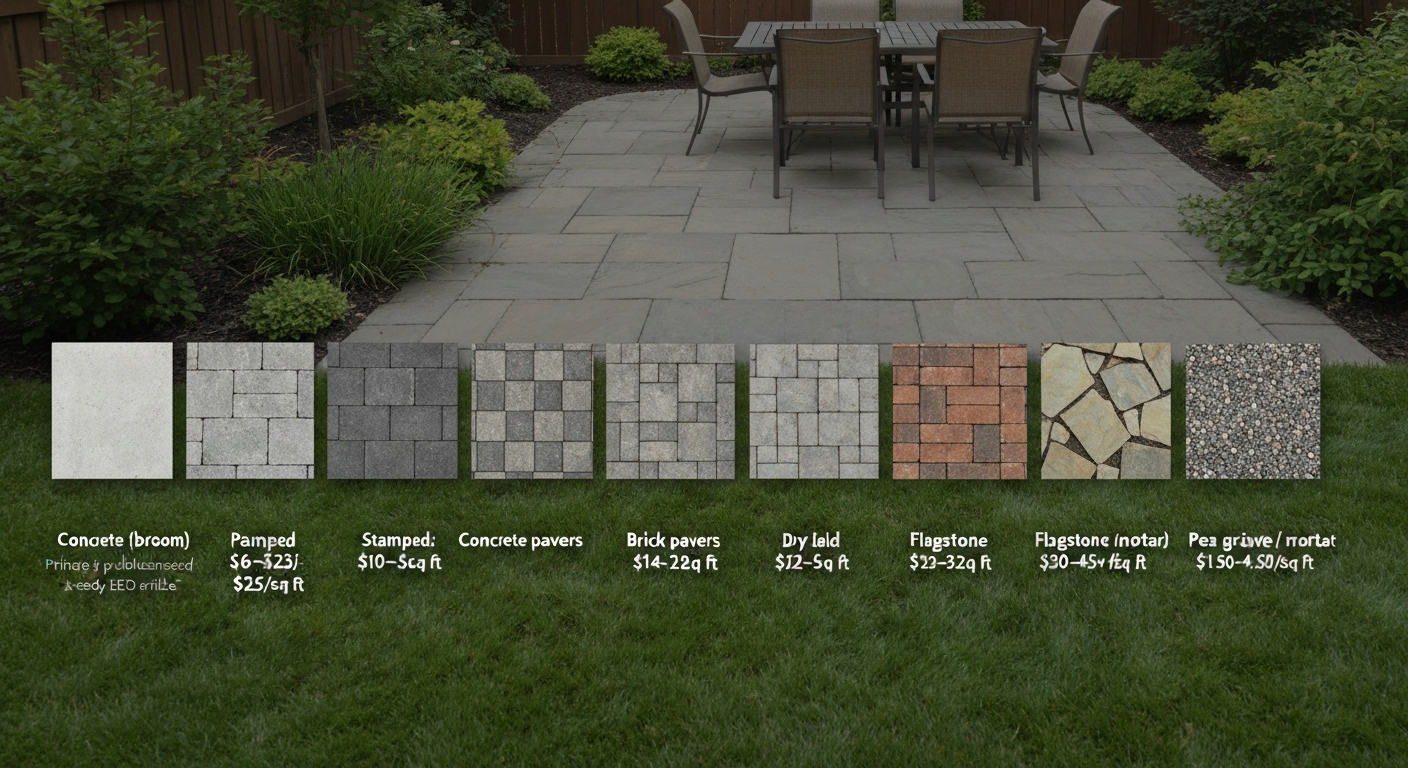
Patio materials in 2026 range from about $1.50 per sq ft for a basic gravel surface all the way to $45 or more per sq ft for custom mortar-set flagstone. For the most popular mid-range options, expect installed costs of roughly $6–$12/sq ft for plain poured concrete, $12–$25/sq ft for concrete pavers, $14–$28/sq ft for brick pavers, $15–$32/sq ft for dry-laid flagstone, and $10–$20/sq ft for standard stamped concrete. Those ranges cover most residential patios in the U.S., though region, soil conditions, and finish choices can push prices higher or lower.
Patio Materials Cost Comparison: Concrete, Stone, Pavers

Felix Carver
4 Aug 2026
How to use this guide
This guide is built for U.S. homeowners who are in the planning or budgeting phase and want real numbers before they call contractors. Every price range here reflects 2026 installed costs from contractor quotes, supplier price lists, and trade industry guidance. Where DIY is realistic, I've broken that out separately, because the labor savings can be significant but the hidden costs (equipment rental, base materials, waste) often eat into them. The article covers poured concrete, stamped concrete, concrete and brick pavers, natural flagstone, and aggregate finishes. For each material, you'll find per-sq-ft ranges, a line-item breakdown, and honest notes on where costs can creep up. If you're weighing one specific pairing, topics like brick vs. concrete or concrete vs. flagstone go deeper on those head-to-head comparisons.
Quick cost snapshot: what each material costs per sq ft
| Material | DIY Cost (per sq ft) | Installed Cost (per sq ft) | Typical Lifespan |
|---|---|---|---|
| Poured concrete (broom finish) | $2–$5 | $6–$12 | 25–50 years |
| Stamped concrete | $5–$9 | $10–$25+ | 15–30 years (w/ sealing) |
| Concrete pavers | $5–$12 | $12–$25 | 25–50 years |
| Brick pavers | $6–$10 | $14–$28 | 25–50 years |
| Flagstone (dry-laid) | $8–$15 | $15–$32 | 30–50+ years |
| Flagstone (mortar-set) | $12–$20 | $30–$45+ | 30–50+ years |
| Aggregate / pea gravel / DG | $1–$2.50 | $1.50–$4.50 | 5–10 years (needs refresh) |
DIY costs above reflect materials plus consumables (forms, sand, base gravel, jointing material) but not equipment rental, which typically adds $150–$400 per day for a plate compactor, concrete saw, or mixer. If you're renting equipment for a 200-sq-ft patio, factor that in before deciding the DIY route is obviously cheaper.
Cost comparison at a glance: 10x10, 12x12, and 20x20 patios
The table below uses the mid-range of installed costs for each material to give you a realistic total budget target. These are installed prices (materials plus labor) for a straightforward flat patio with no demolition, steps, or drainage complications. Add 10–20% if your site has slopes, clay soil, or existing hardscape to remove. For another relevant comparison, see concrete vs flagstone patio cost.
| Material | 10x10 (100 sq ft) | 12x12 (144 sq ft) | 20x20 (400 sq ft) |
|---|---|---|---|
| Poured concrete (broom) | $600–$1,200 | $865–$1,730 | $2,400–$4,800 |
| Stamped concrete | $1,000–$2,000 | $1,440–$2,880 | $4,000–$8,000 |
| Concrete pavers | $1,200–$2,500 | $1,730–$3,600 | $4,800–$10,000 |
| Brick pavers | $1,400–$2,800 | $2,015–$4,030 | $5,600–$11,200 |
| Flagstone (dry-laid) | $1,500–$3,200 | $2,160–$4,610 | $6,000–$12,800 |
| Flagstone (mortar-set) | $3,000–$4,500 | $4,320–$6,480 | $12,000–$18,000 |
| Aggregate / pea gravel | $150–$450 | $215–$650 | $600–$1,800 |
A few things those numbers don't include: permit fees (usually $50–$300 for residential patios, though many jurisdictions waive them for ground-level slabs), patio steps if there's a grade change (typically $150–$600 per step installed), and demolition of an existing surface ($1–$3/sq ft for concrete removal and haul-off). For estimates of stairs, see the patio steps cost guide for typical per-step prices and installation considerations. If your project involves any of those extras, budget for them separately.
Poured and stamped concrete: what you're actually paying for
Plain broom-finish concrete is almost always the lowest installed cost among permanent patio surfaces, typically $6–$12/sq ft. The bulk of that is labor: site prep, forming, pouring, and finishing. Ready-mix concrete itself runs roughly $120–$180 per cubic yard delivered (2026 regional average), and a 4-inch slab uses about 1.23 cubic yards per 100 sq ft, so materials alone are relatively cheap. What you're paying for is the crew's time and the base prep.
Itemized cost breakdown: poured concrete
| Line Item | Typical Cost Range |
|---|---|
| Excavation and grading | $0.50–$2.00/sq ft |
| Compacted gravel base (4") | $0.75–$1.50/sq ft |
| Formwork (perimeter forms) | $0.50–$1.25/sq ft |
| Ready-mix concrete (4" slab) | $1.50–$2.50/sq ft |
| Reinforcement (wire mesh or rebar) | $0.30–$0.75/sq ft |
| Finishing (broom texture) | $0.50–$1.00/sq ft |
| Control joints (sawcut) | $0.25–$0.50/sq ft |
| Sealer (optional but recommended) | $0.50–$1.25/sq ft |
| Total installed estimate | $5–$12/sq ft |
The standard residential patio uses a 4-inch (100 mm) slab on a compacted aggregate base. Concrete Slab Construction, ConcreteNetwork (slab thickness, reinforcement, joints) recommends 4 in. patio slabs, discusses reinforcement options (wire mesh, rebar, fibers), and control joint placement for crack management Concrete Slab Construction — ConcreteNetwork (slab thickness, reinforcement, joints). If you're parking a hot tub or heavy planter on it, go to 6 inches and add rebar rather than wire mesh. Contractors typically sawcut control joints at 8–10 foot intervals to manage cracking. Skip the control joints and you'll likely regret it within a few years.
Stamped concrete: where the cost jumps
Standard single-color, single-pattern stamped concrete runs $10–$20/sq ft installed. Add a second color, a contrasting border, or a complex custom pattern and you're looking at $18–$25+/sq ft. The premium comes from stamping tools (contractors buy or rent them), color hardener, release agent, and the extra finishing labor. A plain slab might take a crew half a day; a stamped job on the same slab takes a full day or more. The concrete itself is identical, so this is almost entirely a labor and finishing cost premium. Sealing is non-negotiable with stamped concrete because color fades fast without it, and resealing every 2–3 years adds to the long-term cost picture.
DIY concrete: realistic savings and gotchas
For slabs larger than about 50 sq ft, bagged concrete mix is usually not worth it. One 80-lb Quikrete bag yields roughly 0.6 cubic feet of concrete. A 10x10 patio at 4 inches deep needs about 33 cubic feet, meaning you'd need 55+ bags at $7–$9 each, plus your time and a rented mixer. A half-yard of ready-mix delivered is almost always cheaper and faster once you're past that threshold. The realistic DIY savings on a plain concrete patio are in the forming, base prep, and finishing labor, not in mixing concrete yourself. Most experienced DIYers save $2–$4/sq ft on small jobs, which comes to $800–$1,600 on a 20x20 patio. The catch: if your finish is uneven or you don't cut control joints, repairs can cost more than you saved.
Pavers: the most popular premium choice
Concrete paver patios installed by a contractor typically run $12–$25/sq ft for standard residential products like Belgard, Unilock, or comparable regional brands. Premium large-format pavers, natural stone pavers, or intricate herringbone patterns with cuts on every course can push $35–$50/sq ft. The material is only part of the cost: about 80% of a quality paver installation is in the base preparation, which is what separates a patio that stays flat and level for decades from one that heaves and shifts within five years.
Itemized cost breakdown: concrete pavers
| Line Item | Typical Cost Range |
|---|---|
| Excavation and haul-off | $1.00–$2.50/sq ft |
| Compacted aggregate base (6"–8") | $1.50–$3.00/sq ft |
| Geotextile fabric (if needed) | $0.15–$0.35/sq ft |
| Bedding sand (3/4"–1") | $0.50–$1.00/sq ft |
| Paver materials (concrete) | $4–$12/sq ft |
| Edge restraint (plastic or metal) | $1.00–$2.50/linear ft |
| Cutting and waste allowance (5–10%) | Included in material cost |
| Polymeric jointing sand | $0.25–$0.75/sq ft |
| Plate compaction and equipment | $0.50–$1.25/sq ft |
| Sealing (optional) | $0.75–$1.50/sq ft |
| Total installed estimate | $12–$25/sq ft |
The ICPI (Interlocking Concrete Pavement Institute) specifies a 6–8 inch compacted granular base for residential patios, with 3/4 to 1 inch of screeded bedding sand on top. That's a lot of material and labor before you place a single paver. HomeGuide IQ (Paver Patio Cost, San Diego) shows sample line-item breakdowns and contractor quotes HomeGuide IQ (Paver Patio Cost — San Diego) shows sample line-item breakdowns and contractor quotes.. Skipping or skimping on base depth is the number one reason paver patios fail prematurely, so if a quote looks suspiciously low, ask the contractor exactly how deep their base will be.
DIY pavers: doable, but equipment matters
Laying pavers yourself is more accessible than pouring concrete, but you still need to rent a plate compactor ($150–$250/day) and likely a wet saw or angle grinder for cuts. Material costs for concrete pavers typically run $4–$12/sq ft depending on the product line. Add base gravel, sand, edge restraint, and polymeric sand and your all-in DIY material cost lands around $7–$14/sq ft. That's a real saving versus the $12–$25 installed range, but budget for equipment rental and plan on the base prep taking longer than the actual paver placement. For irregular patterns like herringbone or circular designs, waste can hit 15% or more, so order accordingly.
Natural stone (flagstone): beautiful, but price it carefully
Flagstone is the most visually striking patio surface and also one of the most variable in cost. Dry-laid flagstone on a compacted base typically runs $15–$32/sq ft installed. Switch to mortar-set construction with cut joints and you're at $30–$45+/sq ft. The difference is mostly labor: mortar work is slower, requires more skill, and involves more material. The stone itself (Pennsylvania bluestone, Arizona sandstone, Tennessee crab orchard, etc.) varies widely in price depending on type and region, but you can generally estimate $4–$12/sq ft for the stone material alone.
Itemized cost breakdown: flagstone
| Line Item | Dry-Laid | Mortar-Set |
|---|---|---|
| Excavation and base prep | $1.00–$2.50/sq ft | $1.50–$3.00/sq ft |
| Compacted gravel base | $1.00–$2.00/sq ft | $1.50–$2.50/sq ft |
| Flagstone material | $4–$12/sq ft | $5–$14/sq ft |
| Bedding sand or mortar bed | $0.50–$1.00/sq ft | $2.00–$4.00/sq ft |
| Labor (placement and fitting) | $6–$15/sq ft | $12–$20/sq ft |
| Jointing (sand or mortar) | $0.50–$1.00/sq ft | $1.50–$3.00/sq ft |
| Sealing (recommended) | $0.75–$1.50/sq ft | $0.75–$1.50/sq ft |
| Total installed estimate | $15–$32/sq ft | $30–$45+/sq ft |
For a deeper look at how flagstone stacks up specifically against a concrete slab, the concrete vs. For a focused comparison of stone patio vs concrete cost, see the stone patio vs concrete cost guide for a detailed breakdown. flagstone patio cost comparison covers that trade-off in more detail, including how maintenance costs shift over time.
Installation complexity and maintenance expectations
The biggest hidden cost with flagstone is installation complexity. Because natural stone is irregular in thickness and shape, a skilled mason spends significant time fitting pieces together and adjusting the base to keep everything level. This is not a beginner DIY project for mortar-set work. Dry-laid flagstone is more accessible but still demands patience. On the maintenance side, dry-laid joints will need periodic weeding and may need occasional resetting if stones shift. Mortar-set patios can crack at the joints over freeze-thaw cycles, which is worth considering in northern climates.
Brick patios: classic look, durable performance
Brick paver patios installed professionally typically run $14–$28/sq ft. That range puts brick above standard concrete pavers but often below premium natural stone. The materials (clay brick pavers) usually cost $5–$10/sq ft, which is competitive, but the labor tends to run a bit higher than concrete pavers because brick has tighter tolerances and pattern work is common. Running bond is the cheapest pattern to install; herringbone and basketweave patterns require more cuts and time.
Itemized cost breakdown: brick pavers
| Line Item | Typical Cost Range |
|---|---|
| Excavation and grading | $1.00–$2.50/sq ft |
| Compacted aggregate base (6"–8") | $1.50–$3.00/sq ft |
| Bedding sand | $0.50–$1.00/sq ft |
| Brick paver materials | $5–$10/sq ft |
| Edge restraint | $1.00–$2.50/linear ft |
| Cutting and waste (8–12% typical) | Included in material cost |
| Jointing sand (polymeric) | $0.25–$0.75/sq ft |
| Sealing (optional) | $0.75–$1.50/sq ft |
| Total installed estimate | $14–$28/sq ft |
Brick is highly durable and ages well, with a lifespan that commonly reaches 25–50 years with basic maintenance. The clay material is more frost-resistant than many people expect, but you do want to buy pavers rated for your climate zone (SX or MX grade for severe or moderate freeze-thaw exposure). If individual bricks crack or shift, they can be replaced individually, which is a significant long-term advantage over a poured concrete slab.
Long-term care and cost
Brick patios generally need less maintenance than most homeowners expect. Re-sanding joints with polymeric sand every 5–10 years is the main routine task, running $0.25–$0.75/sq ft in materials if you do it yourself. Sealing is optional but extends life and color. If you're comparing brick against concrete specifically, the stone patio vs. For a focused comparison of upfront and lifetime costs, see the is a brick or concrete patio cheaper guide. concrete cost comparison and the is a brick or concrete patio cheaper topic both break down the lifetime cost picture in more detail. For a direct comparison of installation and lifetime expenses, see our brick patio vs concrete cost guide.
Aggregate and exposed-aggregate finishes: budget-friendly and underrated
Loose aggregate patios (pea gravel, decomposed granite, crushed stone) are the most budget-friendly option at $1.50–$4.50/sq ft installed with proper edging and base. DIY costs for materials alone can drop to $1.00–$2.50/sq ft if you buy in bulk rather than bagged. Exposed aggregate concrete, on the other hand, is a permanent finish that adds $1–$3/sq ft over a standard broom-finish slab and delivers a durable, slip-resistant surface with a distinctive look.
Loose aggregate: pricing and what to expect
Crushed stone and road base typically run $15–$75 per ton before delivery, depending on material type and region. Pea gravel and decorative washed stone usually land at $30–$80 per ton. Here's the key thing to know: bagged aggregate at a big-box store is substantially more expensive per ton than bulk delivery from a quarry or landscape supplier. For any patio over about 150 sq ft, call a local landscape materials supplier for a bulk price. For a 20x20 patio at 3 inches deep, you'd need roughly 3–4 tons of material, which at bulk rates keeps costs very manageable. The trade-off is durability: loose aggregate surfaces shift underfoot, require edging (metal or plastic, $1–$2/linear ft installed) to stay contained, and typically need replenishment or re-grading every 5–10 years.
Exposed-aggregate concrete: the middle-ground option
Exposed aggregate is a standard concrete slab where the surface paste is washed away while the concrete is still green, revealing the decorative aggregate (river pebbles, crushed granite, etc.) underneath. Installed cost typically runs $7–$15/sq ft, which is slightly above plain concrete but below stamped. It's more durable than stamped in high-traffic areas because there's no surface layer to chip or peel. Maintenance is minimal: a coat of penetrating sealer every few years is all most patios need. If you're comparing this to stamped concrete purely on cost and longevity, exposed aggregate usually wins.
Choosing the right material: a practical decision framework
Before getting quotes, it helps to narrow your choice to two or three materials so you're comparing apples to apples. Here's how to think through the main trade-offs:
| Factor | Best Option | Notes |
|---|---|---|
| Lowest installed cost | Poured concrete or aggregate | Plain concrete is best for permanent surfaces; aggregate for informal spaces |
| Best aesthetics / curb appeal | Flagstone or brick | Highest visual appeal; also highest installed cost |
| DIY-friendly | Concrete pavers or loose aggregate | Pavers require equipment; aggregate is easiest overall |
| Best in freeze-thaw climates | Concrete pavers or brick (SX grade) | Individual units flex; monolithic slabs are more prone to cracking |
| Longest lifespan (low maintenance) | Concrete pavers or flagstone | Both can last 50+ years with basic upkeep |
| Best resale value | Pavers or natural stone | Generally perceived as premium by buyers |
| Tightest budget | Aggregate (loose) or broom concrete | Aggregate for informal use; concrete for a clean permanent look |
Climate is a factor that often gets overlooked. In the northern U.S. where freeze-thaw cycles are frequent and hard, monolithic concrete slabs crack more predictably than interlocking units. Pavers and brick can be reset if they heave; a cracked concrete slab typically needs grinding, filling, or full replacement. In warmer climates without frost, poured concrete is a more reliable long-term choice and costs less to install.
Regional cost variation: what moves the price
Labor rates vary enough by region that the same patio can cost 30–50% more in a high-cost metro area (San Francisco, New York, Seattle) than in a mid-sized Midwest or Southern city. Material costs vary less dramatically but still shift based on what's quarried or manufactured locally. Flagstone is notably cheaper in regions where it's quarried nearby (Pennsylvania, Tennessee, Arizona) than in areas where it has to be shipped. Concrete prices are more stable nationally. When you're budgeting, use the national ranges above as a starting point, then get at least three local quotes to calibrate for your market.
Getting quotes: a short checklist
Before you contact contractors, having your project details ready will help you get faster, more accurate quotes and make it easier to compare bids side by side.
- Measure your planned patio area (length x width) and note any irregular shapes.
- Know your site conditions: flat or sloped, current surface (grass, existing concrete, gravel), and soil type if you know it.
- Decide on a material preference or narrow it to two options you want priced.
- Note any special requirements: hot tub, fire pit, grade changes, or drainage issues.
- Ask each contractor for an itemized quote, not a lump-sum price, so you can compare line by line.
- Confirm what's included: does the quote cover excavation and haul-off, base prep, edge restraint, sealing, and cleanup?
- Ask about permit requirements in your jurisdiction and whether the contractor handles the permit.
- Get at least three quotes from licensed, insured contractors and check references or reviews.
Your next step: use a cost calculator before you call
Running your specific dimensions and material choice through a patio cost calculator before contacting contractors gives you a realistic budget range to anchor your conversations. If you're specifically deciding between concrete and wood, see the concrete vs wood patio cost comparison for a focused price and maintenance comparison. It's much easier to evaluate whether a quote is reasonable when you have a baseline. Once you have your calculator estimate, collect three local quotes, compare them line by line against the itemized breakdowns in this guide, and make sure each contractor is pricing the same scope. Hidden differences in base depth, edge restraint inclusion, or sealing are common sources of price gaps between bids. The more specific your comparison, the better your outcome will be.
FAQ
What are realistic installed cost ranges per sq.ft. for common patio materials?
Installed per sq.ft. typical U.S. ranges: Concrete poured (plain broom finish, 4") $5–$15/sq.ft. (most jobs $6–$12). Stamped decorative concrete $10–$20/sq.ft. (complex jobs $18–$25+). Concrete pavers $12–$25/sq.ft. (standard) and $25–$45+/sq.ft. for premium patterns/stone pavers. Natural flagstone (dry‑laid) $15–$32/sq.ft.; mortar/set flagstone $30–$45+/sq.ft. Brick pavers $14–$28/sq.ft. Aggregate (pea gravel/DG) professionally installed $1.50–$4.50/sq.ft. (DIY material‑only can be $1–$2.50/sq.ft.). These ranges include typical material, base, labor and basic edging but exclude special site conditions or high‑end finishes.
What are realistic DIY (material‑only + basic rental) cost ranges per sq.ft.?
DIY material and basic rental approximate ranges: Plain poured concrete (small slab using bagged mix / rented mixer) $3–$7/sq.ft. (small jobs more expensive per unit). Pavers (material only) $4–$12/sq.ft. depending on brand/quality; add rental of compactor/plate, saw rental and joint sand. Flagstone material (mesh‑mounted) $6–$18/sq.ft.; dry‑lay reduces labor cost but stone handling is labor intensive. Brick material $6–$12/sq.ft. Aggregate (bulk DG/pea gravel) material $1–$2.50/sq.ft.; compaction and edging still required. DIY does not include professional site grading, permits, or complex drainage work.
What are example total budgets for common patio sizes (100 sq.ft. / 144 sq.ft. / 400 sq.ft.) by material (installed)?
Approximate installed totals (round numbers; site variation applies): 100 sq.ft. (10x10): Concrete poured $500–$1,500; Stamped concrete $1,000–$2,000; Pavers $1,200–$2,500; Flagstone $1,500–$3,200; Brick $1,400–$2,800; Aggregate $150–$450. 144 sq.ft. (12x12): Concrete poured $720–$2,160; Stamped $1,440–$2,880; Pavers $1,728–$3,600; Flagstone $2,160–$4,608; Brick $2,016–$4,032; Aggregate $216–$648. 400 sq.ft. (20x20): Concrete poured $2,000–$6,000; Stamped $4,000–$8,000; Pavers $4,800–$10,000; Flagstone $6,000–$12,800; Brick $5,600–$11,200; Aggregate $600–$1,800. These totals reflect common installed ranges including base, labor, edging; exclude major demolition, landscaping restoration, or specialty drainage/sawcut work.
What line‑items should I expect on professional quotes and typical cost drivers?
Common quote line items: excavation & hauling (demo/soil removal), base material (crushed stone/road base), compaction, bedding sand (for pavers), concrete forms & reinforcement, finish (broom/stamp/exposed aggregate), cutting/waste allowance (5–15%), edge restraints, jointing/polymeric sand, sealing (optional), drainage (trenching/drain), steps/landing, cleanup & disposal, permits/inspections. Major cost drivers: depth/quality of base prep (often ~60–80% of paver work), site access and grade corrections, removal/disposal of old patio, complex slopes or retaining walls, custom patterns or borders, reinforcing for hot tubs/heavy loads, and regional labor rates.
How much do permits, removal, edging, sealing and patio steps typically add?
Typical adders (ballpark per job): Permit fees $0–$400 (local building codes vary). Removal/demolition and haul off $1–$6/sq.ft. (depends on thickness and disposal distance). Edging/edge restraint $1–$4/sq.ft. Sealing (concrete, pavers, stone) $0.50–$3/sq.ft. Patio steps or small landings $150–$1,200 each depending on material & complexity. Always confirm whether contractor includes these in the base quote or lists them as extras.
How do contractor rates and regional variation affect final cost?
Labor and markup vary by region; expect 10–40% variation across U.S. metro areas. Higher‑cost areas (West Coast, Northeast, major metro) typically pay higher labor and permit costs—add 10–30% above national midpoints. Rural or lower‑cost regions can be 10–20% below. Contractor labor rates for patio installation commonly run $40–$100+/hour for crews; many contractors price per sq.ft. instead. Get 3 local quotes and request itemized line‑items to compare apples‑to‑apples.
Next Articles
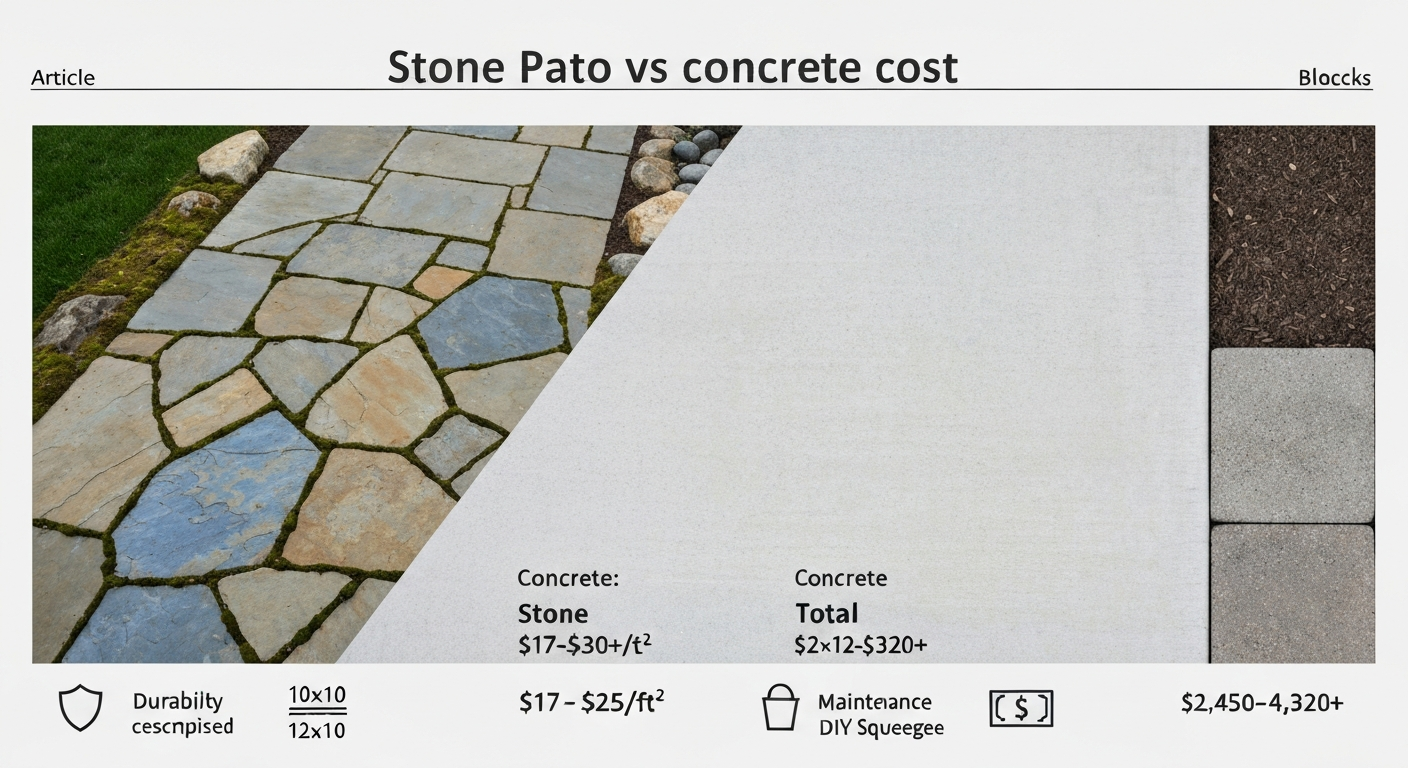
Stone Patio vs Concrete Cost: Real Prices, Quotes & Budget
Stone patio vs concrete cost: compare price ranges, DIY vs pro, sample estimates and contractor questions.
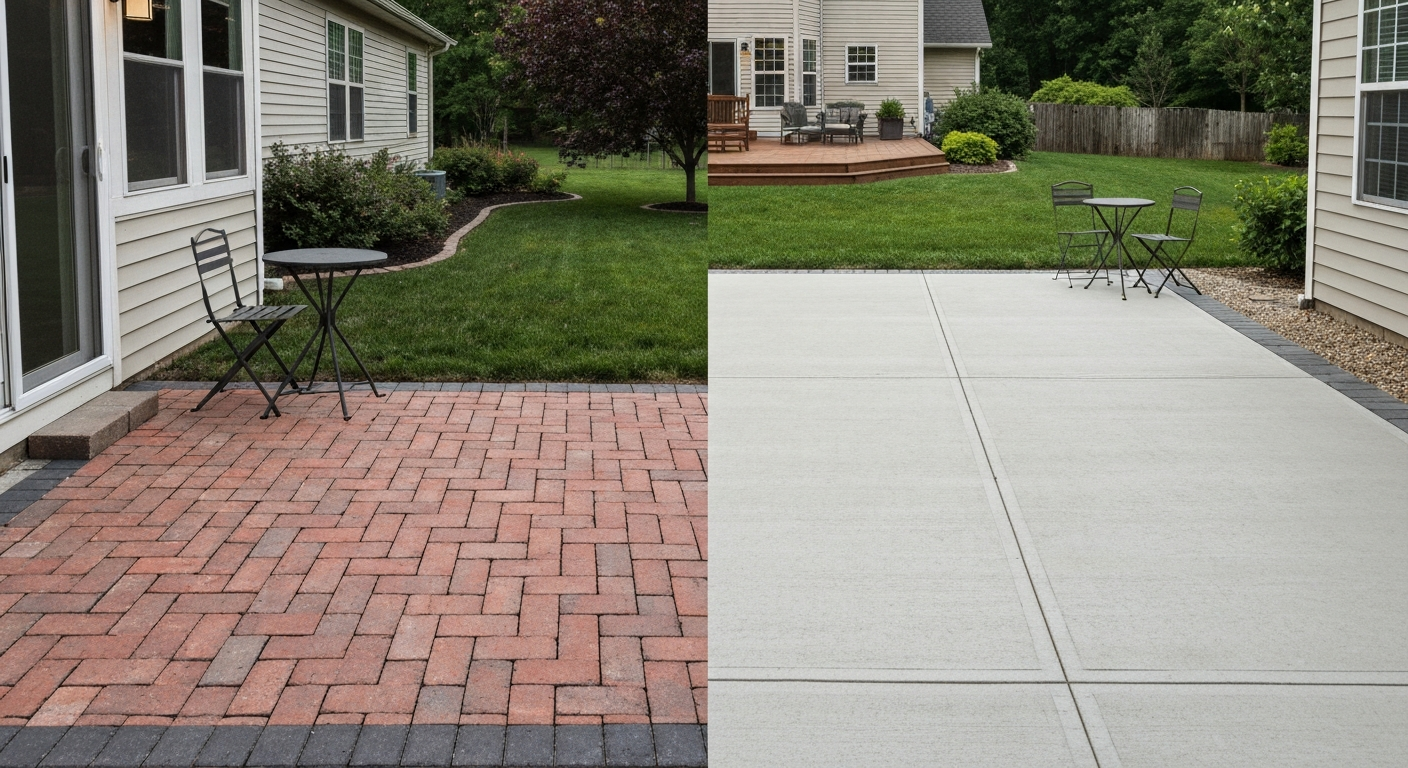
Brick Patio vs Concrete Cost: Per-Sqft Prices, Project Guide
Compare brick patio vs concrete cost with clear per‑sqft and per‑project ranges, DIY vs pro tips, and regional pricing.
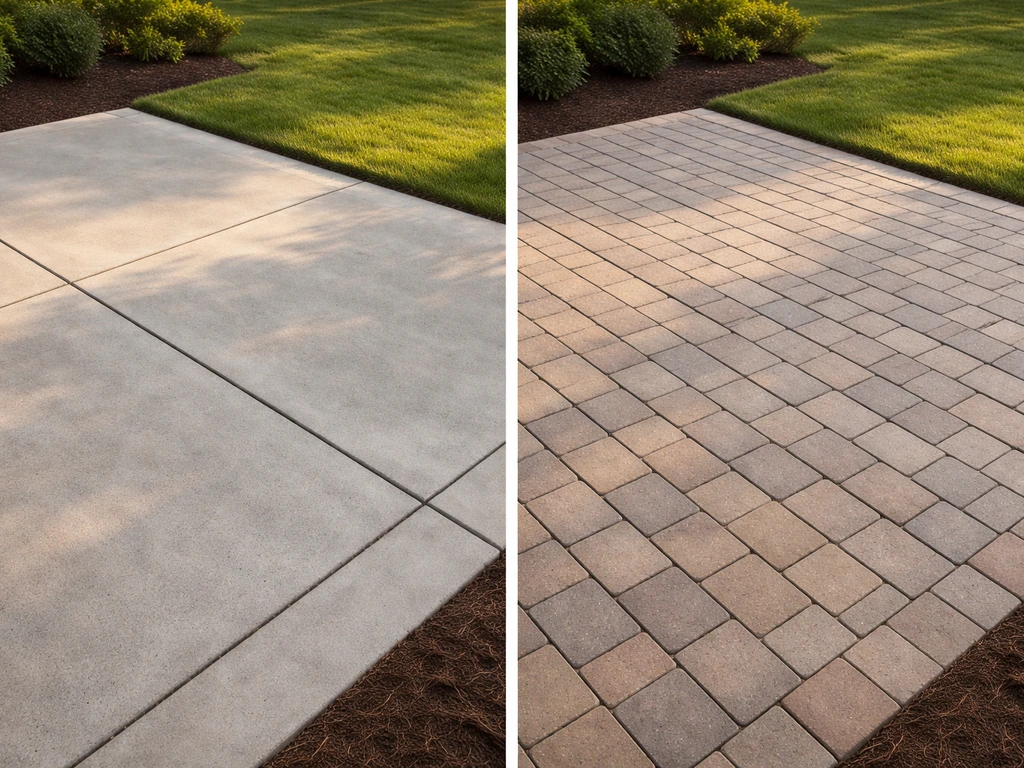
Is a Brick or Concrete Patio Cheaper? Costs Compared
Compares installed costs of brick vs concrete patios, with cost breakdowns, typical sizes, and a budget checklists.