
Concrete patios run $6–$25 per square foot installed, depending on finish. Natural stone patios (bluestone, flagstone, and similar) run $17–$30+ per square foot installed. On a popular 12x12 patio (144 sq ft), that works out to roughly $865–$3,600 for concrete and $2,450–$4,320+ for stone. Stone almost always costs more upfront, but the gap narrows when you choose decorative concrete finishes like stamped or colored concrete, and it reverses when you factor in long-term durability and maintenance cycles. Which one wins depends on your budget, your soil, your climate, and how long you plan to stay in the house.
Stone Patio vs Concrete Cost: Real Prices, Quotes & Budget

Felix Carver
23 Jul 2026
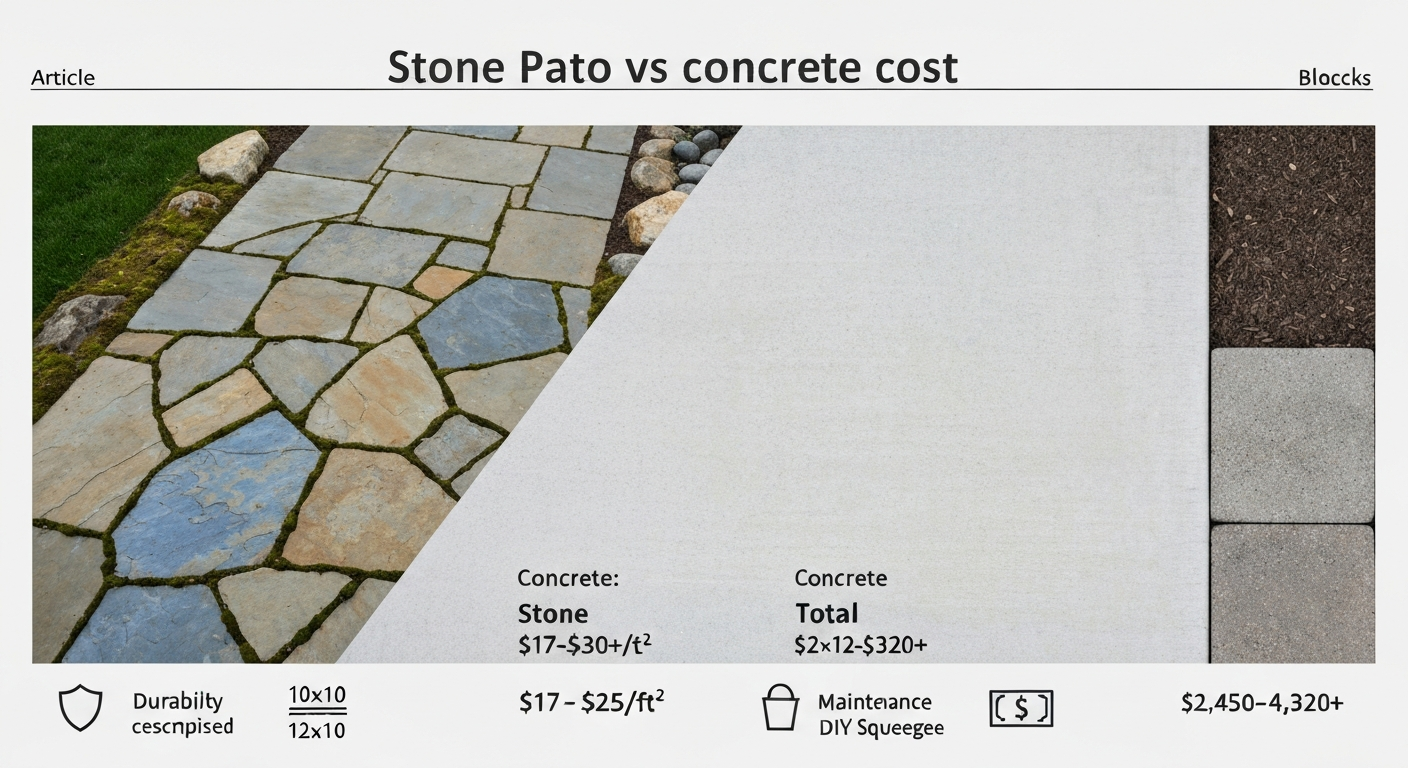
How to read these price ranges
Every range in this article covers a low, typical, and high scenario for a professionally installed patio on a reasonably accessible residential site in the continental U.S. as of mid-2026. 'Low' means basic materials, straightforward site conditions, a flat lot, and a competitive local market. 'High' means premium materials, difficult access or soil conditions, complex patterns or cuts, and a fully insured contractor with strong demand. 'Typical' is the middle ground most homeowners actually land in.
These ranges do not include demolition of an existing surface, major grading, rock removal, permits, or extras like steps and outdoor lighting. All of those are real line items that can push you from the low band to the high band quickly. Regional variation is significant too: the same stamped concrete patio can cost 30–40% more in coastal California or the Northeast compared to the rural Midwest. I'll break down regional adjustment rules in their own section below.
Full cost breakdown: stone patio
A natural stone patio involves several distinct cost layers. Here is what each one typically contributes to that $17–$30/sq ft installed number.
Stone materials
Material-only stone (flagstone, bluestone, limestone, slate) commonly runs $5–$12 per square foot for standard residential grades. Premium or dimensional quarried pieces, thicker cuts (2" or more), or specialty stones like thermal-finish bluestone can push material cost to $12–$25 per square foot before anyone swings a hammer. Where you fall in that range depends heavily on your stone yard's sourcing and how far the material has to travel.
Subbase and bedding
Every stone patio needs a compacted crushed-stone base. Standard guidance is 4 inches of compacted aggregate on well-draining soil, or 6 inches on clay soils and in freeze-thaw climates. At roughly 2 cubic yards of crushed stone per 100 square feet for a 4-inch base, and bulk crushed stone running $30–$80 per cubic yard delivered, you are looking at $60–$160 per 100 square feet just for base material. Add a 1-inch bedding sand layer (about 0.3 yd³ per 100 sq ft) at $20–$40/yd³ and you are adding another $6–$12 per 100 sq ft. On a 200 sq ft patio, base and bedding materials alone can run $150–$350.
Labor
Setting irregular flagstone by hand is slow, skilled work. Labor-only often runs 12–40 man-hours per 100 square feet depending on the complexity of the pattern, whether stones need cutting, and whether the install is dry-laid or mortared. With contractors billing loaded crew rates of roughly $50–$90/hour per laborer (reflecting the BLS mean wage for tile and stone setters at $28.49/hr plus the 1.8–3x overhead and profit factor contractors apply), labor alone for a 200 sq ft irregular flagstone patio can run $1,700–$7,200 depending on complexity.
Finishing and cleanup
Stone patios typically need joint filling (polymeric sand runs $25–$50 per bag; a 200 sq ft patio usually takes 2–4 bags), sealing ($0.50–$2.50/sq ft for a professional 2-coat job), and general site cleanup. Budget $150–$600 for these finishing items on a mid-size project.
Full cost breakdown: concrete patio
Concrete materials
Ready-mix concrete delivered to site runs roughly $130–$180 per cubic yard for standard residential mixes (with real municipal bid data showing $153–$182/yd³ as a representative delivered range). A 4-inch slab uses about 1.23 cubic yards per 100 square feet, so material cost for the concrete itself is roughly $160–$225 per 100 sq ft, plus a possible short-load delivery surcharge ($50–$150) if your order is under the ready-mix truck's minimum. Add rebar or welded wire mesh: #3 rebar runs $5–$8 per 20-foot stick at retail, and a typical slab uses roughly 100–200 lb of steel per cubic yard of concrete.
Subbase and prep
Concrete also needs a compacted gravel base, typically 4 inches on stable soil. Budget the same $60–$160 per 100 sq ft for base material as with stone. Concrete is less forgiving of base failures though: a crack in a concrete slab is a permanent visual problem, while a sunken flagstone can be releveled relatively easily.
Labor
Poured concrete is faster to install than stone once the form-work is set. BLS data puts the mean wage for cement masons and concrete finishers at $28.87/hr (May 2025), and contractors bill this out at roughly $52–$87/hr loaded. Form-setting, pour, and basic broom finish on a 200 sq ft slab typically runs 8–14 man-hours of skilled labor. Stamped or colored finishes add time and cost, especially if multiple colors or detailed patterns are involved.
Finishing and cleanup
Broom finish concrete needs little finishing beyond a curing compound ($0.10–$0.30/sq ft material) and form removal. Stamped concrete requires color hardener, release agent, pattern tools, and sealant. Professional sealing on a completed concrete slab runs the same $0.50–$2.50/sq ft as stone. Budget $100–$800 for finishing depending on the concrete type chosen.
Price ranges by material type
Here is how the main material options stack up on an installed, all-in per-square-foot basis (professional installation, national average, mid-2026). For a side-by-side breakdown of typical installed costs and lifecycle considerations, see our patio materials cost comparison. See our guide comparing brick patio vs concrete cost for another common material comparison.
| Material | Installed Low | Installed Typical | Installed High | Notes |
|---|---|---|---|---|
| Basic concrete (broom finish) | $6/sq ft | $9/sq ft | $12/sq ft | Plain flatwork, one color, standard base |
| Colored/exposed aggregate concrete | $8/sq ft | $13/sq ft | $18/sq ft | Adds pigment or surface aggregate reveal |
| Stamped concrete | $10/sq ft | $17/sq ft | $25+/sq ft | Complex patterns, multiple colors cost more |
| Manufactured concrete pavers | $10/sq ft | $16/sq ft | $22/sq ft | Includes full base, bedding, and compaction |
| Flagstone (dry-laid) | $14/sq ft | $20/sq ft | $28/sq ft | Random/irregular pieces, polymeric sand joints |
| Flagstone (mortared) | $18/sq ft | $24/sq ft | $35/sq ft | More labor, concrete base required |
| Bluestone / natural stone | $17/sq ft | $23/sq ft | $30+/sq ft | Grade, thickness, and finish all affect price |
Notice that stamped concrete's high end overlaps with stone's low end. If you are comparing a high-end stamped pattern to basic dry-laid flagstone, the price difference may be smaller than you expect. The bigger gap shows up when comparing basic broom-finish concrete to premium natural stone.
Sample project estimates by common size
These estimates use the installed ranges above, applied to common residential patio sizes. Low assumes basic materials and straightforward conditions; typical is mid-grade materials on a normal site; high assumes premium materials, difficult access, or a high-cost market. Extras like steps, permits, and demo are not included.
| Size (sq ft) | Basic Concrete Low/Typical/High | Stamped Concrete Low/Typical/High | Natural Stone Low/Typical/High |
|---|---|---|---|
| 10×10 (100 sq ft) | $600 / $900 / $1,200 | $1,000 / $1,700 / $2,500 | $1,700 / $2,300 / $3,000 |
| 12×12 (144 sq ft) | $865 / $1,295 / $1,730 | $1,440 / $2,450 / $3,600 | $2,450 / $3,310 / $4,320 |
| 14×14 (196 sq ft) | $1,175 / $1,765 / $2,350 | $1,960 / $3,330 / $4,900 | $3,330 / $4,510 / $5,880 |
| 20×20 (400 sq ft) | $2,400 / $3,600 / $4,800 | $4,000 / $6,800 / $10,000 | $6,800 / $9,200 / $12,000+ |
The assumptions behind these numbers: a flat, accessible lot; no existing surface to remove; 4-inch compacted aggregate base already accounted for; basic permit (if any) included in contractor overhead; and a single contractor crew in a mid-cost U.S. market. A 20x20 stone patio in coastal New England or the Bay Area could reasonably push past $14,000–$16,000 once regional labor rates and material freight are factored in.
How location, season, and contractor rates change the numbers
Geography is probably the single biggest swing factor outside of material choice. High-cost metros like San Francisco, New York, Boston, and Seattle typically run 30–50% above national averages on labor. Lower-cost Midwest and rural Southeast markets can run 15–25% below. A practical rule: use national average estimates as your starting anchor, then adjust up 30–40% for major coastal metros and down 15–20% for rural or lower-cost markets.
Season also matters in freeze-thaw climates. Contractors in the Midwest and Northeast are often booked solid from May through September, which keeps prices firm. Booking a patio for early spring or late fall installation can sometimes get you a 5–15% discount as crews look to fill their schedules. However, working in cold weather adds risk: concrete should not be poured below 40°F without cold-weather precautions, and stone install on frozen ground is a recipe for settling problems later.
Contractor rates themselves vary with overhead structure. A two-person owner-operated crew working out of a truck typically bids lower than a larger landscaping firm with multiple crews, insurance, and office staff. Both can do excellent work, but the larger firm usually comes with better liability coverage and warranty backing. When you get quotes, ask each contractor to break out material cost, labor cost, and markup separately so you can compare apples to apples.
DIY vs. hiring a pro: real cost comparison
DIY concrete and DIY stone are very different beasts. Poured concrete has a hard deadline: once the truck arrives, you have roughly 90 minutes before the mix starts to set. Mistakes are permanent. For a 200 sq ft slab, you would realistically need 3–4 experienced helpers, a concrete vibrator rental ($50–$100/day), bull float and finishing tools (another $50–$100 in rentals or purchases), and the physical stamina to move fast. If you mess up a pour, there is no do-over.
DIY flagstone is more forgiving. Dry-laid flagstone can be adjusted as you go, and there is no time pressure. The skill involved is mostly patience and a good eye for fitting irregular pieces together. Tools needed include a plate compactor (rent for $100–$175/day), a wet saw or angle grinder for cuts ($50–$150/day rental), hand tools, and a wheelbarrow. If you are comfortable with physical labor and careful measuring, DIY flagstone is one of the more approachable hardscape projects.
| Factor | DIY Concrete | DIY Stone (dry-laid) | Pro Concrete | Pro Stone |
|---|---|---|---|---|
| Material cost | $3–$6/sq ft | $7–$15/sq ft | $3–$6/sq ft | $7–$20/sq ft |
| Labor cost | $0 (your time) | $0 (your time) | $3–$6/sq ft | $8–$15/sq ft |
| Tool/rental cost | $150–$400 total | $200–$500 total | Included in quote | Included in quote |
| Realistic time (200 sq ft) | 1–2 full weekends + helpers | 2–4 weekends solo | 1–2 days | 2–5 days |
| Error tolerance | Very low | Moderate | High (contractor liable) | High (contractor liable) |
| Warranty | None | None | Typically 1–3 years | Typically 1–3 years |
| Skill required | Intermediate–high | Low–intermediate | N/A | N/A |
The honest DIY savings on a 200 sq ft patio run roughly $800–$2,000 on concrete and $1,200–$2,500 on stone, after accounting for rentals and any wasted material. That is real money, but weigh it against the very real risk of a failed pour, a cracked slab, or a settling stone field that you then have to hire someone to fix anyway. DIY makes the most sense on smaller patios (100–150 sq ft), when you have prior hardscape experience, and when a dry-lay method is used rather than mortar or poured concrete.
Add-on costs that stack up fast
This is where projects most often blow their budgets. Homeowners get a quote for the slab or stone field, then discover five other things they need or want. Here is what each common add-on typically costs.
Patio steps
If your patio is elevated or transitioning from a door threshold, you will likely need one to three steps. Poured concrete steps run $100–$300 per step installed. Natural stone steps can run $200–$600 per step depending on the stone and cut. A two-step entry can easily add $400–$1,200 to your project cost. For a detailed breakdown of patio steps cost and options, see our patio steps cost guide.
Edging and borders
Plastic or aluminum paver edging runs $0.50–$2/linear foot installed and is often included in contractor quotes for paver and stone work. Decorative concrete or stone borders, soldier-course brick borders, or steel edging can run $3–$15/linear foot. On a 20x20 patio, that is 80 linear feet of perimeter, so even a modest $5/lf border adds $400.
Drainage improvements
Poor drainage is the number-one cause of patio failure. A simple French drain or trench drain at the patio edge runs $500–$2,000 depending on length and outlet location. A full catch basin with underground piping can run $1,500–$5,000+. If your yard has drainage issues, skipping this step is a way to spend twice: once on the patio, once on repairing it after it heaves or floods.
Sealing
Professional sealing runs $0.50–$2.50 per square foot for a 2-coat application, meaning $100–$500 on a 200 sq ft patio. Resealing is needed every 1–5 years depending on sealant type and traffic. Stone patios and stamped concrete patios both benefit from regular sealing to prevent staining and freeze-thaw damage. Plain broom-finish concrete can go longer without sealing but still benefits from it in harsh climates.
Lighting
Low-voltage LED patio lighting systems start around $300–$600 for a DIY kit and $800–$2,500 professionally installed with wiring run and fixtures set in the patio surface or along borders. Line-voltage systems for overhead string lights or wall sconces add more.
Fire pits and built-ins
A simple pre-cast or kit fire pit set on the patio surface costs $200–$800 for the unit, with no installation cost if it is freestanding. A custom built-in gas fire pit or fire table runs $2,500–$8,000+ installed, including gas line work. Outdoor kitchen built-ins (grill surround, countertop, storage) typically start at $3,000–$5,000 for a basic setup and scale up quickly from there.
Site prep extras
Excavation and grading on flat, accessible lots is usually included in patio quotes. But if you have sloped terrain, buried roots, rock, or an existing surface to demo, costs escalate. Excavator crews typically charge $50–$150/hour. Demo and disposal of an old concrete slab or paver field runs $1–$5 per square foot. A 200 sq ft demo can add $200–$1,000 before new work even begins. Permit fees are another wildcard: some municipalities charge nothing for small patios, others charge $100–$500+ depending on size and whether the work requires a building permit.
Stone vs. concrete: which one is actually cheaper over time
Natural stone patios, properly installed on a good base, can last 50+ years with minimal maintenance beyond occasional resealing and joint sand replacement. A well-poured concrete slab has a typical serviceable life of 20–30 years before cracking and surface wear become significant. Stamped concrete is especially prone to surface delamination if the sealer is neglected, which can require costly resurfacing at 10–15 years.
If you plan to stay in your home for 20+ years, the higher upfront cost of natural stone can genuinely be offset by lower lifecycle maintenance costs and fewer replacement cycles. If you are planning to sell in 5–10 years, the question becomes one of return on investment: natural stone and quality pavers typically add more perceived value to a listing than basic concrete, though neither material recovers 100% of its installation cost in resale.
For pure short-term budget efficiency, broom-finish or exposed-aggregate concrete is hard to beat. If you're weighing brick against concrete, see our guide Is a brick or concrete patio cheaper for a direct cost and lifecycle comparison. For long-term value and aesthetics, natural stone wins. Stamped concrete sits in an interesting middle ground: it gives you stone-like looks at a lower upfront cost, but it requires more diligent maintenance to keep looking good. Flagstone and bluestone comparisons come up often in this context, and they follow the same calculus. For a direct side-by-side comparison of concrete vs flagstone patio cost, see the concrete vs flagstone patio cost guide.
Decision framework: which surface makes sense for your project
Run through these questions before you request a single quote. If you're also comparing materials beyond stone and concrete, see our concrete vs wood patio cost guide for a direct cost and lifecycle comparison. They will help you figure out which material direction to go and which contractor questions to ask.
- What is your all-in budget ceiling? If it is under $3,000 for a mid-size patio, concrete is almost certainly your only professional-install option. Stone becomes feasible above $4,000–$5,000 for most sizes.
- How long do you plan to stay in the home? Under 7 years: prioritize upfront cost. Over 15 years: lifecycle cost and durability matter more.
- What is your climate? Freeze-thaw cycling (Zones 4–7) is harder on both concrete and mortared stone than on dry-laid stone or flexible paver systems. A 6-inch compacted base is not optional in these climates.
- What are your soil conditions? Clay-heavy or poorly draining soil adds base depth requirements and potentially drainage costs to every option.
- Do you want the work to look good in 15 years without major intervention? Natural stone or pavers beat plain or stamped concrete on this metric.
- Is DIY realistic for you? Dry-laid flagstone on a smaller patio (under 150 sq ft) is a reasonable weekend project for a handy homeowner. Poured concrete is not.
Questions to ask every contractor before signing
Getting accurate quotes means asking the right questions up front. Here is a practical checklist to use when meeting with contractors.
- Is the base prep included in your quote, and what depth of compacted aggregate are you spec'ing? (Ask for 4" minimum, 6" on clay or in freeze-thaw zones.)
- What is the concrete mix design or PSI rating you are using? (Standard residential patios use 3,000–4,000 PSI; 4,000 PSI is worth requesting.)
- Will rebar or wire mesh be used, and which do you recommend for my soil conditions?
- Is the quote materials plus labor all-in, or is there a separate materials allowance? (Get both broken out.)
- What is your process if the slab cracks or a stone settles within the first year? (Get the warranty in writing.)
- Does your quote include permit pulling, or is that a separate cost?
- Who does the actual work: your direct employees or subcontractors?
- Can you provide references for two or three similar patios you have done in the last 12 months that I can visit or call?
- What is the payment schedule? (Be cautious of anyone asking for more than 30–40% upfront.)
- Does your quote include sealing, or is that an add-on?
Getting three quotes with all of the above details spelled out will tell you more about what your project actually costs than any national average estimate, including the ones in this article. Use these ranges to sanity-check quotes and identify outliers in either direction before you commit.
FAQ
What are the headline installed cost ranges for concrete patios vs natural stone patios (U.S., 2026 planning)?
Concrete patios: basic broom-finish/flatwork typically $6–$12 per sq ft; colored or exposed-aggregate $8–$18/sq ft; stamped decorative concrete $10–$25+/sq ft depending on pattern and complexity. Natural stone (flagstone/bluestone and similar): installed all‑in typically $17–$30 per sq ft for common grades; premium quarried stone or thicker dimensional pieces can exceed $30+/sq ft.
How should I break down the total cost when budgeting (line‑item categories)?
Primary line items to budget: 1) Materials — concrete (yd³), stone (per sq ft or yd³), base aggregate, bedding sand, reinforcement (rebar/mesh), edge restraints; 2) Labor — crew hours for excavation, base prep, setting/finishing, cleanup; 3) Subbase & sitework — excavation, rock removal, compaction, geotextile; 4) Finishes — stamping, coloring, sealing, jointing/polymeric sand; 5) Add‑ons — steps, edging, drainage, retaining walls, lighting; 6) Disposal & permits — demo, hauling, municipal permit fees; 7) Contractor markup/overhead — included in quotes but estimate 1.8–3× base wages to infer billed labor rates.
What are typical material and subbase unit costs to use in a Patio Cost Calculator?
Useful planning unit costs: ready‑mix concrete $120–$200/yd³ (practical $130–$180/yd³); crushed stone base $30–$80/yd³ (or $20–$80/ton depending on supply); flagstone/bluestone material-only $5–$12+/sq ft for many grades (premium $12–$25+/sq ft); bedding sand ~ $30–$60/yd³. Base depth assumptions: 4" compacted aggregate for normal conditions; 6"+ for poor soils or freeze/thaw areas. Add ~1" bedding sand for stone/paver installs.
Can you give sample installed estimates for common patio sizes (10x10, 12x12, 20x20)? (Assumes typical site, 4" base)
Approximate installed ranges (rounded) per surface: - 10x10 (100 sq ft): Concrete broom-finish $600–$1,200; stamped/colored $1,000–$2,500; stone $1,700–$3,000. - 12x12 (144 sq ft): Concrete broom $864–$1,728; stamped/colored $1,440–$3,600; stone $2,448–$4,320. - 20x20 (400 sq ft): Concrete broom $2,400–$4,800; stamped/colored $3,200–$10,000 (pattern dependent); stone $6,800–$12,000. Notes: ranges reflect low–typical–high bands; site difficulty, pattern complexity, and local rates can shift estimates significantly.
How much do labor and productivity influence cost differences between stone and concrete?
Labor is a dominant driver. Concrete pouring/finishing is generally faster and more predictable — lower labor hours per sq ft. Natural stone (irregular flagstone or thick slabs) is labor‑intensive: hand‑setting, adjusting, mortaring or bedding increases man‑hours substantially (10–40 man‑hours per 100 sq ft depending on method). Contractors commonly budget 8–20 man‑hours/100 sq ft for pavers and higher for irregular stone. Use local wage data (BLS) and apply a contractor multiplier (1.8–3×) to estimate billed labor rates.
How much do regional and contractor-rate variations affect a homeowner's budget?
Substantial effect: delivered material prices (concrete, stone, aggregate) vary with haul distance and local supply; labor rates vary by region and specialty skill (cement masons vs general labor). Expect +/-20–40% swings between low‑cost and high‑cost markets for installed work. Use local ready‑mix prices, aggregate quotes, and BLS regional wage data to adjust a national estimator to your market.
Next Articles
Brick Patio vs Concrete Cost: Per-Sqft Prices, Project Guide
Compare brick patio vs concrete cost with clear per‑sqft and per‑project ranges, DIY vs pro tips, and regional pricing.
Is a Brick or Concrete Patio Cheaper? Costs Compared
Compares installed costs of brick vs concrete patios, with cost breakdowns, typical sizes, and a budget checklists.
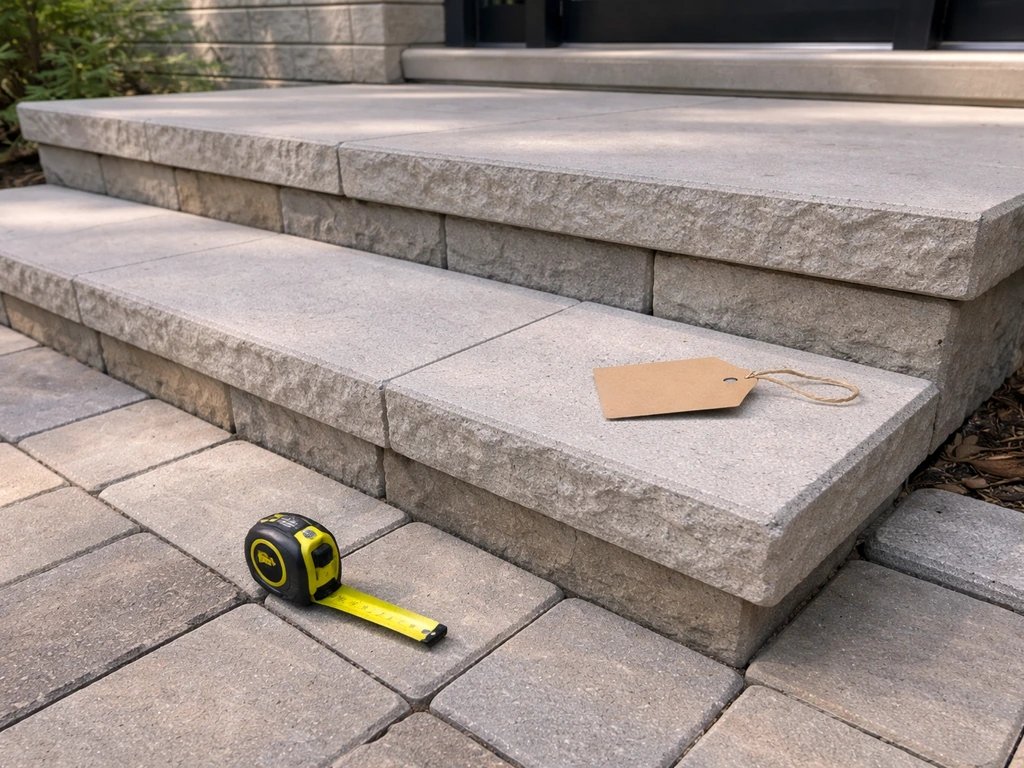
Patio Steps Cost: All-in Pricing, Materials, and DIY Tips
All-in patio steps cost breakdown by materials and labor, DIY vs install tips, budgeting ranges for common patio sizes.