
A professionally installed 10x12 concrete patio (120 square feet) typically costs between $780 and $1,260 for a plain broom-finished slab at the national midrange of $6.50 to $10.50 per square foot. If you want decorative finishes like stamped patterns or integral color, budget $1,200 to $3,600 or more. Most homeowners in 2026 land somewhere around $1,000 to $1,500 for a clean, functional plain slab with standard site prep included. Those numbers assume a relatively flat, accessible backyard with no demolition of an old slab.
How Much Does a 10x12 Concrete Patio Cost? Instant Estimate

Felix Carver
25 Jul 2026
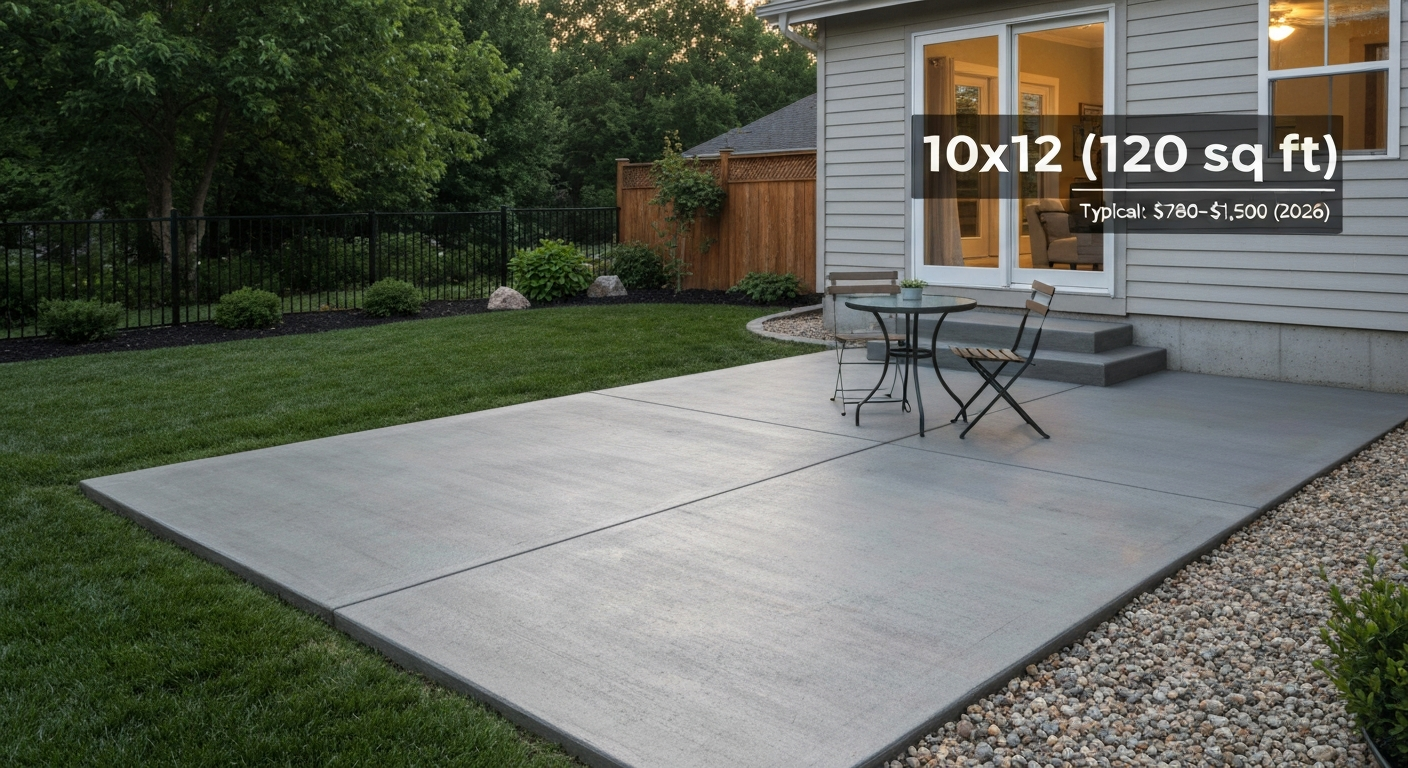
What You're Actually Paying For: Every Cost Driver Explained
Concrete patio pricing isn't just about the concrete itself. The slab material is often the smallest line item on the invoice. Here's what actually moves the needle on your final number.
Concrete Material
Ready-mix concrete delivered to a residential site in 2026 runs about $140 to $200 per cubic yard nationally, with a practical midpoint around $160 to $180 per yard. A standard 4-inch thick slab needs roughly 0.012 cubic yards per square foot, so your 120-square-foot patio requires about 1.44 cubic yards of concrete before accounting for waste. At $165 per yard, that's roughly $238 in raw concrete material. Short-load delivery fees (when you order less than a full truck) can add $50 to $150 to that number, so plan for $280 to $400 just for the delivered concrete.
Labor
Professional installation labor for standard broom-finish flatwork runs about $2.50 to $8.00 per square foot in 2026. On 120 square feet, that's $300 to $960 just for the crew. The range is wide because labor pricing depends heavily on your region, the contractor's overhead, and how competitive the local market is. For decorative work like stamped concrete, labor jumps to $8 to $20-plus per square foot because the forming, texturing, and timing are more demanding.
Site Prep and Excavation
Before any concrete is poured, the ground needs to be excavated, graded, and compacted. For a flat, accessible site this is usually a modest cost, but a sloped yard, heavy clay soil, buried roots, or tight access for equipment can push this number up fast. Excavator and skid-steer operators typically charge $120 to $250 per hour, and hauling/disposal fees add more. A 4-inch compacted gravel base for 120 square feet requires roughly 0.5 to 0.75 cubic yards of crushed stone, which adds $20 to $150 in material depending on local aggregate prices ($15 to $75 per ton).
Demolition of an Existing Slab
If you have an old patio to remove, tack on $2 to $6 per square foot for breaking, hauling, and disposal. Demolition & removal of an existing concrete patio is commonly priced around $2–$6 per sq ft for straightforward residential slabs (includes breaking, hauling and landfill/disposal); many small jobs have minimums ($300–$800) because of crew mobilization and disposal truck minimums. For 120 square feet that's $240 to $720. Most demo contractors have minimums of $300 to $800 because of truck mobilization and landfill minimums, so even a small slab removal rarely comes in under $350 in practice.
Permits and Inspections
Permit requirements vary widely. Some municipalities don't require a permit for a ground-level concrete patio under a certain size. Others require a full building permit and inspection, which can run anywhere from a nominal $50 to $800 or more depending on your jurisdiction and whether a plan review is required. For example, the Menifee 2026 Fee Schedule (City of Menifee CA) lists building permit and inspection fee line items effective July 1, 2026. Always check with your local building department before starting, especially if you're in a HOA or adding a patio adjacent to the house foundation.
Reinforcement
Residential patios typically use one of three reinforcement approaches: welded wire mesh, rebar grid, or synthetic macro-fibers added to the mix. Wire mesh is the most economical at roughly $0.35 to $0.75 per square foot for material and placement. Rebar (#4 bar) costs $0.45 to $0.85 per linear foot in material alone and requires more labor to place and tie. Fiber reinforcement adds $5 to $15 per cubic yard to the concrete mix price but can reduce mesh labor. For a basic backyard patio, wire mesh is usually the right call unless the patio will support heavy vehicle weight.
Finish Selection
The finish you choose is one of the biggest levers on your final price. A broom finish (the standard non-slip texture most patios get) is included in the $6.50 to $10.50 per square foot baseline. Step up to exposed aggregate, integral color, acid staining, or stamped concrete and your per-square-foot cost climbs quickly.
Sealing and Edging
A concrete sealer applied at the end of the project protects the slab from moisture, staining, and freeze-thaw damage. Many contractors include a basic sealer coat in their quote; if not, plan for $0.50 to $2.00 per square foot. Edge treatments like rounded bull-nose edges or decorative borders add a modest labor cost but make a big visual difference.
10x12 Concrete Patio: Line-Item Cost Breakdown
Here's how a typical 10x12 (120 sq ft) plain concrete patio breaks down line by line. These are installed costs from a professional contractor on a straightforward site with no demo required.
| Line Item | Low Estimate | Midrange Estimate | High Estimate | Notes |
|---|---|---|---|---|
| Ready-mix concrete (~1.44 yd3) | $238 | $285 | $340 | Includes short-load delivery fee |
| Gravel base material | $30 | $75 | $150 | 4" compacted crushed stone base |
| Form lumber and stakes | $25 | $50 | $90 | Perimeter 2x6 forms + hardware |
| Welded wire mesh reinforcement | $45 | $65 | $90 | $0.35–$0.75/sq ft material + placement |
| Site prep / excavation | $100 | $200 | $400 | Flat accessible site; slopes cost more |
| Labor (pour, finish, cure) | $300 | $600 | $960 | $2.50–$8.00/sq ft for broom finish |
| Sealer (basic penetrating) | $60 | $120 | $240 | $0.50–$2.00/sq ft applied |
| Edge finishing | $30 | $60 | $120 | Bull-nose or basic trowel edge |
| Permits and inspections | $0 | $150 | $500 | Varies widely by jurisdiction |
| Demolition (existing slab) | $0 | $0 | $720 | Only if removing old concrete |
| TOTAL (no demo) | $828 | $1,605 | $2,890 | Plain broom finish, pro installed |
The demo line is zeroed out in the low and mid columns because many homeowners don't have an existing slab to remove. If you do, add $240 to $720 to whichever column fits your situation. The high column also assumes a more complex site (some slope, limited equipment access) and a more thorough sealing job.
Finish Options and What They Add to the Price
| Finish Type | Cost Per Sq Ft (Installed) | 10x12 Total Impact | Best For |
|---|---|---|---|
| Broom finish (standard) | $6.50–$10.50 | $780–$1,260 | Functional, budget-friendly patios |
| Exposed aggregate | $8–$18 | $960–$2,160 | Texture and visual interest, durable |
| Integral color | $10–$16 | $1,200–$1,920 | Uniform color throughout slab |
| Acid or water-based stain | $2–$6 add-on | +$240–$720 | Color on existing or new slab |
| Stamped concrete | $10–$30+ | $1,200–$3,600+ | High-end decorative look |
Regional Price Adjustments and Contractor Rates
The national numbers above are a solid starting point, but where you live can shift your quote by 20 to 40 percent in either direction. Labor rates follow local construction market conditions. In high-cost metros like San Francisco, Seattle, Boston, or New York, expect to pay at the top of or above the national range. In mid-size Midwestern cities or rural areas, you'll often land at the lower end. Ready-mix concrete prices also vary by region because concrete is a heavy, locally-sourced material, and delivery distances affect cost.
| Region | Typical Per-Sq-Ft Range (Plain Slab) | 10x12 Estimated Total |
|---|---|---|
| Northeast (NY, MA, CT) | $11–$16 | $1,320–$1,920 |
| West Coast (CA, WA, OR) | $10–$15 | $1,200–$1,800 |
| Southeast (GA, FL, NC) | $6–$10 | $720–$1,200 |
| Midwest (OH, IN, MO) | $7–$11 | $840–$1,320 |
| Southwest (TX, AZ, NM) | $7–$12 | $840–$1,440 |
| Mountain West (CO, UT) | $9–$14 | $1,080–$1,680 |
On contractor pricing structure: some contractors quote a flat per-square-foot price for the whole job; others give you a detailed line-item bid. Both are fine, but a line-item bid lets you compare apples to apples across quotes and spot where one contractor is cutting corners (like skipping the gravel base or using minimal reinforcement). Hourly rates for cement masons and concrete finishers run $20 to $35 per hour in BLS wage data, but after payroll burden, overhead, equipment, and profit margin, the installed labor cost to you is typically higher. That's normal and expected.
DIY vs. Hiring a Contractor
Pouring a concrete patio yourself can cut the labor cost significantly, but concrete is genuinely one of the more unforgiving DIY projects. Once the truck leaves, you have a narrow window to finish the surface before it sets. For a 1.44-cubic-yard pour (a very small load), you're working fast on your knees in the sun. Here's an honest side-by-side look.
| Factor | DIY | Professional Install |
|---|---|---|
| Material cost (120 sq ft) | $350–$600 | $350–$600 (same materials) |
| Labor cost | $0 (your time) | $300–$960 |
| Total estimated cost | $350–$700 | $780–$2,500+ |
| Time required | 1–2 full weekends | 1–2 days (crew) |
| Tools needed | Concrete mixer or pump rental, screed, float, trowel, wheelbarrow, level, tamper | Contractor-supplied |
| Skill level | Moderate to high; timing is critical | Professional, warrantied |
| Risk | Surface defects, cracking, uneven grade, improper cure | Low with reputable contractor |
| Permits | Still required in many areas | Contractor typically handles |
The honest truth: for a 120-square-foot slab, the labor savings from DIY are real but modest. A contractor is saving you maybe $300 to $700 in labor. If you've never poured concrete before, a botched finish or improperly cured slab means cracking, spalling, or a rough surface that's hard to fix later. A hybrid approach, where you handle site excavation, gravel base compaction, and form-setting yourself and hire a concrete crew just for the pour and finish, can save you $100 to $300 while keeping the most critical steps in experienced hands.
Concrete vs. Other Patio Materials: Which Makes Sense?
Concrete is rarely the cheapest option and rarely the most expensive. Here's how it stacks up against the other common choices for a 120-square-foot patio.
| Material | Installed Cost Per Sq Ft | 10x12 Total Range | Lifespan | Maintenance | Best For |
|---|---|---|---|---|---|
| Plain concrete | $6.50–$10.50 | $780–$1,260 | 25–50 years | Seal every 2–5 years | Durable, low-maintenance everyday patio |
| Stamped concrete | $10–$30+ | $1,200–$3,600+ | 20–40 years | Reseal every 1–3 years | Decorative look, budget less than pavers |
| Concrete pavers | $10–$20 | $1,200–$2,400 | 25–50 years | Re-sand joints every few years | Easy repairs, flexible design |
| Natural flagstone | $15–$30+ | $1,800–$3,600+ | 50+ years | Repoint joints occasionally | Premium natural aesthetic |
| Gravel / decomposed granite | $1.50–$4 | $180–$480 | Ongoing | Re-grade and top-off annually | Budget patios, informal spaces |
| Pressure-treated wood deck | $15–$35 | $1,800–$4,200 | 15–25 years | Stain/seal every 2–3 years | Elevated, above-grade spaces |
My recommendation for most homeowners: plain or broom-finished concrete gives you the best balance of durability, low maintenance, and upfront cost for a functional ground-level patio. If budget is tight, gravel is the only thing cheaper, but it has ongoing maintenance costs. If aesthetics matter a lot, pavers give you more flexibility for repairs and design changes down the road since individual pavers can be replaced without breaking up a whole slab. Flagstone and natural stone cost more upfront but can last generations with minimal care.
How Costs Scale: 10x10, 10x12, 10x20 Concrete and Paver Patios
If you're deciding between sizes, it helps to see the numbers side by side. If you specifically need ballpark pricing, see our guide on how much is a 10x10 patio for quick per-size comparisons. For a focused price breakdown for a smaller option, see our guide on how much does a 10 x 10 patio cost. The per-square-foot cost for concrete patios doesn't change dramatically between a 10x10 and a 10x20, but there are some mobilization and minimum-charge effects that make very small slabs slightly more expensive per square foot. If you want price details for a slightly smaller option, check our guide on how much does a 10x10 concrete patio cost for a focused breakdown and sample budgets.
| Size | Square Feet | Plain Concrete (Installed) | Concrete Pavers (Installed) |
|---|---|---|---|
| 10x10 | 100 sq ft | $650–$1,050 | $1,000–$2,000 |
| 10x12 | 120 sq ft | $780–$1,260 | $1,200–$2,400 |
| 10x20 | 200 sq ft | $1,300–$2,100 | $2,000–$4,000 |
A 10x10 concrete patio and a 10x20 concrete patio follow the same per-square-foot logic as the 10x12, just scaled. The 10x20 in particular benefits from some economies of scale in concrete delivery (you're getting closer to a full or half-truck load, which reduces short-load fees on a per-yard basis). A 10x10 paver patio costs more per square foot than a same-size concrete slab because the material and installation labor for individual pavers is more intensive. For specific per-square-foot and installed price estimates for pavers, see how much does a 10x10 paver patio cost.
If you're thinking about covering your patio after the fact, that changes the budget calculation significantly. Adding a pergola, patio cover, or full roof structure over an existing 10x10 or 10x12 patio typically costs $1,500 to $8,000+ depending on the structure type, and may require its own permit. It's worth planning for that possibility during the initial patio design since footings for cover posts can be integrated into the original slab pour much more cheaply than added later.
Three Sample Budgets: Basic, Midrange, and High-End
These are realistic, contractor-installed quotes for a 10x12 patio in a typical suburban setting, presented as homeowners might actually see them on a bid. Contractor markup (overhead and profit) of 20 to 35 percent is embedded in the labor line of each scenario.
Budget #1: Basic Plain Slab ($900 total)
- Concrete material (1.44 yd3, $165/yd3 + short-load fee): $280
- Gravel base material: $35
- Form lumber and stakes: $30
- Wire mesh reinforcement: $50
- Site prep (flat, accessible yard): $120
- Labor (broom finish, small crew): $350
- Basic sealer: $60
- Edge finishing: $30
- No permit required (local rules): $0
- Contractor overhead and profit (~20%): estimated embedded in labor
- Total: approximately $955
Budget #2: Standard Midrange ($1,600 total)
- Concrete material (1.44 yd3 + overage, $175/yd3 + delivery): $320
- Gravel base and compaction: $90
- Form lumber, stakes, hardware: $55
- Wire mesh reinforcement: $75
- Site prep (minor grading, machine work): $200
- Labor (broom finish, professional crew, curing blanket): $600
- Premium penetrating sealer: $120
- Bull-nose edge and control joints: $75
- Permit and inspection: $150
- Contractor overhead and profit (~25%): embedded in labor and materials
- Total: approximately $1,685
Budget #3: High-End Stamped and Colored ($3,200 total)
- Concrete material with integral color additive: $420
- Gravel base and compaction: $120
- Form lumber, decorative edge forms: $90
- Rebar grid reinforcement (#4 rebar): $180
- Site prep (sloped yard, machine work + haul): $350
- Labor (stamped finish, release agent, pattern mats, detailing): $1,440
- High-quality polyurethane sealer (2 coats): $220
- Decorative border and step: $200
- Permit, plan review, and inspection: $350
- Contractor overhead and profit (~30%): embedded throughout
- Total: approximately $3,370
What to Ask Contractors Before You Sign Anything
Getting three quotes is the standard advice, and it's good advice, but only if you know what you're comparing. Here's what to ask every contractor you contact and what must be in writing before work starts.
Questions to Ask
- Is the quote all-in, or are materials billed separately? (Some contractors quote labor only and you buy the concrete.)
- What thickness is the slab? (4 inches is standard for patios; 6 inches for driveways.)
- What type of reinforcement are you using: wire mesh, rebar, or fiber?
- How deep and what type of base material are you using?
- Are you pulling the permit, or is that on me?
- What finish and sealer are included in this price?
- What's your concrete mix design (PSI rating)?
- How long will the project take from start to finish?
- What's your warranty on workmanship? On cracking?
- Do you carry general liability and workers' comp insurance? Can I see proof?
- How do you handle change orders if unexpected issues come up during site prep?
What Must Be in Your Written Contract
- Full scope of work: dimensions, thickness, finish type, base depth, reinforcement type
- Concrete mix specification (minimum 3,000 PSI for residential patios)
- Payment schedule (avoid paying more than 30–40% upfront)
- Project start date and estimated completion date
- Change order process: any additions must be agreed to in writing before work proceeds
- Warranty terms: typical contractor warranties on concrete flatwork run 1–3 years on workmanship
- Permit responsibility: who pulls it and who pays for it
- Cleanup and debris removal expectations
- Dispute resolution or lien waiver provisions
When to DIY, When to Hire, and the Hybrid Middle Ground
Here's my honest framework for making this decision. DIY the entire project if you have experience with concrete work, access to the right tools (a plate compactor, concrete screed, bull float, hand trowels), a helper or two, and you live somewhere with mild weather that gives you a comfortable working window during the pour. The savings are real: you can cut the total cost of a 120-square-foot patio from $1,200 to roughly $400 to $600 in materials.
Hire a professional for the whole job if this is your first concrete project, if your site has any slope or drainage complexity, if you want a decorative finish (stamped concrete is genuinely difficult to get right), or if the project has structural implications like attaching to the house foundation. The cost premium is worth it for the quality assurance and the contractor's liability coverage.
The hybrid approach works well for budget-conscious homeowners with some hands-on experience. You handle the excavation (rent a plate compactor for $100 to $150 per day), set the forms yourself, and install the gravel base. Then hire a concrete crew just for the pour, finish, and cure oversight. You'll save $100 to $300 in labor while keeping the hardest and most time-sensitive step in professional hands. Make sure the contractor inspects your form work and base before the truck arrives.
Realistic Project Timeline: Permit to Completion
A 10x12 concrete patio is a small project, but the calendar time from decision to done is often longer than homeowners expect because of permit processing and concrete curing.
| Phase | Typical Duration | Notes |
|---|---|---|
| Get quotes and choose contractor | 1–2 weeks | Allow time to compare 3 bids |
| Permit application and approval | 1–4 weeks | Varies by jurisdiction; some same-day, some require plan review |
| Site prep and excavation | Half to 1 day | Longer if rock, roots, or slope present |
| Form setting and base compaction | Half to 1 day | Can be done by homeowner in hybrid approach |
| Concrete pour and finish | 4–8 hours | Weather-dependent; ideal 50–85°F |
| Initial cure (before foot traffic) | 24–48 hours | Keep off the slab; keep it moist |
| Full cure before heavy use or sealing | 28 days | Concrete reaches design strength at 28 days |
| Sealer application | Half day (after 28-day cure) | Some sealers require second coat after 24 hours |
Seasonal considerations matter. Pouring concrete in temperatures below 40°F or above 95°F requires special measures (insulating blankets, accelerating or retarding admixtures) that add cost and complexity. Spring and fall are generally ideal seasons in most of the country. In the South and Southwest, summer heat can be a challenge. In the North, avoid late fall pours if hard frost is likely within 28 days.
Lifespan, Maintenance, and What Contractors Typically Warrant
A properly installed concrete patio should last 25 to 50 years. The main enemies of concrete are freeze-thaw cycling, surface deicers (salt), water infiltration, and tree roots. Here's what to do to protect your investment.
Maintenance Schedule
- Apply a concrete sealer every 2 to 5 years (penetrating sealers for plain slabs, film-forming sealers for stamped or decorative work, which may need resealing annually to every 3 years)
- Avoid rock salt and calcium chloride deicers directly on the slab, especially in the first winter after pour
- Clean surface stains promptly; use a pressure washer at low to medium pressure (1,200 to 2,500 PSI) for periodic cleaning
- Fill hairline cracks early with a concrete crack filler before water infiltration causes further freeze-thaw damage
- Keep mulch, soil, and organic material off the slab edges to prevent staining and root intrusion
Contractor Warranties
Most residential concrete contractors offer a 1-year workmanship warranty; some offer 2 to 3 years. Warranty coverage typically applies to structural issues and obvious installation defects, not to surface cracks that develop from normal settlement or thermal movement (which are expected in concrete). Hairline cracks under 1/8 inch wide are generally not considered defects. Ask your contractor specifically: what cracks are covered, what would void the warranty (like salting the slab or letting a sprinkler hit it constantly), and what remedies they provide.
Suggested Images and Diagrams for This Project
If you're building a presentation for your contractor or just want to understand what you're paying for, these visual references are worth tracking down.
- Cost breakdown table (the line-item table above, formatted as a printable reference)
- Site prep cross-section diagram showing excavation depth, gravel base thickness, slab thickness, and grade level
- Reinforcement detail diagram showing wire mesh placement at mid-slab height, supported on chairs or bar ties
- Finish options photo grid: broom finish, exposed aggregate, stamped patterns, and acid-stained concrete side by side
- Control joint layout diagram showing recommended joint spacing (typically every 8 to 10 feet, or no more than 1.5x the slab thickness in feet)
- Before-and-after photos of a standard residential 10x12 backyard patio project
- Regional cost map showing how per-square-foot prices vary across U.S. regions
Actionable Next Steps: How to Budget and Get Good Quotes
Here's exactly what to do next if you're planning a 10x12 concrete patio project.
- Measure your actual site and confirm the 10x12 footprint works for your intended use (furniture, traffic flow, clearance from doors and structures).
- Check your municipality's permit requirements before contacting contractors. A quick call to the building department or check of their website can save you surprises.
- Use the Patio Cost Calculator to run your specific square footage, region, and finish choice to get a tighter estimate before you call anyone.
- Decide on your finish preference before getting quotes (broom finish vs. stamped vs. colored) because this changes the scope significantly and different contractors specialize in different work.
- Contact at least 3 local concrete contractors. Send each the same scope description: '10x12 concrete patio, 4-inch slab, wire mesh reinforcement, broom finish, gravel base, please include permit if required in your quote.'
- Request itemized bids (not just a total number) so you can compare line by line.
- Ask each contractor for references from concrete flatwork jobs in the past 12 months and actually call them.
- Once you choose a contractor, review the written contract against the checklist in the section above before signing.
- Plan your budget with a 10 to 15 percent contingency on top of the quoted price for unexpected site issues.
Sample Message to Send Contractors
Here's a template you can copy and adjust: 'Hi, I'm looking for a quote on a 10x12 concrete patio (120 sq ft) at my home in [City, State]. I'd like a 4-inch slab with a gravel base, wire mesh reinforcement, and a standard broom finish. Please include any permit fees if required in your area. I'm getting 3 quotes and would appreciate an itemized bid showing materials, labor, site prep, and any other line items separately. I'm targeting a project start in [Month]. Please let me know your availability for a site visit.'
Related Patio Sizes and Materials Worth Comparing
If you're still deciding on size or material, the cost data for a 10x10 concrete patio and a 10x20 concrete patio provides good reference points on either side of the 10x12. If you're weighing concrete against pavers, the cost breakdown for a 10x10 paver patio and a 10x20 paver patio shows you how the installed price per square foot compares across material types at similar sizes. For specifics on paver pricing and installed ranges, see our guide on how much does a 10x20 paver patio cost for a clear line-item breakdown. For homeowners who want to add weather protection after the initial patio is built, coverage options for a 10x10 patio (pergolas, shade sails, solid roof covers) involve a separate budget analysis with its own permit and structural considerations.
Final Checklist Before You Move Forward
Run through this list before you commit to a project start date or sign a contract.
- Confirmed final dimensions and location of the patio on your property
- Checked HOA rules (if applicable) for patio size, material, and setback requirements
- Called 811 (Call Before You Dig) to mark underground utilities at your site
- Verified permit requirement with your local building department
- Selected your finish type and have photos or samples to share with contractors
- Received at least 3 itemized written quotes
- Verified contractor insurance and license
- Reviewed the written contract scope, schedule, payment terms, and warranty clause
- Set a contingency budget of 10 to 15 percent above the quoted price
- Identified where the concrete truck will park and whether it has clear access to the pour area
FAQ
Instant answer: How much does a 10×12 concrete patio cost (per sq ft and total)?
Quick estimate for a standard 4" broom‑finished concrete patio (120 sq ft): typical national installed range about $6.50–$10.50 per sq ft for a plain slab in 2026. That yields an immediate total estimate of roughly $780–$1,260. Broader national ranges for plain to very decorative work run about $4–$30/sq ft, so absolute low/high totals for 10×12 are about $480–$3,600 depending on finish and complexity.
What drives the cost of a 10×12 concrete patio?
Primary cost drivers: slab thickness and volume (4" standard), finish type (broom, exposed aggregate, stamped, colored, stained), reinforcement (wire mesh, rebar, fibers), site prep (excavation, grading, roots, rock), demolition/old slab removal, base material (crushed stone), concrete delivery (per yd3), labor/crew rates, forms/edge work, curing/cleanup, permits/inspections, and accessibility/mobilization. Decorative or complex edge/steps and site obstacles raise cost significantly.
Line‑item cost breakdown example for a 10×12 (120 sq ft) plain 4" slab
Example midrange breakdown (national 2026 guidance): - Concrete (1.44 yd3 × $165/yd3): ≈ $238 - Gravel base, compaction: $40–$120 - Reinforcement (wire mesh & placement): $42–$84 (≈$0.35–$0.70/sq ft) - Forms, stakes, fasteners: $30–$90 - Labor (placing, finishing, curing): $300–$720 (≈$2.50–$6.00/sq ft) - Mobilization/delivery/minimums: $50–$150 - Permits/inspections: $0–$400 (varies) - Cleanup/disposal (if demo): $0–$600 (if removal needed) Midrange installed total ≈ $780–$1,260. Expect variation by region and finish.
How much does demolition or removing an existing slab add?
Typical demolition/haul‑off for a residential slab: roughly $2–$6 per sq ft when straightforward, often with job minimums ($300–$800). For 120 sq ft that commonly adds ~$240–$720. Difficult access, large thickness, or contaminated materials can increase the price.
How much concrete do I need for a 10×12 patio and what does that cost?
A 4" slab over 120 sq ft requires about 1.44 cubic yards of concrete (120 × 0.012 yd3/sq ft). With national mid 2026 ready‑mix pricing around $140–$200/yd3 (commonly ≈$165 mid), the delivered concrete material cost is roughly $200–$290 (≈$238 at $165/yd3). This excludes gravel base, reinforcement, form lumber, and labor.
How do finishes change the per‑sq‑ft price?
Finish premiums (national guidance 2026): - Broom finish (basic): baseline $4–$8/sq ft - Exposed aggregate: +$8–$18/sq ft - Integral color: +$10–$16/sq ft - Acid or water‑based staining: +$2–$6/sq ft (plus sealer) - Stamped concrete: +$10–$30+/sq ft Decorative choices commonly multiply base installed cost by 1.5–3× based on complexity.
Next Articles

How Much Does a 10 x 10 Patio Cost in 2026?
10x10 patio cost in 2026: installed price ranges for concrete, pavers, stone, brick, plus DIY, site prep, permits factor
How Much Does a 10x10 Paver Patio Cost? Price Breakdown
Estimate a 10x10 paver patio total cost with material vs install breakdown, add-ons, and DIY vs contractor pricing facto
How Much Does a 10x10 Concrete Patio Cost in 2026?
2026 price ranges for a 10x10 concrete patio, itemized costs, key adders, DIY vs hiring, and quote specs to request.