
A professionally installed flagstone patio costs blank" rel="noopener noreferrer">between $15 and $30 per square foot in 2026, which works out to roughly $1,500 to $3,000 for a 10x10 patio, $2,160 to $4,320 for a 12x12, and $6,000 to $12,000 for a 20x20. The national average lands around $3,600, but the spread is wide because flagstone pricing depends heavily on the type of stone, your site conditions, and whether you hire a contractor or do it yourself. Brick patio costs depend on the same factors like material choice, site prep, and labor rates, so using square-foot pricing and getting local quotes will help you estimate yours.
How Much Does a Flagstone Patio Cost? Prices by Size

Felix Carver
29 May 2026
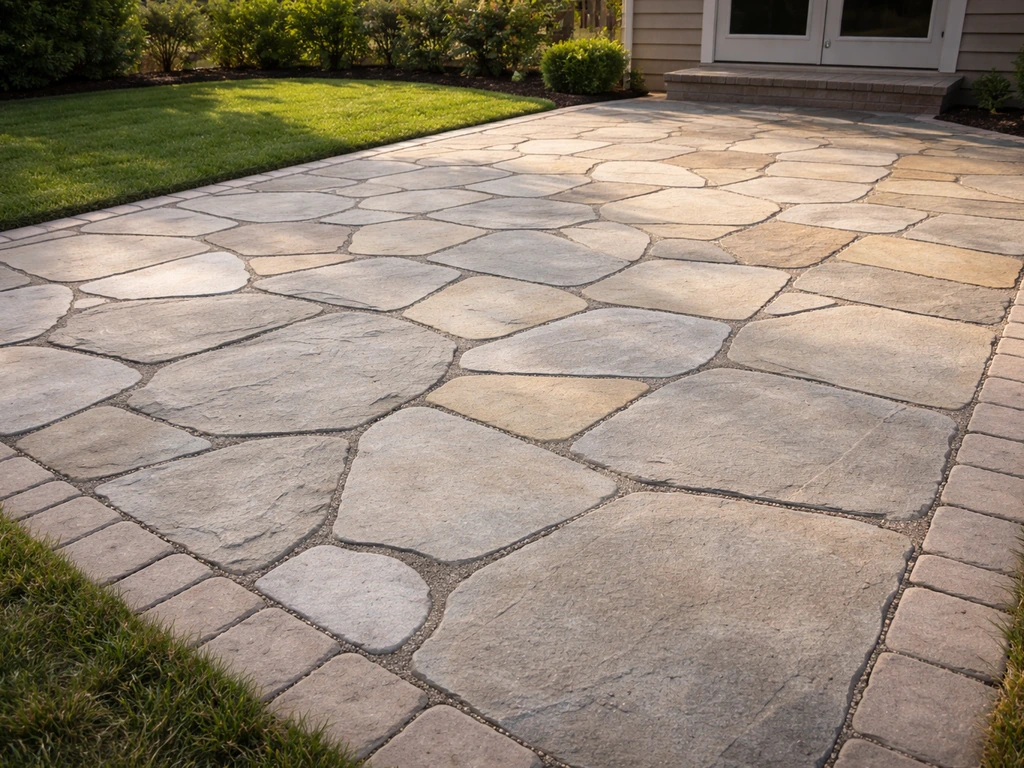
What a Flagstone Patio Actually Costs: The Full Range
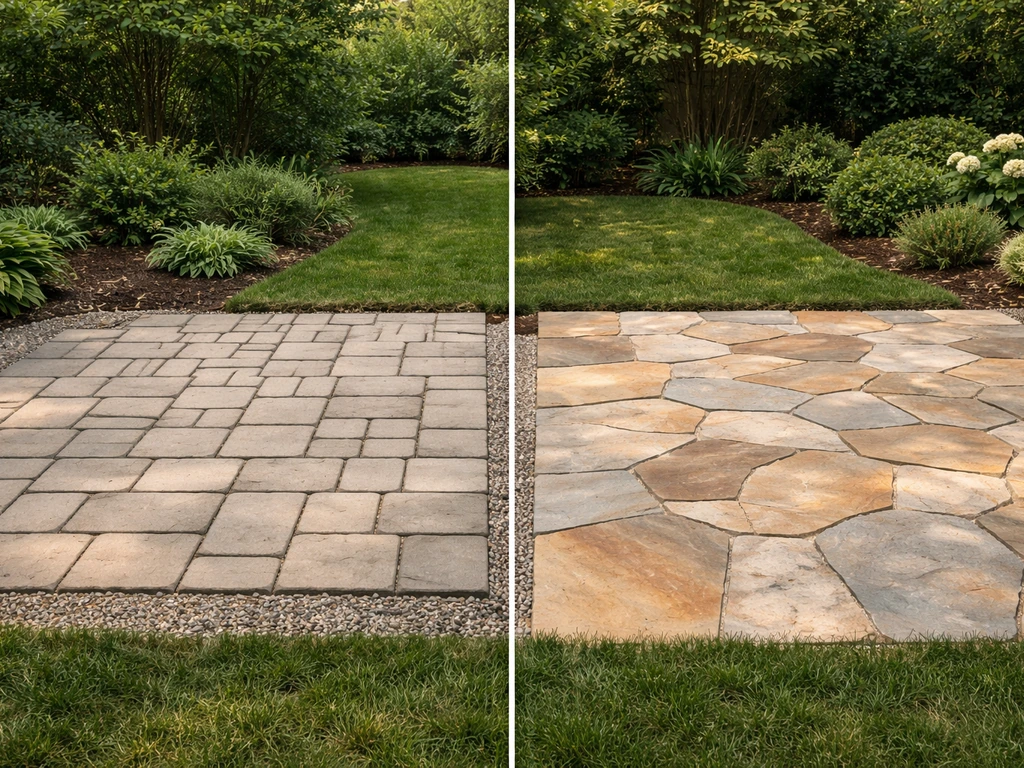
Multiple pricing sources for 2026 consistently peg installed flagstone patios at $15 to $30 per square foot, with some smaller or simpler projects coming in under $1,000 and larger or more complex ones running past $8,000. The $15-to-$27 range covers most standard residential projects. You start pushing toward $30 or beyond when you're using premium stone like bluestone or slate, working on a sloped or hard-to-access site, or choosing tightly cut and fitted stones over a more rustic irregular pattern.
The broad range isn't a cop-out. Flagstone genuinely varies more than almost any other patio material because you're working with natural stone that's quarried, priced, and shipped differently depending on where you live. A limestone patio in Texas costs a fraction of what the same square footage would in New England, where bluestone is the local standard. Keep that in mind as you budget.
Cost Per Square Foot: Materials vs. Labor
Breaking the installed cost into its two parts helps you figure out where your money is actually going and where you can cut back.
| Cost Component | Typical Range (per sq ft) | Notes |
|---|---|---|
| Flagstone material | $3 – $10 | Varies by stone type; limestone is cheapest, bluestone and slate cost more |
| Base materials (gravel, sand) | $1 – $2 | Crushed gravel base plus setting sand or mortar |
| Labor | $8 – $18 | Prep, excavation, laying, leveling, jointing |
| Edging and finishing | $1 – $3 | Metal, stone, or concrete edging; joint sand or polymeric sand |
| Total installed | $15 – $30 | Full project including all of the above |
Labor is consistently the biggest line item, often running 50 to 60 percent of your total bill. That's because laying flagstone is slow, physical work. Each stone has to be sized, positioned, leveled, and set properly. Irregular flagstone takes longer than cut or dimensional stone because the installer has to puzzle-fit each piece. If you're getting a quote that seems high, look at the labor breakdown before assuming the contractor is overcharging.
On the material side, your biggest decision is stone type. Limestone typically runs $3 to $5 per square foot for the stone itself. Sandstone is in a similar range. Bluestone and slate jump to $5 to $10 or more per square foot for the material alone, before a single shovel of dirt is moved. Also factor in a 10 to 15 percent overage when ordering: irregular flagstone has odd edges and gaps that eat into coverage, and you'll have breakage during cutting.
What Contractors Are Actually Charging (and Why)
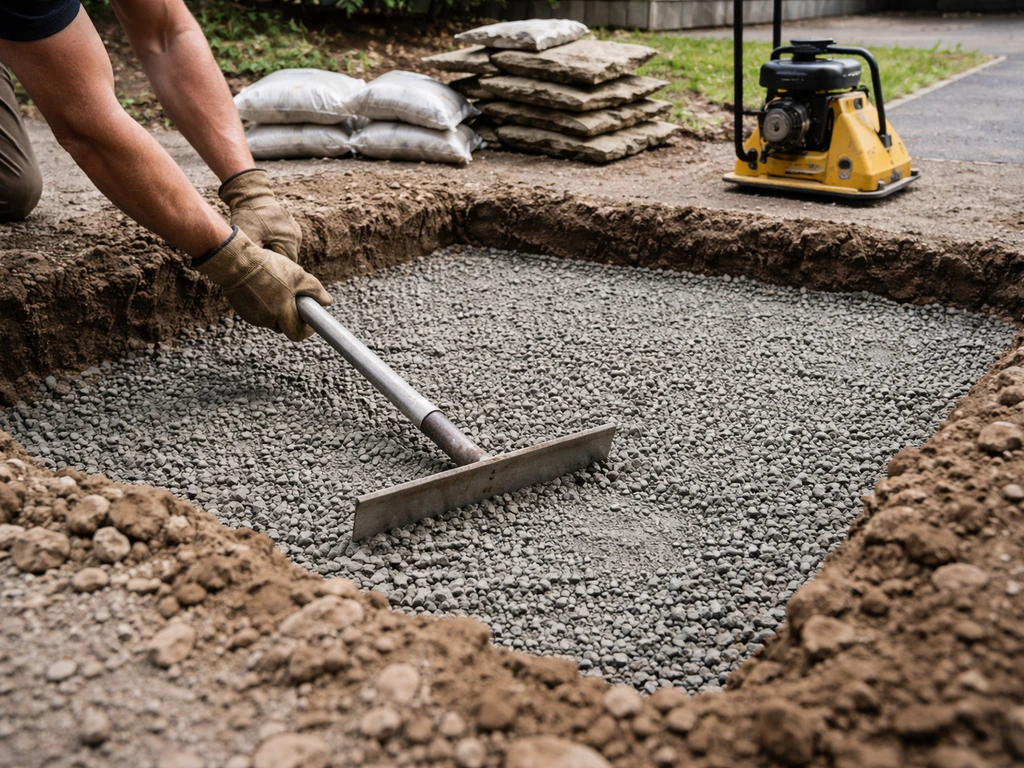
When you hire a contractor, their labor quote isn't just for the time spent placing stones. A properly installed flagstone patio includes excavation (typically 4 to 6 inches deep), a compacted gravel base, a sand or mortar setting bed, laying and leveling each stone, cutting pieces to fit edges, filling joints with sand or mortar, and final cleanup. Skipping or skimping on any of those steps is how you end up with a patio that shifts, heaves, or drains poorly within a few years.
The main factors that push contractor pricing up or down:
- Stone type and thickness: Thicker irregular stone (1.5 to 2 inches) is heavier and harder to handle than thinner cut stone, which takes more labor time.
- Dry-lay vs. mortared: Mortared flagstone on a concrete base costs more upfront (add $3 to $5 per sq ft for the concrete sub-base) but is more durable in freeze-thaw climates.
- Site prep and grading: A flat, accessible backyard is straightforward. A sloped yard, steep grade, or tight access (like a walled backyard in a row home) adds excavation time and cost.
- Drainage requirements: If your site pools water, contractors may recommend a French drain or re-grading, which can add $500 to $2,000+ to the project.
- Design complexity: Curves, inlays, or patterns that require precise cutting add labor hours.
- Project size: Contractors get more efficient on larger projects, so cost per square foot often drops a bit on a 400 sq ft patio vs. a 100 sq ft one.
- Sealing: Sealing the finished patio adds $0.50 to $2 per sq ft but is worth doing on porous stones like limestone or sandstone.
DIY vs. Hiring a Pro: Where the Numbers Actually Land
Going DIY can realistically cut your total cost in half since you're eliminating $8 to $18 per square foot in labor. On a 200 square foot patio, that's a savings of $1,600 to $3,600. That's real money. But flagstone DIY is genuinely harder than other patio types, and the margin for error is smaller than it looks.
Here's what a realistic DIY cost looks like: you're paying $3 to $10 per square foot for stone, $1 to $2 per square foot for base materials, and maybe $200 to $400 in tool rentals (plate compactor, wet saw for cutting, wheelbarrow). On a 12x12 patio (144 sq ft), your all-in DIY materials cost runs roughly $600 to $1,700, versus $2,160 to $4,320 for professional installation. The savings are clear on paper.
The honest trade-offs though: flagstone is heavy (irregular pieces can weigh 50 to 100+ pounds each), the base work is physically demanding, and getting a level surface that drains properly takes experience. A poorly laid flagstone patio can shift and become a tripping hazard within a season or two in cold climates. If you're comfortable with outdoor construction projects and have access to help for moving heavy stone, DIY is absolutely doable. If this is your first hardscaping project on a sloped site, hiring a pro is the safer bet.
| Approach | Estimated Cost (12x12) | Estimated Cost (20x20) | Best For |
|---|---|---|---|
| DIY (materials only) | $600 – $1,700 | $1,800 – $5,200 | Experienced DIYers, flat sites, simple designs |
| Contractor (full install) | $2,160 – $4,320 | $6,000 – $12,000 | Complex sites, premium finishes, no DIY experience |
| Hybrid (DIY prep, pro lay) | $1,400 – $2,800 | $4,000 – $7,500 | Budget-conscious but willing to do base work yourself |
A hybrid approach worth considering: do the excavation and base prep yourself (rent a plate compactor for about $75 to $100 a day), then hire a mason just for the stone-laying portion. Some contractors will quote labor-only jobs. You save significantly on the labor-intensive base work while still getting a professional finish on the visible part of the project.
Quick Estimates by Patio Size
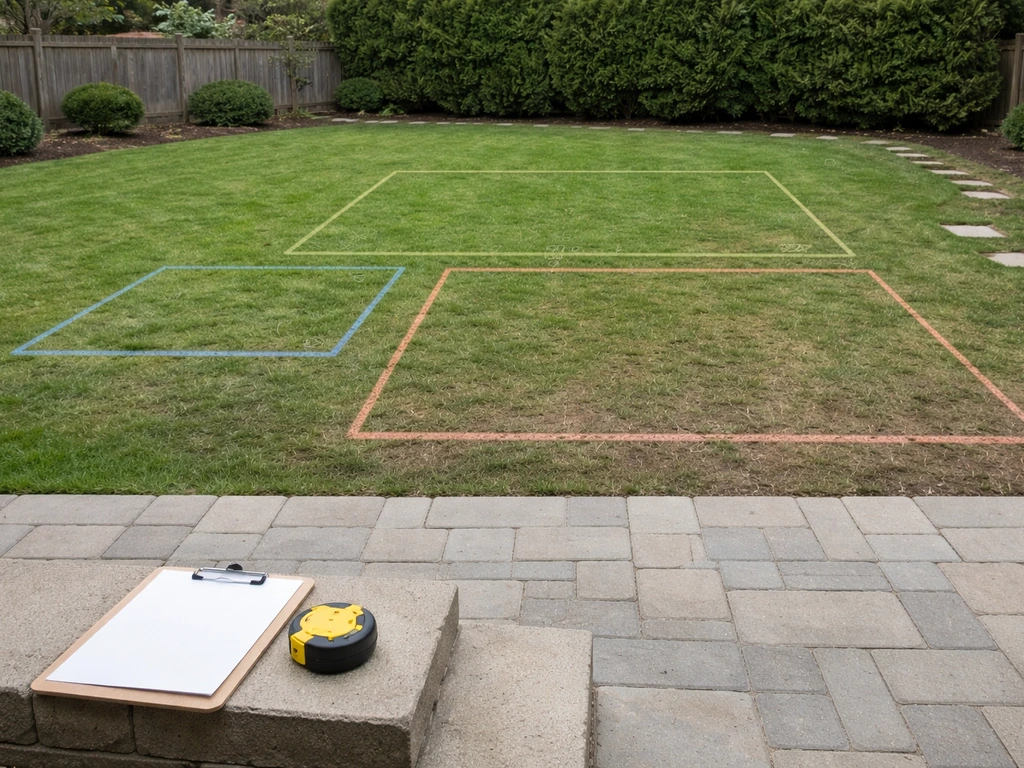
Using the $15 to $30 per square foot installed range, here's what common patio sizes work out to. These are contractor-installed totals. DIY material costs will be roughly 40 to 50 percent of these figures.
| Patio Size | Square Feet | Low Estimate (installed) | High Estimate (installed) | Midpoint |
|---|---|---|---|---|
| 10x10 | 100 sq ft | $1,500 | $3,000 | $2,250 |
| 12x12 | 144 sq ft | $2,160 | $4,320 | $3,240 |
| 12x16 | 192 sq ft | $2,880 | $5,760 | $4,320 |
| 16x16 | 256 sq ft | $3,840 | $7,680 | $5,760 |
| 20x20 | 400 sq ft | $6,000 | $12,000 | $9,000 |
| 20x30 | 600 sq ft | $9,000 | $18,000 | $13,500 |
The midpoint is a useful planning number, but don't lock in a budget based on it. Unilock patio costs vary by paver type, base prep, and installation labor, so it helps to get a line-item quote for your specific square footage how much does a unilock patio cost. Stone type and site conditions can shift your quote to either extreme. A 20x20 patio in irregular limestone in a flat Midwest backyard might land at $7,000. The same footprint in cut bluestone on a sloped coastal New England property could hit $15,000 or more.
Regional Pricing: Why Your Zip Code Matters
Flagstone pricing shifts more by region than almost any other patio type because the stone itself is heavy and expensive to ship. Areas near quarries get much better material pricing. That creates real cost differences across the country.
- Mid-Atlantic and Northeast: Bluestone is the dominant local stone and relatively affordable here. Expect installed costs of $18 to $28 per sq ft for standard projects.
- Southeast and Southwest: Limestone and sandstone are cheap and widely available. Budget $13 to $22 per sq ft for installed work in many parts of Texas, Tennessee, and the Carolinas.
- Midwest: Mix of limestone and imported stone. Installed costs typically run $15 to $25 per sq ft.
- West Coast: Labor costs in California, Oregon, and Washington push totals higher even with decent local stone availability. Budget $20 to $35 per sq ft in major metro areas.
- Mountain West: Material availability varies widely. Flagstone can be very affordable in some areas and expensive in others due to shipping.
To get an accurate number for your project, you need at least three local quotes. Before you call anyone, measure your space, note any slopes or drainage issues, and decide on stone type if you have a preference. When you talk to contractors, ask specifically for a line-item breakdown showing material cost per square foot, labor rate, base prep details, and what finishing (jointing, sealing) is included. That breakdown makes comparing quotes much easier and exposes when someone is padding one line to compensate for a low-ball total.
It's also worth comparing flagstone against similar natural stone options like a standard stone patio or pavers before committing. Flagstone has a look that's hard to replicate, but depending on your region, you might find comparable aesthetics at a lower installed cost with a different material.
How to Budget Smart and Avoid the Common Mistakes
The single most common budgeting mistake with flagstone is using a price-per-square-foot estimate without accounting for site prep costs and coverage waste. If you want a straight answer for how much for stone patio projects, start with the installed per-square-foot range, then add site prep and overage. If you are comparing materials, you may also want to check how much patio bricks cost in your area before you decide. Stone coverage loss alone (10 to 15 percent overage) adds meaningfully to material cost, and excavation on an average residential site runs $300 to $800 before a single stone is laid.
Practical ways to keep costs in check without cutting corners:
- Choose irregular over cut stone: Random irregular flagstone typically costs $1 to $3 per sq ft less for the material and is the traditional look most people picture anyway. Cut or dimensional flagstone is more uniform but pricier.
- Go with a locally sourced stone: Ask your supplier what stone comes from the nearest quarry. That question alone can save you $1 to $3 per sq ft on material costs.
- Keep the shape simple: Rectangular patios are faster to lay and require less cutting than curved or freeform designs. A curved patio can add 15 to 25 percent to labor time.
- Schedule off-season: Many contractors offer 10 to 15 percent discounts for jobs booked in late fall or winter (in non-freeze regions) when demand drops.
- Get a dry-lay quote first: In climates that don't see hard freezes, a dry-laid flagstone patio on a well-compacted gravel base is nearly as durable as mortared and significantly cheaper.
- Skip sealing on your first year: Wait and see how the stone performs before paying for sealing. Dense stones like bluestone often don't need it right away.
- Don't under-build the base: The one place you shouldn't cut corners is the gravel base. A 4-inch minimum compacted gravel base prevents the shifting and heaving that leads to costly repairs or redo jobs.
As a next step, use the size-based estimates above to set a rough budget range, then get three local quotes with itemized breakdowns. If quotes come back significantly over your range, ask contractors specifically whether changing the stone type or simplifying the design could bring it down. Most good contractors will work through those trade-offs with you rather than just asking you to stretch your budget.
FAQ
What is the true cost difference between limestone, sandstone, bluestone, and slate for a flagstone patio?
The per-square-foot installed range stays similar, but material-heavy patios skew higher with bluestone or slate because the stone itself can cost several dollars more per square foot, plus you often see higher cutting and waste. If you are comparing quotes, ask for the stone species named on the proposal and confirm whether the contractor is using the same thickness and finish on every line item.
Does the $15 to $30 per square foot price include base prep and jointing, or are those add-ons?
In a properly itemized quote, base prep (excavation depth, compacted gravel, and a setting layer), cutting, and joint filling should be included. If you only see a single lump sum, ask what is included specifically, especially jointing sand versus mortar, and whether final cleanup and haul-off are part of the price.
How much does drainage and site condition change the cost?
Poor drainage usually pushes costs up because installers may need a thicker base, additional subgrade correction, or a revised slope toward a drain. Expect a higher labor component when the site is uneven or has roots, utility lines, or a need to manage runoff, and get the slope plan in writing before work starts.
Is sealing a flagstone patio usually included, and what does it cost if it is not?
Sealing is sometimes included for certain contractors or stone types, but often it is an extra line item. If it is not specified, ask whether you will be getting a penetrating sealer, how many coats, and whether the price covers sealing the joints after installation.
What patio design choices most increase flagstone costs?
Patterns with tight fitting, curves, borders, steps, or custom edging typically raise labor because each piece must be cut and positioned. If you want to reduce cost, ask about using a simpler layout, larger-stone selection, and fewer cuts at edges, since cutting time is a common hidden driver.
How does overage or coverage waste work in the real world?
Even though many estimates begin with square footage, irregular flagstone often requires 10 to 15 percent extra material to account for breakage, cutting losses, and uneven coverage. Confirm whether your quote includes that overage in the material quantity, especially for complex shapes.
Why can two contractors quote the same size patio at very different prices?
Differences usually come from stone choice (thickness and grade), how they handle the base (depth, gravel spec, and compaction), and whether they include leveling, cutting, and jointing details. Request a line-item breakdown and compare those categories, not just the final total per square foot.
Is DIY truly cheaper, and what is the biggest cost trap?
DIY can cut labor out, but the biggest trap is underestimating the cost and time of base prep and correct leveling, which can lead to rework. If you plan to DIY, budget for proper compaction equipment, a wet saw if you need cuts, and enough helper coverage to move heavy stones safely.
What tools are commonly needed for a DIY flagstone patio, and how should I budget them?
Most projects require a plate compactor rental, hand tools for layout and leveling, and often a wet saw or appropriate cutting method for thicker stones. Don’t forget small consumables like jointing sand, extra blades, and leveling materials, and clarify rental duration so you do not pay for extra days.
How long will a properly installed patio last, and what signs mean the installer skipped steps?
A well-built patio should resist shifting and maintain good drainage for many years. Red flags include visible rocking stones, joints washing out, uneven surfaces, puddling after rain, and gaps that look larger over time, all of which can point to insufficient base, poor compaction, or incorrect setting bed.
Do I need permits or planning approval for a flagstone patio, and does that affect cost?
Some areas require permits for patios, especially if there are drainage changes or construction near property lines. Permit fees are usually separate from contractor pricing, so ask your local building department (or the contractor) early and include any required inspections in your budget and timeline.
Should I compare flagstone pricing against pavers or another natural stone before deciding?
Yes, if your goal is a predictable budget. Pavers often cost less installed and offer more uniform installation time, while flagstone can be significantly more variable due to cutting and stone thickness. Use your three local quotes to compare apples to apples, asking what thickness and base specs each material includes.
Next Articles
How Much Does It Cost for a Brick Patio in 2026
Brick patio cost ranges for 10x10, 12x12, 20x20, including base prep, labor, and extras for fair budgeting in 2026.
How Much Do Patio Bricks Cost? Complete Price Guide
Patio brick and total brick patio costs with real ranges for 10x10, 12x12, 20x20 plus DIY vs contractor pricing factors.
How Much Do Stone Patios Cost? Installed Price Guide
Get realistic stone patio costs by size, stone type, and labor. Includes breakdown, hidden fees, and DIY vs pro budgetin