
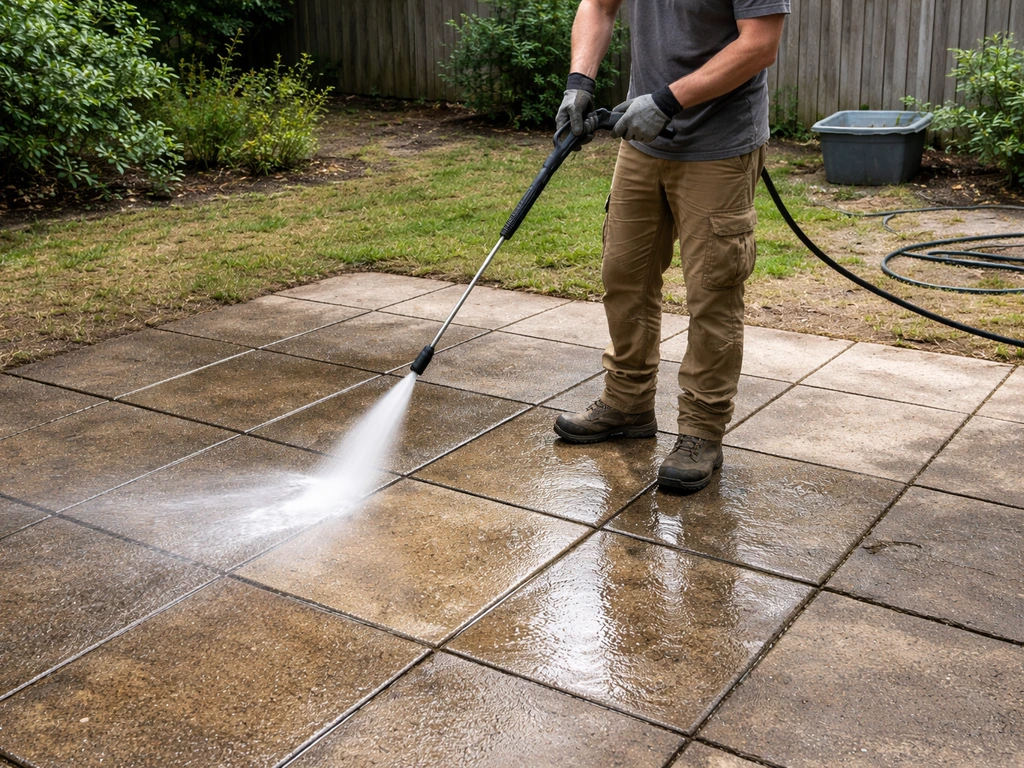
For most residential patios, expect to charge or pay somewhere between $135 and $400 for a standard pressure wash, with the sweet spot for a typical 200–400 sq ft concrete or paver patio landing around $150–$250. Per-square-foot rates run $0.25–$0.75 depending on the surface, condition, and what's included. If you add sealing, that can push the total to $300–$700 or more. Those ranges hold for 2026 across most U.S. markets, though regional labor costs, patio material, and the amount of gunk you're dealing with can swing the number significantly in either direction.
How Much to Charge for Patio Cleaning: Real Prices

Felix Carver
26 Jun 2026
Quick price ranges by patio size
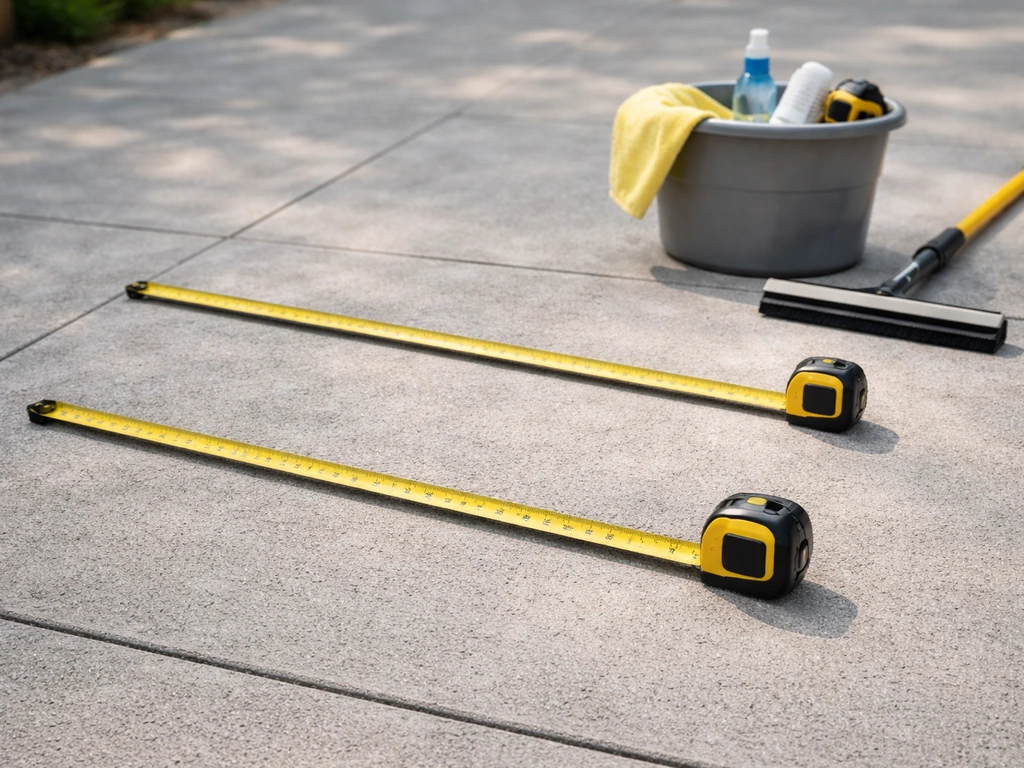
Here's how cleaning costs stack up at common patio sizes, using a baseline rate of $0.30–$0.55 per sq ft for a standard concrete or paver patio in moderate condition. These are cleaning-only estimates (no sealing). Add roughly 50–100% on top if you're bundling in a seal coat.
| Patio Size | Square Footage | Cleaning Only (est.) | Clean + Seal (est.) |
|---|---|---|---|
| 10x10 | 100 sq ft | $100–$150 (minimum applies) | $200–$350 |
| 12x12 | 144 sq ft | $100–$150 (minimum applies) | $215–$375 |
| 16x16 | 256 sq ft | $100–$160 | $280–$450 |
| 20x20 | 400 sq ft | $120–$220 | $320–$550 |
| 20x30 | 600 sq ft | $180–$330 | $480–$800 |
| 25x40 | 1,000 sq ft | $300–$550 | $800–$1,400 |
Notice that small patios (under about 300 sq ft) almost always hit a contractor minimum rather than being calculated purely on square footage. Most operators set a floor of $100–$250 per visit just to cover the drive, setup, and time. A 100 sq ft patio at $0.40/sq ft would technically be $40, but no professional is going to drive out for that. Expect to pay the minimum regardless of size for anything under about 250–300 sq ft.
What actually moves the price up or down
Patio material and finish
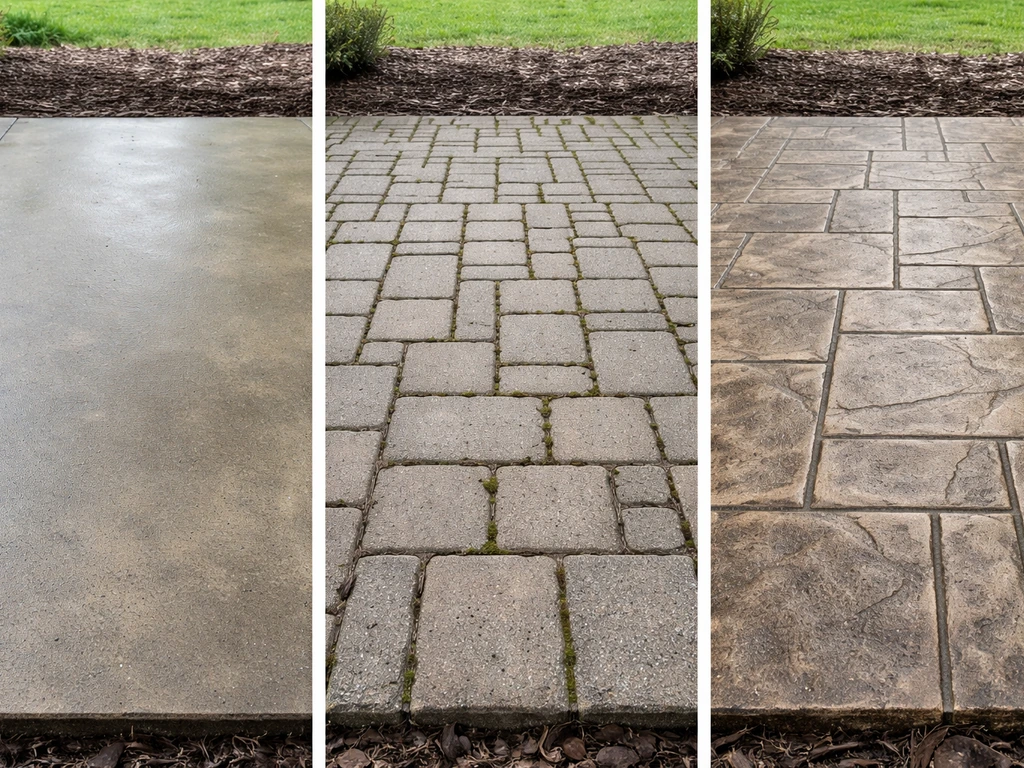
Plain concrete is the cheapest to clean because it can handle higher pressure and doesn't need specialty chemicals. Concrete patio cleaning typically runs $0. 30–$0. 55 per sq ft.
Pavers cost more because joints need to be protected, efflorescence and weed growth in the joints require extra attention, and the risk of damaging the sand bed or joint filler means operators need to be more careful. Paver cleaning alone runs $1. 50–$3. 00 per sq ft in most markets, and a full restoration (clean, re-sand joints, reseal) can hit $2.
50–$7. 00 per sq ft depending on condition. Stamped concrete falls in between because the texture traps debris and the decorative finish can be damaged by too-high pressure. Flagstone and natural stone are similar to pavers: more cautious technique, more chemical cost, higher rate.
Condition and level of buildup
This is one of the biggest price drivers that homeowners underestimate. A patio that just needs a routine annual rinse takes maybe 30–45 minutes. A patio with thick algae and mildew colonies, heavy efflorescence, embedded rust stains, or years of neglect can take two to three times longer and require pre-treatment chemicals, dwell time (10–20 minutes for soft-wash chemistry to do its job), and multiple passes. Contractors who price from a photo often under-quote badly. The honest move is always a site visit before quoting heavy-duty jobs.
Scope: cleaning method and add-ons
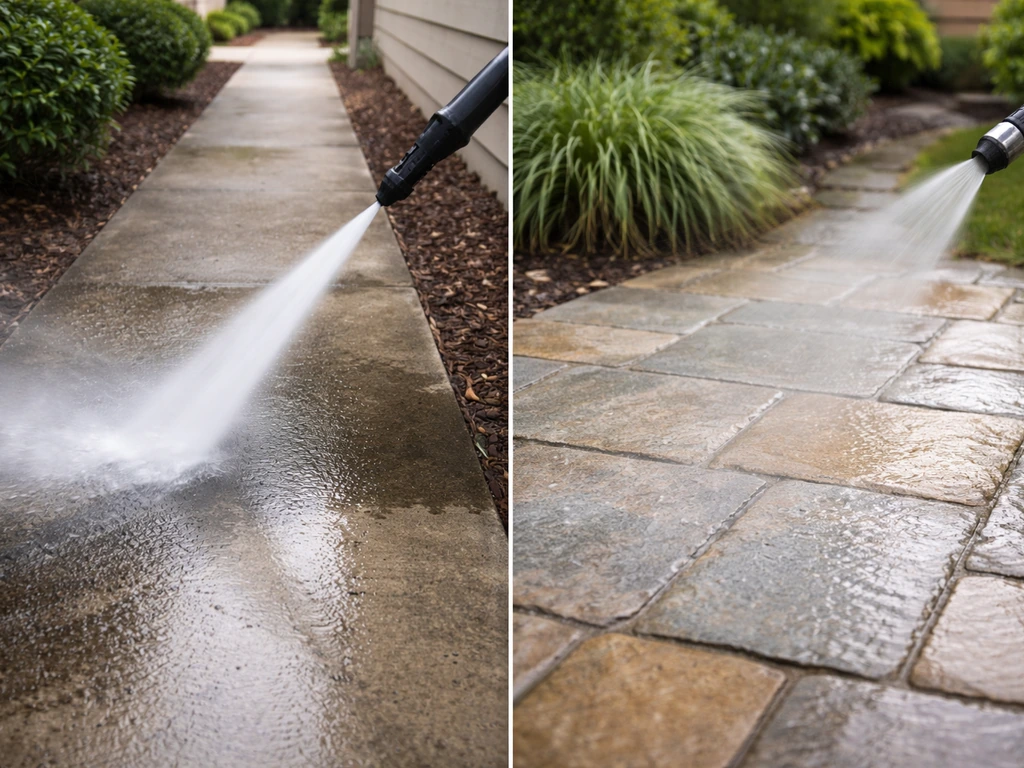
The cleaning method changes cost significantly. blank" rel="noopener noreferrer">Standard pressure washing (3,000–4,400 PSI for gas machines) is fast and straightforward on concrete. blank" rel="noopener noreferrer">Soft washing uses low pressure (below 500 PSI at the nozzle) with sodium hypochlorite-based chemistry doing the heavy lifting, then rinsing after the dwell period. Soft washing costs more in chemicals but is essential for certain surfaces and organic staining. Either way, if sealing is on the table, that's almost always a separate line item and a major cost add-on.
Access and complexity
A fenced backyard with a narrow gate, a second-story patio, furniture that needs to be moved, planters built into the surface, tight corners, or any obstacle that slows down setup and water management adds time. Most contractors add 15–25% for difficult access. If there's no hose hookup nearby and the operator has to tank, that's another add-on.
How contractors price the job
There are three main pricing structures you'll see in the market, and most contractors use a combination of all three depending on job size.
- Per square foot: The standard approach for medium to large jobs. Rates run $0.15–$0.75/sq ft for plain pressure washing, or $1.50–$3.00/sq ft for paver cleaning that involves joint work or restoration. The per-sq-ft model rewards accurate measuring and punishes estimates pulled from memory.
- Flat rate per job: Common for small to mid-size patios where the contractor has a good feel for how long it will take. A flat $150–$200 for a standard 200–300 sq ft backyard patio is typical in mid-cost markets.
- Minimum service charge: Almost universal. Most operators set a floor of $100–$250 per visit regardless of square footage. In higher-cost markets like California or New York, minimums of $150–$250 are standard. This covers mobilization, equipment setup, and baseline labor.
- Add-ons: Chemical surcharges ($15–$40 for specialty chemicals), sealing (priced per sq ft on top of cleaning), furniture moving ($20–$50), disposal fees if hazardous runoff needs management, and mobilization fees for jobs more than 30–45 minutes away.
A practical pricing formula that holds up well: (square footage × rate) + chemical surcharge + mobilization fee + add-ons, with a minimum floor applied if the calculation comes in below your threshold. If you're building a quote, start there.
Cost breakdown: where the money actually goes
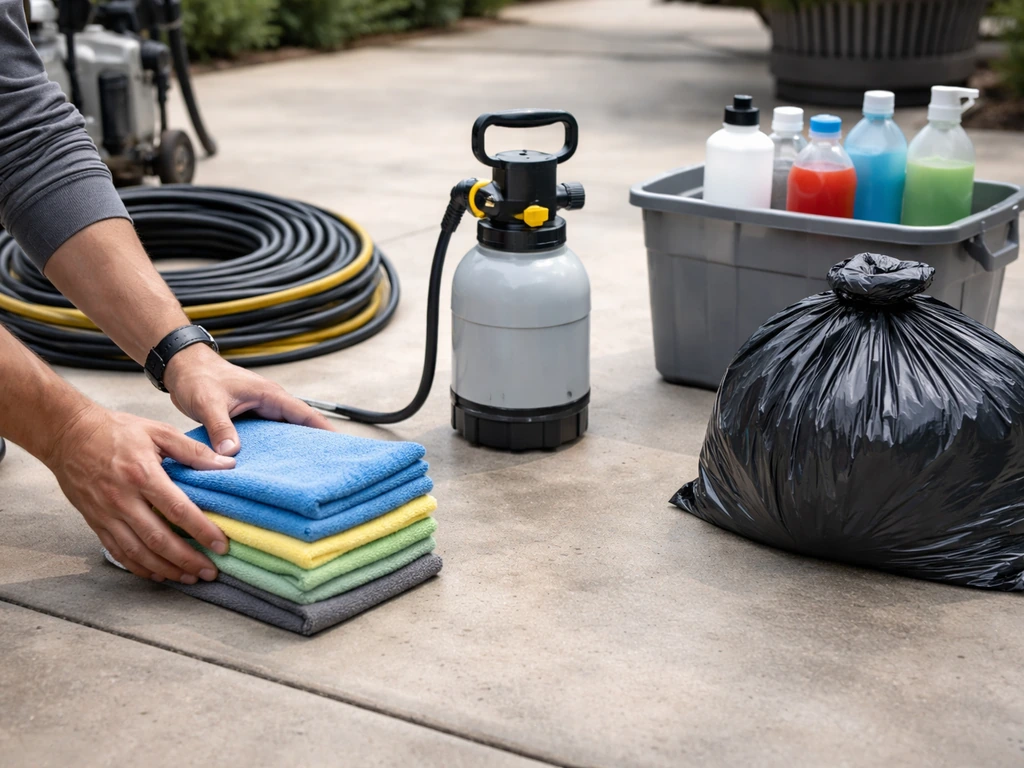
On a typical $175 patio cleaning job for a 300–400 sq ft concrete patio, here's roughly how the costs break down on the contractor side: If you're specifically asking about painting (not cleaning), the labor and material costs can be different from patio pressure-washing prices.
| Cost Category | Typical Range | Notes |
|---|---|---|
| Labor (1–2 hrs) | $60–$120 | Includes setup, cleaning, breakdown |
| Chemicals/detergents | $10–$30 | Higher for soft-wash or heavy organic buildup |
| Equipment overhead (amortized) | $15–$30 | Machine, surface cleaner attachment, hoses |
| Mobilization/travel | $10–$25 | More for distant jobs |
| Disposal/runoff management | $0–$20 | Usually $0 for standard residential; more if chemical neutralization required |
| Sealing (if included) | $50–$200+ | Varies widely by product and sq footage |
Labor is the dominant cost on most jobs, which is why condition matters so much. A 90-minute job and a 3-hour job may look identical in a photo but cost double to service. Chemicals are a relatively small line item for basic cleaning but jump up for soft-wash jobs using sodium hypochlorite or specialty products like oxygenated (hydrogen peroxide-based) cleaners for natural stone. Equipment overhead is real but often invisible to homeowners. A surface cleaner attachment rental alone runs $20–$35/day, and the pressure washer itself rents for $50–$250/day depending on spec and market.
Sealing is a separate conversation entirely. If you're pricing cleaning plus sealing as a package, the sealing component alone typically adds $0.50–$2.50 per sq ft for a standard paver or concrete seal coat, and full paver restoration (clean, re-sand, reseal) can reach $4.00–$7.00 per sq ft in premium markets. If your customer is asking about sealing after cleaning, it's worth pointing them toward comparing the costs of each service separately so they understand what they're paying for.
Regional and seasonal price variation
Location moves patio cleaning prices more than most people expect. As a rough calibration: a 300 sq ft patio cleaning job that costs $100–$175 in a mid-size Midwest or Southern city might run $175–$300 in metro California, New York, or Seattle. A local example from Vancouver, WA puts a concrete patio/porch cleaning at $100–$250 with an average of $175 and a time requirement of 1–2 hours. That's a useful benchmark for Pacific Northwest mid-market pricing.
Florida and the Gulf Coast are interesting outliers because humidity, algae, and mold growth are so aggressive that cleaning frequency and chemical intensity go up. South Florida paver cleaning and restoration services price noticeably higher per square foot than national averages, with full prep-and-seal packages commonly starting at $300–$600 for mid-size patios.
Seasonally, spring and early summer are peak demand for patio cleaning, so contractors in competitive markets can hold or raise rates. Late fall and winter (in cold climates) slow down dramatically, and many operators discount 10–20% to keep work flowing. If you're a homeowner trying to get the best price, booking in September or October in Northern states often gets you a better deal and faster scheduling. If you're the contractor, know your local demand curve and price accordingly.
How to quote accurately: site-visit checklist and measuring steps
Never give a firm quote on a patio cleaning job from photos alone if the condition is uncertain. A quick 15-minute site visit can prevent you from under-quoting a job by $100 or more. Here's a practical checklist for the visit:
- Measure the patio accurately. Walk the perimeter and multiply length by width for a rectangle. For irregular shapes, break it into rectangles or use a laser measurer. Don't rely on homeowner estimates, which are almost always wrong.
- Identify the surface material. Concrete, pavers, stamped concrete, flagstone, brick, and tile all have different method and rate implications. Look for any cracked, loose, or deteriorated areas that could be damaged by high pressure.
- Assess condition and buildup. Light dust and leaf debris? Routine job. Thick algae, black mildew, embedded rust, or heavily weed-infested paver joints? Add a condition multiplier (typically 1.25–1.75x your base rate).
- Check access. How wide is the gate? Is there a hose bib within 50 feet? Is there somewhere to manage runoff? Any furniture, planters, or structures that need to be worked around or moved?
- Determine what's in scope. Cleaning only? Cleaning plus sealing? Joint sand replacement on pavers? Spot treatment for rust or oil stains? Each of these is a separate line item.
- Confirm water access and electrical availability if needed for equipment.
- Note any environmental constraints. Nearby garden beds that could be damaged by chemical overspray, slopes that could send runoff into a neighbor's yard, or any local disposal regulations for wash water.
Once you have these details, build your quote using the formula: base sq ft rate × measured area, floored at your minimum, plus any applicable add-ons. If condition was worse than expected when you arrive on the day of the job, have a clear policy about how you communicate scope changes before proceeding.
DIY vs. hiring a contractor: what it actually changes
DIY patio cleaning makes sense in a specific situation: you have a plain concrete or brick patio in reasonable condition, you're comfortable operating a pressure washer, and you're willing to put in 2–4 hours including prep and cleanup. If you’re wondering how much it costs to paint a patio cover, the pricing factors are different from cleaning and usually include surface prep, coating type, and labor for reaching overhead areas DIY patio cleaning.
The equipment math works out to roughly $50–$100/day for a pressure washer rental plus $20–$35/day for a surface cleaner attachment, so maybe $70–$135 in equipment plus $15–$25 in chemicals. Total DIY cost for a 300–400 sq ft concrete patio: $90–$160. That's real savings versus a $150–$225 professional quote for the same scope.
However, DIY changes the risk profile significantly depending on the surface. Pavers, natural stone, flagstone, and stamped concrete can all be damaged by improper pressure settings, wrong nozzle choice, or incorrect chemical application. A standard residential pressure washer at 3,000–4,400 PSI that works fine on plain concrete can blow out paver joint sand, etch stamped finishes, or flake loose stone if you're not experienced. If you damage the surface, you've just created a much more expensive problem than the cleaning job itself.
Sealing is where the DIY math gets harder. Professional sealing involves proper surface prep (which has to be right for the sealer to bond), correct product selection for the surface type, and application skill that affects how even and durable the result is. A bad DIY seal job often needs to be stripped and redone by a professional, which costs more than just having it done right the first time. If your patio needs cleaning only and it's plain concrete in good shape, DIY is a reasonable call. If sealing is on the table or the surface is anything more complex than basic concrete, the professional route typically pays for itself.
| Scenario | DIY Cost | Pro Cost | Recommendation |
|---|---|---|---|
| Plain concrete patio, routine cleaning | $90–$160 | $135–$250 | DIY is reasonable if you're comfortable with equipment |
| Paver patio, moderate algae/weeds in joints | $90–$160 (equipment) | $200–$450 | Pro recommended; joint damage risk is real |
| Stamped concrete, light cleaning | $90–$160 | $150–$300 | DIY possible at low pressure; know your equipment settings |
| Any surface, clean + seal | $130–$300 (materials+rental) | $300–$700+ | Pro recommended for better adhesion and longer-lasting result |
| Flagstone or natural stone | $90–$160 | $200–$500+ | Pro strongly recommended; chemical compatibility matters |
Your next steps before getting or giving a quote
Whether you're a homeowner budgeting the job or a contractor preparing a bid, the same five steps apply: measure the actual square footage, identify the exact surface material and finish, honestly assess the condition and scope of work, decide upfront whether sealing or restoration is part of the job, and factor in any access or regional cost adjustments. With those five data points in hand, you can build a number that holds up in the real world rather than a guess that falls apart on arrival.
If you're also weighing whether power washing is the right approach for your specific surface, or whether the patio needs sealing after cleaning, those decisions directly affect both cost and the long-term result. Patio sealing, especially for pavers, adds meaningful cost but also extends the time before the next cleaning is needed. Knowing the full scope before you price the job is what separates a quote that works for both sides from one that creates friction after the fact.
FAQ
How much less should I pay if I only need spot cleaning, not the whole patio?
Most pros quote per visit with a minimum, so ask whether the price assumes a full clean of the entire patio or just a targeted spot treatment. If you need only a few stained sections, you may pay less than the standard per-square-foot rate, but you should still expect a minimum charge for setup and water management.
Why does the quote change if the patio has algae or mildew?
If the patio has organic growth (algae, mildew, lichens), the contractor may need a dwell time and possibly a soft-wash chemistry step before rinsing. Ask whether the listed rate includes pre-treatment, dwell time, and re-rinse, because “power wash only” pricing often underestimates the time required for heavy growth.
What add-ons should I expect for water runoff, plants, or drainage during patio cleaning?
Water control affects labor time. If the contractor must protect landscaping, run hoses farther than expected, or use containment to keep runoff off sensitive areas, you can see add-ons. Confirm whether they cover protecting plants, controlling overspray, and where the runoff will drain, especially near lawns, drains, or garden beds.
What should I ask a contractor to include so the final bill does not jump after they arrive?
There is usually no reliable way to “know” after photos alone, but you can reduce surprises by asking for the scope definition. Request that the quote states the cleaning method (pressure vs soft wash), whether it includes pre-treatment dwell time, number of passes, and whether rust or efflorescence is included or treated as an extra.
Does patio cleaning always remove stains, or should I budget extra?
Not always. Many contractors will remove surface dirt efficiently, but embedded stains like rust, tannin, or mineral deposits may require specialized treatments and multiple visits. Ask whether they guarantee stain removal or just cleaning, and whether stain-heavy areas are priced as an additional chemical or labor surcharge.
How can I tell if the quote is for cleaning only versus paver restoration (re-sanding and resealing)?
On pavers and natural stone, joint sand, joint filler, and efflorescence risk can push the job toward gentler methods. Ask what they will do to protect joints, whether they will re-sand after cleaning, and whether “restoration” is included in the quoted price.
How do I compare two quotes that list different per-square-foot prices and minimums?
You can compare quotes more fairly by asking for a per-sq-ft rate and a stated minimum, then checking what is included in each line item. A low per-square-foot number can still be expensive if the contractor hits a high minimum, uses a more limited method, or excludes key steps like pre-treatment and post-rinse.
Are there safety or compliance factors that can change the price?
If a home has special risks like lead paint chips, nearby storm drains, or fragile landscaping, some companies may adjust technique and add safety steps. Ask whether they use chemicals that require specific handling and whether they manage runoff to comply with local expectations.
What’s the biggest DIY mistake that causes costs to jump beyond the quote?
DIY costs can look cheaper, but the “hidden” cost is risk and time. If you plan to do pavers or stamped concrete, consider testing a small inconspicuous area first and protecting joints or finish with correct nozzle settings and chemistry. If you cannot match professional dwell times and rinsing discipline, the risk of damage can erase the savings quickly.
What timing strategy typically gets the best price, and are there weekday or bundling options?
For scheduling, peak demand can move prices, but discounting is most common in slower seasons. If you want the best pricing, request quotes for your intended time window and ask whether they bundle multiple nearby jobs or offer weekday rates, since access and congestion can affect labor efficiency.
Next Articles
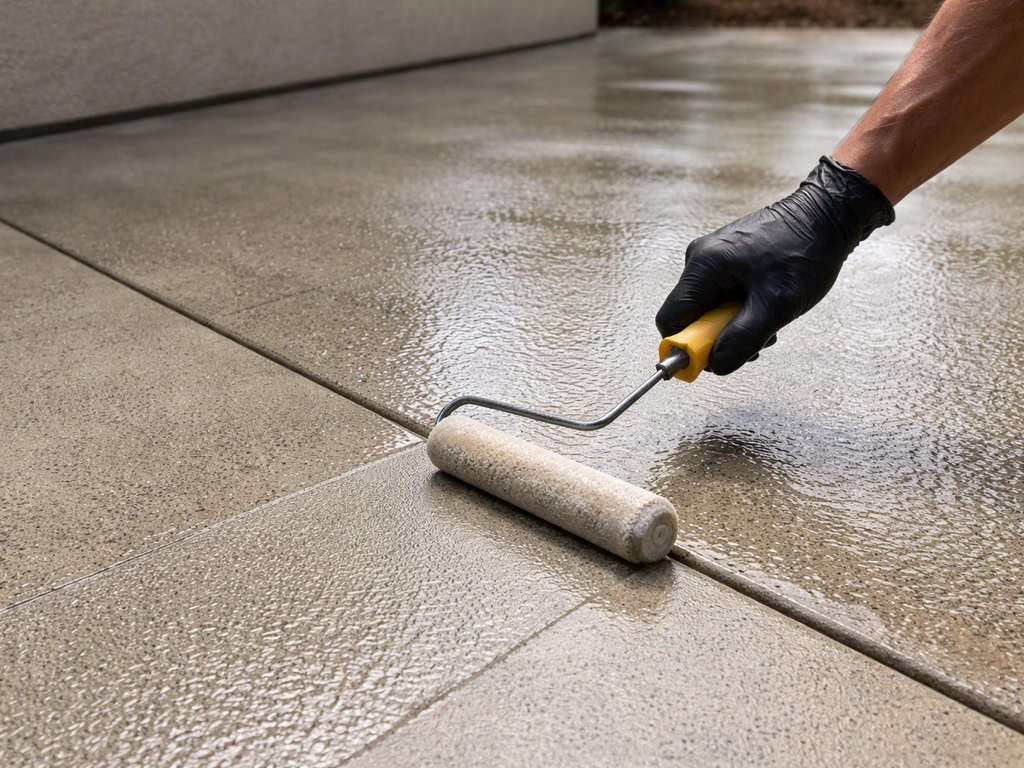
How Much Does It Cost to Seal a Patio? Concrete and More
Get patio sealing costs fast: ranges for concrete and other surfaces, what’s included, typical sizes, and DIY vs pro tip

How Much Does It Cost to Power Wash a Patio?
Patio pressure or power washing costs by size, material, and grime, plus DIY vs pro budgeting and quote checklist.
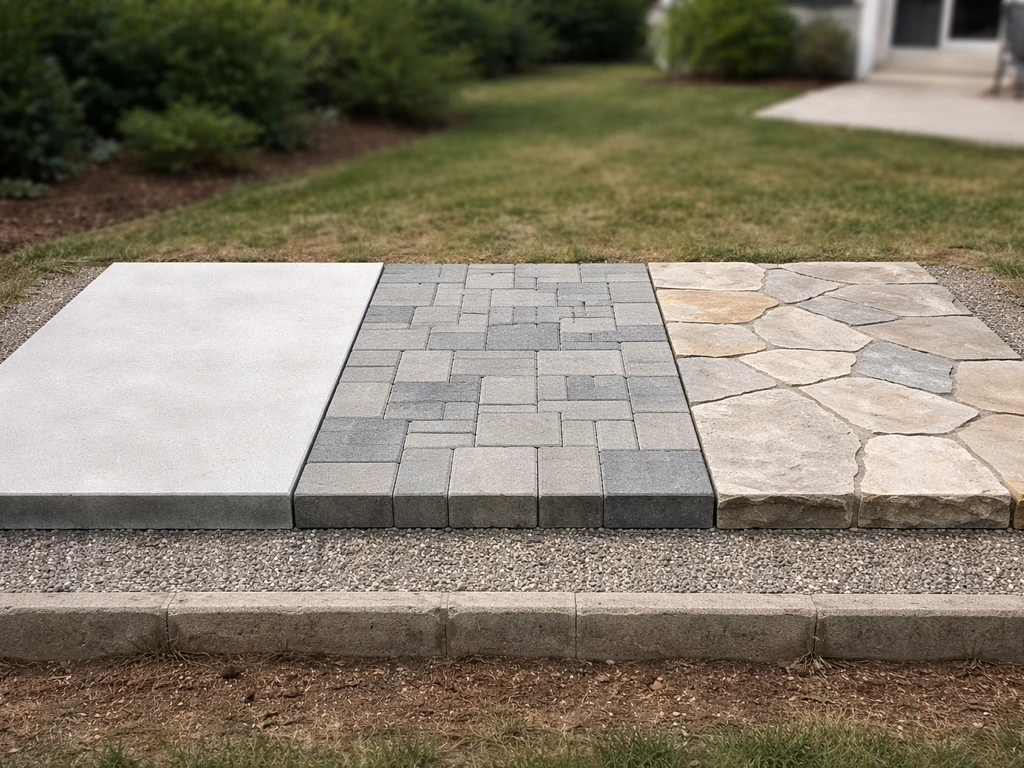
How Much Should I Expect to Pay for a Patio
Patio cost guide with real price ranges by size and material, full line-item budget, DIY vs install, and quote checklist