
For most flat, ground-level yards, a patio is cheaper than decking. For a focused cost comparison and more on choosing between surfaces, see our guide on whether is it cheaper to build a deck or paver patio. A basic poured concrete patio runs $5–$12 per sq ft installed, while the least expensive deck option, pressure-treated wood, starts around $15–$25 per sq ft once you factor in the substructure, footings, and framing that concrete simply does not need. The gap widens on sloped or elevated sites because decks require engineered footings, posts, and beams. That said, a premium flagstone or stamped concrete patio can cost more than a simple pressure-treated deck, so the real answer depends on material choice, site conditions, and how much of the work you are willing to do yourself.
Is It Cheaper to Lay a Patio or Decking? Cost Guide

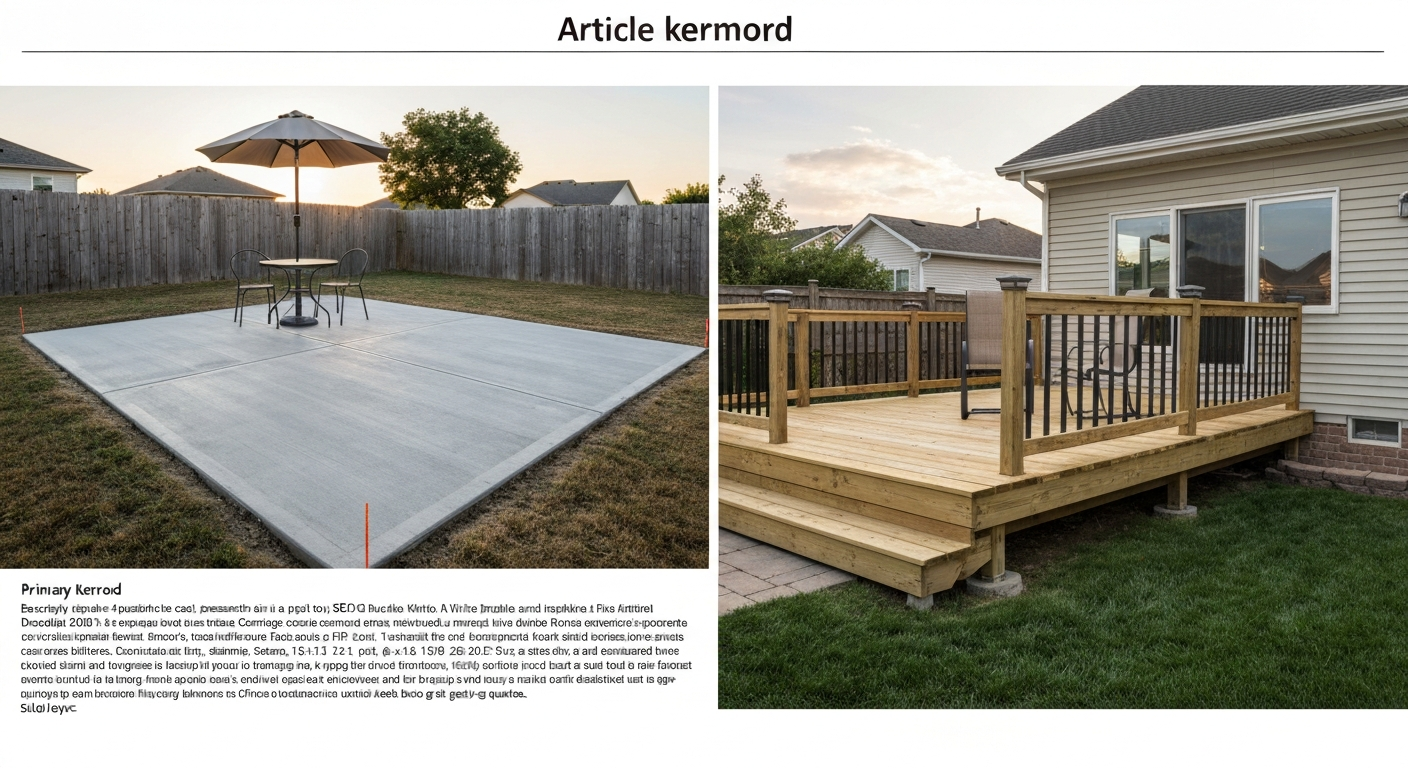
When a patio is cheaper (and when a deck wins)
Patios are almost always cheaper on flat ground. The concrete or stone sits directly on a prepared base, so there is no substructure to engineer or build. A 12x12 poured concrete patio can be done for roughly $700–$1,700 installed. A comparable pressure-treated deck starts closer to $2,100 and can easily reach $4,000+ once footings, joists, decking boards, and a basic railing are included. If your yard is level and you are comfortable with a hard surface, patio wins on price every time at the entry level.
Decking becomes cost-competitive when your yard slopes significantly. On a site that drops more than 12–18 inches over the deck span, a patio requires expensive excavation and fill, retaining walls, or substantial grading. A deck built over the slope can actually be cheaper in those situations because the structure simply bridges the grade change. Decking is also worth the extra cost when you specifically need a wood surface (for aesthetics, comfort underfoot, or a covered outdoor room feel) and are willing to budget for it.
| Scenario | Cheaper Option | Why |
|---|---|---|
| Flat yard, budget build | Patio (concrete) | No substructure needed; slab sits on gravel base |
| Flat yard, mid-range finish | Patio (pavers or brick) | Still no framing; labor-intensive but competitive |
| Sloped yard (12+ in. drop) | Deck (often) | Avoids retaining walls and major regrading costs |
| Premium finish, flat yard | Deck (PT wood) | Stamped or flagstone patio can exceed a basic deck |
| Long-term low maintenance | Composite deck or concrete patio | Both resist rot; composite deck costs more upfront |
| DIY-friendly project | Patio (concrete or pavers) | Simpler tools, no structural engineering required |
What actually drives the final price
Size is the obvious driver, but it is rarely the whole story. These are the factors that push quotes well above or below the average ranges.
- Size and shape: Irregular shapes, curved edges, or cut-outs around trees add labor and waste material. A simple rectangle is always the cheapest footprint.
- Site slope and grading: Even a modest 6-inch grade change across a 20x20 patio adds excavation, fill, and compaction costs. Steep slopes can add $1,000–$5,000+ to a patio job.
- Soil conditions: Expansive clay soils, high water tables, or areas with poor drainage require a deeper or engineered subbase, adding $1–$5 per sq ft or more.
- Access: A walled backyard that a concrete truck or skid-steer cannot reach means manual labor, which adds hours. Expect a 10–20% surcharge for restricted access.
- Permits: Many jurisdictions require a permit for decks over 200 sq ft or above a certain height. Patio permits are less common but required in some municipalities. Permit fees typically run $100–$500, with inspections adding scheduling time.
- Finish level: A broom-finish concrete slab costs a fraction of stamped, stained, or exposed-aggregate finishes. Pavers vary wildly by stone type. Natural flagstone can cost 3–5x more than concrete per sq ft.
- Drainage: If your yard drains toward the house, you may need channel drains, French drains, or re-grading. Drainage work can add $500–$3,000 to a project.
- Demolition: Removing an old patio or deck adds demo and haul-away costs, typically $500–$2,500 depending on size and material.
Patio material costs: what you actually pay per sq ft
These are installed cost ranges, meaning materials plus contractor labor, a standard gravel subbase, and basic site prep. If you’re asking what is the cheapest patio to build, basic poured concrete is typically the least expensive option per square foot. They reflect national averages; expect costs in high-labor markets like California, New York, or Seattle to run 20–40% above the midpoints listed.
| Material | Installed Cost (per sq ft) | Typical 200 sq ft Project | Notes |
|---|---|---|---|
| Poured concrete (broom finish) | $5–$12 | $1,000–$2,400 | Cheapest installed option; 4-in. slab on 3–4 in. gravel base |
| Concrete slab (reinforced) | $6–$18 | $1,200–$3,600 | Rebar or wire mesh adds cost; needed for heavier loads or frost areas |
| Concrete pavers (interlocking) | $8–$24 | $1,600–$4,800 | Labor is 50–80% of total cost; stone type drives range |
| Brick pavers | $10–$22 | $2,000–$4,400 | Classic look; durable but labor-intensive to set and level |
| Flagstone (natural stone) | $15–$27 | $3,000–$5,400 | Dry-laid is cheaper than mortar-set; stone type varies widely |
| Stamped concrete | $8–$28 | $1,600–$5,600 | Low end = simple single-color stamp; high end = custom multi-color patterns |
Poured concrete is consistently the cheapest patio to install at scale. Once you move to pavers or natural stone, a large portion of the budget goes to the base prep and labor rather than the stone itself. Multiple contractor guides report that blank" rel="noopener noreferrer">labor and base work represent 50–80% of a paver patio's total installed cost, which is why a quote for pavers often surprises homeowners who only priced the stones at a garden center. See 'blank" rel="noopener noreferrer">How Much Does a Paver Patio Cost? (HomeAdvisor)' for typical installer quotes: crews commonly quote either hourly rates (around $50–$100/hr for a two‑person crew) or per‑sq‑ft installed pricing, and labor/base work often makes up the bulk of a paver patio's installed cost.
Decking material costs: per sq ft and full project ranges
Deck costs include the decking boards AND the substructure (ledger board, beams, joists, posts, and footings). That substructure is the hidden cost that makes decks more expensive than patios on a flat site. Even a simple ground-level floating deck needs footings, framing, and hardware that a patio does not.
| Decking Material | Installed Cost (per sq ft) | Typical 200 sq ft Project | Notes |
|---|---|---|---|
| Pressure-treated wood | $15–$50 | $3,000–$10,000 | Cheapest deck option; requires staining and maintenance |
| Cedar | $20–$60 | $4,000–$12,000 | Naturally rot-resistant; better aesthetics than PT wood |
| Composite (mid-range, e.g., Trex) | $35–$75 | $7,000–$15,000 | Low maintenance; 25-year warranties common; wide cost range by brand tier |
| PVC decking | $40–$80 | $8,000–$16,000 | Fully synthetic; most moisture-resistant; higher material cost |
| Tropical hardwoods (e.g., Ipe) | $40–$120 | $8,000–$24,000 | Extremely durable and dense; very high material and labor cost |
The board-only cost for pressure-treated 5/4x6 decking runs roughly $1.50–$3.00 per linear foot at big-box retailers, which translates to about $2–$6 per sq ft for materials alone. Composite boards cost $3–$8+ per linear foot ($6–$18+ per sq ft for boards only). But remember: boards are only one part of a deck. The substructure, footings, hardware, and labor typically double or triple the boards-only cost.
Worked cost examples for common project sizes
These estimates use national midpoint labor and material rates and assume a flat site with standard soil and normal contractor access. Low estimates reflect simple finishes and favorable conditions; high estimates reflect complex finishes, reinforcement, or elevated construction.
10x10 (100 sq ft)
| Option | Low Estimate | Mid Estimate | High Estimate |
|---|---|---|---|
| Poured concrete patio | $500 | $900 | $1,800 |
| Concrete paver patio | $800 | $1,400 | $2,400 |
| Stamped concrete patio | $800 | $1,500 | $2,800 |
| Pressure-treated deck | $1,500 | $2,500 | $5,000 |
| Composite deck | $3,500 | $5,500 | $7,500 |
12x12 (144 sq ft)
| Option | Low Estimate | Mid Estimate | High Estimate |
|---|---|---|---|
| Poured concrete patio | $720 | $1,300 | $2,600 |
| Concrete paver patio | $1,150 | $2,000 | $3,450 |
| Flagstone patio | $2,160 | $3,100 | $3,900 |
| Pressure-treated deck | $2,160 | $3,600 | $7,200 |
| Composite deck | $5,040 | $7,900 | $10,800 |
20x20 (400 sq ft)
| Option | Low Estimate | Mid Estimate | High Estimate |
|---|---|---|---|
| Poured concrete patio | $2,000 | $3,600 | $7,200 |
| Concrete paver patio | $3,200 | $5,600 | $9,600 |
| Stamped concrete patio | $3,200 | $6,000 | $11,200 |
| Pressure-treated deck | $6,000 | $10,000 | $20,000 |
| Composite deck | $14,000 | $22,000 | $30,000 |
At every size, concrete patio options cluster below their deck equivalents on a flat site. The 20x20 comparison is particularly telling: a poured concrete patio at mid-range costs roughly $3,600 versus $10,000 for a pressure-treated deck of the same area. That $6,400 difference reflects the framing, footings, and structural hardware a deck requires.
Where the money goes: a full cost breakdown
Whether you are getting quotes for a patio or a deck, here is what each line item typically covers and what you should expect to pay.
Materials
For patios, materials include concrete mix (or pavers/stone), reinforcement (rebar or wire mesh for concrete), and any colorant or stamping tools. For decks, materials include decking boards, joists, beams, ledger board, posts, post bases, joist hangers, screws, and any hidden fastener systems. On a composite deck, hardware alone (clips, plugs, screws) can add $500–$1,500 to the material bill.
Site prep and grading
This is the first cost that surprises people. Clearing vegetation, removing sod, and grading the area level can cost $300–$1,500 for a standard patio or deck footprint. If significant topsoil needs to be removed or fill brought in, add $500–$3,000+. Both patios and decks need this work; it is not exclusive to either.
Foundation and subbase
Patios need a compacted gravel subbase, typically 3–4 inches for concrete and 4–6 inches for pavers, plus about 1 inch of leveling sand for paver work. Contractors typically price this at $1–$5 per sq ft depending on depth, soil conditions, and haul-in costs. Decks need footings: standard sonotube concrete piers run $80–$200 each, and a 12x16 deck might need 6–8 footings. Helical (screw) piles are used on problematic soils or where frost depth is extreme and can cost $2,200–$2,700 per pier, making them a significant budget item if your site requires them.
Drainage
Both surfaces need proper water management. Patios should slope away from the house at a minimum 1/8 inch per foot (ideally 1/4 inch per foot). If the site collects water, a channel drain along the patio edge or a French drain at the low end adds $500–$2,500. Decks are inherently better draining because water falls through the gaps, but the area under an elevated deck can become a soggy problem zone without grading.
Labor
Concrete flatwork labor runs $30–$40 per hour for general laborers; finishing and stamping work requires a skilled concrete contractor at a higher rate. Masonry and stone work (pavers, brick, flagstone) uses skilled masons who typically charge $70–$110 per hour. Deck framing and carpentry contractors generally bill $50–$100 per hour or quote a per-sq-ft installed price. For most patio jobs, expect labor to account for 40–60% of total cost on concrete and 50–80% on pavers.
Permits
Decks almost always require permits when attached to the house or above a certain height (the threshold varies by jurisdiction but is often 30 inches above grade). Patios rarely require permits but check local rules, especially in HOA-governed neighborhoods. Permit fees run $100–$500 for most residential projects, and your contractor should be pulling the permit, not asking you to handle it.
Finishing, railings, and stairs
For patios, finishing costs include sealing (recommended every 2–5 years for concrete; adds $0.50–$2.50 per sq ft), grouting for pavers, and any edging or border work. Railings are not typically required on patios at grade. For decks, railings are required by code if the deck is 30 inches or more above grade. Installed railing systems run $20–$60 per linear foot depending on material, and a 12x12 deck perimeter can easily add $1,500–$4,000 in railing costs alone. Stairs add another $100–$300 per step installed.
DIY vs. hiring a contractor
Both patios and decks can be tackled as DIY projects, but the skill requirements, tool needs, and risk levels are very different.
Patio DIY
Laying concrete pavers or brick is the most accessible patio DIY project. The main tools needed are a plate compactor (rentable for $100–$200 per day), a rubber mallet, a level, a circular saw with a masonry blade, and basic landscaping equipment. A 10x10 paver patio is a realistic weekend project for a determined beginner. Poured concrete is harder: you need to move fast before the mix sets, get the pour and screeding right, and handle a ready-mix truck delivery. Most homeowners doing concrete DIY either mix bags by hand (practical only up to about 50–75 sq ft) or hire the pour and finish it themselves. Stamped concrete is not a DIY-friendly project; the timing and technique are unforgiving.
Deck DIY
A simple ground-level floating deck is a manageable DIY job for someone comfortable with framing tools. An attached, elevated deck (requiring a ledger bolted to the house and code-compliant footings and railings) is a more serious structural project. Most jurisdictions require a permit and inspection for attached decks, and an inspector will check footing depth, ledger connection, joist spacing, and railing height. Getting that wrong means tearing it out. If you are handy and can read plans, a ground-level pressure-treated deck DIY can save you $1,500–$4,000 on a 12x12 project versus hiring a crew.
| Factor | Patio (Pavers/Concrete) | Deck (PT Wood, Ground Level) |
|---|---|---|
| Skill level required | Beginner to intermediate | Intermediate to advanced |
| Main tools needed | Plate compactor, level, masonry saw, rubber mallet | Circular saw, drill/driver, level, post-hole digger, framing square |
| Permit required (typical) | Rarely | Often (check local codes) |
| Estimated DIY time (12x12) | 1–2 weekends | 2–4 weekends |
| Typical DIY savings vs. pro | $600–$2,500 | $1,500–$4,000 |
| Biggest DIY risk | Poor drainage, unlevel base | Ledger connection failure, undersized footings |
| When to hire a pro | Stamped concrete, large pours, poor drainage sites | Elevated decks, attached decks, complex railings/stairs |
Hire a pro when the work involves structural risk, code inspections, or techniques where one mistake means expensive remediation. Stamped concrete is a perfect example on the patio side: the window between pour, stamp, and release agent application is narrow, and a botched stamp job looks worse than plain concrete. On the deck side, any deck that is attached to the house or elevated more than 24–30 inches should be professionally designed and built, or at least professionally inspected.
Building a deck over an existing patio: costs and what to check first
This comes up a lot: you have an old concrete patio and you want the look and feel of a deck over it. If you want a quick estimate of how much to deck a patio, see our cost guide for average per‑square‑foot prices and common build options. The good news is that it can be done in a few different ways, and in some cases the existing slab can serve as the foundation, saving money on footings. If you want a quick cost estimate for converting a patio to a deck or building a deck over a slab, see guidance on how much does it cost to build a patio deck.
Option 1: Ground-level floating deck over the slab
If your concrete patio is in decent structural shape (no major cracking, heaving, or drainage problems), you can build a low-profile floating deck directly on top of it. Sleepers (pressure-treated 2x4s or 2x6s) are fastened to the slab using concrete anchors, decking boards are screwed to the sleepers, and you end up with a deck surface that sits 3–5 inches above the existing concrete. This approach typically costs $8–$20 per sq ft for materials plus labor, significantly less than a full ground-up deck build because you skip footings, posts, and most of the substructure. For a 12x12 patio (144 sq ft), that is roughly $1,150–$2,900 installed.
Option 2: Freestanding elevated deck over or adjacent to the patio
If you want a raised deck, the slab underneath cannot support the full structural load without an engineered ledger and footings. You will need footings poured through or beside the existing slab, which adds $500–$2,000 to the project depending on how many piers are needed. The existing patio can sometimes remain in place as a lower level, giving you a two-tier outdoor space.
Option 3: Demo the existing patio and start fresh
If the concrete is badly damaged, heaved, or draining toward the house, removing it and starting clean is often the right call. Concrete demolition and haul-away typically costs $1–$5 per sq ft, so a 200 sq ft patio runs $200–$1,000 for demo alone. Add disposal fees and you might pay $500–$2,000 to clear the site before the new project even starts. Factor this into your total budget.
Structural checks before you deck over a patio
- Check the slab for major cracks (more than 1/4 inch wide), significant heaving, or soft spots that indicate subsidence. A compromised slab will telegraph its problems through any deck built on it.
- Confirm that the patio slopes away from the house at 1/8–1/4 inch per foot. If it pitches toward the foundation, water will be trapped under the new deck and cause long-term damage.
- Check for drainage channels or surface drains already in the slab. Sleepers and decking boards can block existing drains, so reroute them or ensure the sleeper layout preserves drainage paths.
- Verify local code requirements. Some jurisdictions treat a deck over a slab as a new structure requiring permits, even if you are not attaching to the house.
- Assess the height gain. Adding 3–5 inches of sleeper-and-board thickness may affect door threshold heights, step heights, or clearance from windows.
Regional cost differences: how much does location matter?
Location moves prices significantly. High cost-of-living markets (San Francisco Bay Area, New York metro, Seattle, Boston) often see contractor rates 30–50% above national midpoints. Lower cost-of-living areas in the South and Midwest can be 15–25% below. Material costs are more regionally stable for commodity items like concrete and lumber, but locally sourced stone (flagstone, bluestone) prices vary considerably based on proximity to quarries. As a rough rule: if you are in a high-cost metro, push your estimates toward the high end of every range in this article. If you are in a rural area with access to local materials and multiple competing contractors, the low-to-mid ranges are realistic.
Long-term costs: maintenance, lifespan, and resale
Upfront cost is only part of the picture. A $3,000 concrete patio that cracks and requires resurfacing in 10 years is not cheaper than a $7,000 composite deck that lasts 25–30 years without sanding, staining, or board replacement.
| Surface | Expected Lifespan | Annual Maintenance Cost (est.) | Resale Value Impact |
|---|---|---|---|
| Poured concrete patio | 25–50 years (with sealing) | $50–$200/yr (sealing every 2–5 yrs) | Positive; adds functional outdoor space |
| Concrete pavers | 30–50+ years | $50–$150/yr (re-sanding, sealing) | Positive; premium aesthetic appeal |
| Flagstone | 50+ years (mortar-set) | $0–$100/yr (re-pointing occasional) | High; natural stone adds perceived value |
| Pressure-treated deck | 15–25 years | $200–$600/yr (staining, sealing, board replacement) | Positive but lower than composite |
| Composite deck | 25–30+ years | $50–$100/yr (cleaning only) | Strong positive; low maintenance is a selling point |
| Stamped concrete | 20–40 years | $100–$300/yr (re-sealing, crack repairs) | Positive if well-maintained; fading hurts value |
Pressure-treated wood decks are the cheapest deck to build but the most expensive to maintain over time. Staining a 200 sq ft deck costs $200–$600 every 2–3 years including materials and labor, adding up to $1,000–$3,000 in maintenance costs over a decade. Composite decks cost more upfront but need only occasional cleaning. Concrete patios with a good sealer applied every 2–5 years hold up well with minimal ongoing expense, which is part of why concrete is so popular.
Your budgeting checklist before you get quotes
Before calling a contractor, run through this list. Every item you can answer in advance makes for a faster, more accurate quote and fewer surprise change orders.
- Measure your intended area accurately and sketch the shape, noting any obstacles (downspouts, A/C units, doors, steps).
- Check your yard's slope with a line level or smartphone app — note how many inches of drop across the planned area.
- Look up your local permit requirements for patios and decks before your first contractor call (your city or county building department website usually has this).
- Decide on a material before getting quotes. Contractors price differently for concrete vs. pavers vs. stone; mixing up requests leads to incomparable quotes.
- Ask three contractors to quote the same scope: same material, same area, same finish. Get each quote itemized (materials, labor, base prep, demo if needed).
- Ask specifically whether the quote includes gravel subbase, drainage slope, and cleanup/haul-away. These are the three most common items left off low-ball quotes.
- Set aside 10–15% of your total budget as a contingency for hidden drainage issues, soil problems, or scope changes discovered during excavation.
- If an existing patio or concrete is being removed, confirm demo and disposal costs are included in the quote or price them separately before signing.
The cheapest patio options (poured concrete and concrete pavers on a flat site) remain significantly less expensive than entry-level decking across virtually every comparable project size. But the gap shrinks on sloped sites, expands again with premium patio finishes like flagstone or stamped concrete, and shifts further when you add railing and stair requirements to a deck. The right choice is not always the cheapest one upfront. Factor in your site, your maintenance tolerance, and how long you plan to stay in the house, and the numbers will point you in the right direction.
FAQ
Short answer: is it cheaper to lay a patio or decking?
Generally a conventional concrete patio (basic poured slab) is the cheapest installed option per sq ft. Basic patios (plain broom‑finish concrete) typically run about $5–$18 per sq ft installed, while decks commonly start at roughly $15–$50 per sq ft for pressure‑treated wood and higher for cedar, composite, or hardwoods. However, specific site conditions, material choices, required footings/permits, and whether you DIY can change the outcome — a simple wood deck can sometimes cost about the same as a mid‑range paver patio once railings and stairs are included.
What are realistic installed price ranges and per‑sq‑ft averages for common patio materials?
Approximate installed costs (material + labor, nationwide typical ranges): - Poured concrete slab (4" broom finish): $5–$18/sq ft (typical mid $6–$12). - Concrete pavers (interlocking): $8–$24/sq ft. - Brick paver patio: similar to paver range, often $8–$24/sq ft. - Flagstone / natural stone: $15–$27/sq ft. - Stamped/colored concrete: $8–$28/sq ft (detail increases cost). Note: costs vary with base prep, access, drainage, and finish complexity.
What are realistic installed price ranges and per‑sq‑ft averages for common decking materials?
Approximate installed costs (material + labor, typical ranges): - Pressure‑treated wood deck: $15–$50/sq ft. - Cedar (or similar softwoods): $20–$60/sq ft. - Composite decking (capped boards): $35–$75/sq ft. - PVC decking: similar to or slightly above composite. - Tropical hardwoods (Ipe, cumaru): $40–$120/sq ft. These ranges reflect board cost, substructure, footings, railings, and typical labor; higher values reflect complex railings, stairs, or engineered footings.
Worked examples: low / mid / high cost estimates for common sizes (10x10, 12x12, 20x20)
Estimates are total installed cost ranges; rounded to nearest $50. 10 ft × 10 ft = 100 sq ft: - Low: poured concrete $500 ($5/sq ft). - Mid: pavers $1,200 ($12/sq ft). - High: composite deck $7,500 ($75/sq ft). 12 ft × 12 ft = 144 sq ft: - Low: poured concrete $720 ($5/sq ft). - Mid: stamped concrete / paver $2,160 ($15/sq ft). - High: hardwood deck $10,080 ($70/sq ft). 20 ft × 20 ft = 400 sq ft: - Low: poured concrete $2,000 ($5/sq ft). - Mid: paver patio $6,000 ($15/sq ft). - High: composite deck w/ railings/stairs $30,000 ($75/sq ft). These examples illustrate scale — final quotes adjust for site prep, railings, foundation, and locality.
How do costs break down (material, labor, site prep, foundation/subbase, drainage, permits, finishing/railings)?
Typical installed cost components and rough shares (varies by project): - Materials: 20–40% (boards, pavers, concrete, hardware). - Labor: 30–60% (crew time, skill level; masonry and paver labor is more costly). - Site prep / demolition / grading: 5–20% (removal, hauling, grading). - Subbase / footings: 5–20% (compacted crushed stone, concrete footings, piers). - Drainage / permits: 1–8% (drainage solutions, local permit fees). - Finishing & rails/stairs: 5–25% (rail systems commonly $20–$60 per linear ft; adds significantly for decks). Example: a paver patio often has large labor + base share (50–80% of total).
DIY vs. professional installation — what to expect (cost, tools, time)?
DIY: - Potential savings: labor saved—can cut installed cost substantially (sometimes 30–60% of price), especially for simple concrete pours or pressure‑treated small decks. - Required skills/tools: concrete finishing tools or a cement truck for slabs; compaction plate, screed, forms; for decks: saws, drill, posthole auger, level, ledger attachment, framing tools. - Time: 1–3 weekends for small slab or small deck for DIYers with experience; longer for beginners. Professional: - Pros: faster, code‑compliant footings, warranties, handles permits and complex drainage. - Typical contractor rates: many pros price patios/decks per sq ft; skilled masons $70–$110/hr, general concrete crews $30–$40/hr; landscape crews/installer rates vary. - Expect additional cost for labor but reduce risk of costly mistakes (improper drainage, failed footings). For safety and code complexity (raised decks, engineered footings, helical piles), hire a pro.
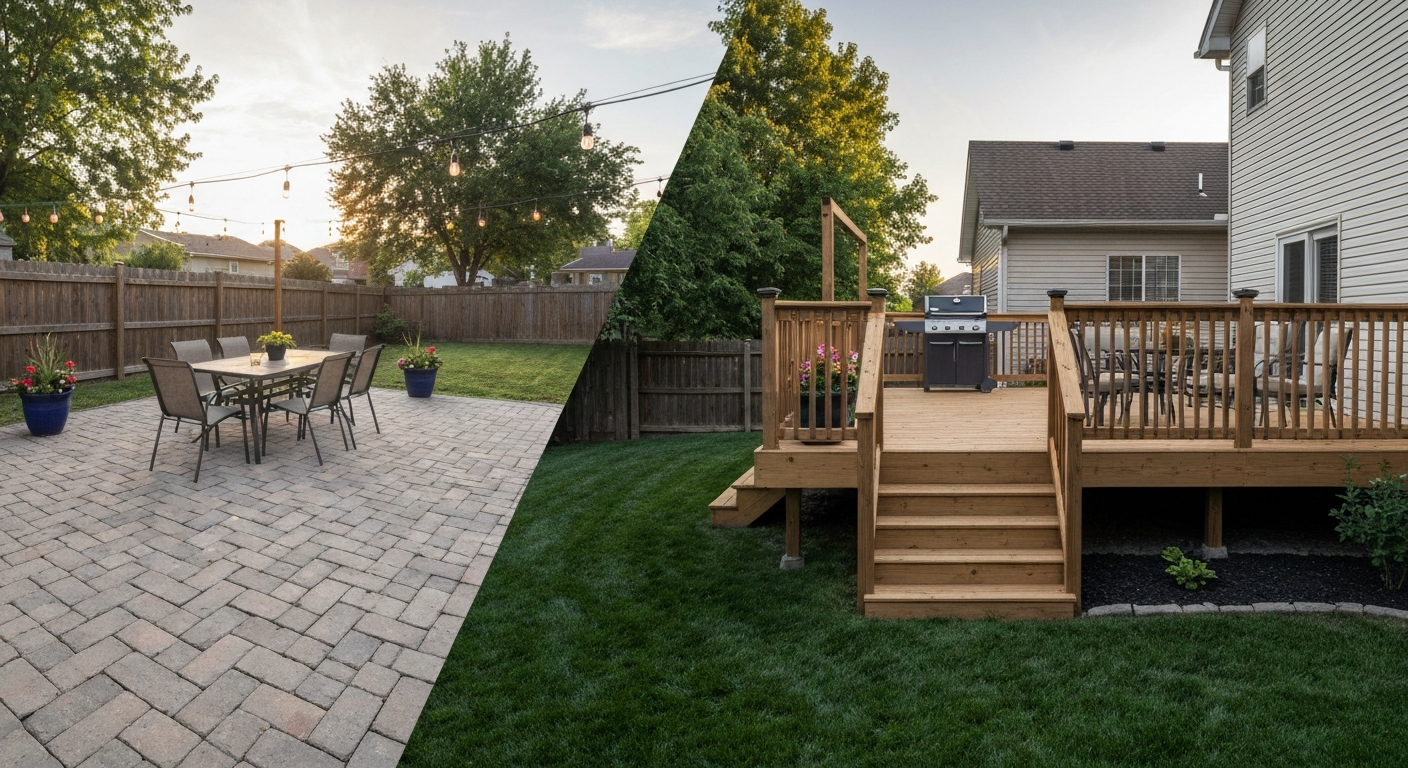
Deck vs paver patio: compare real costs, 10x10–20x20 price ranges, DIY vs pro, line-item budgeting & next steps.
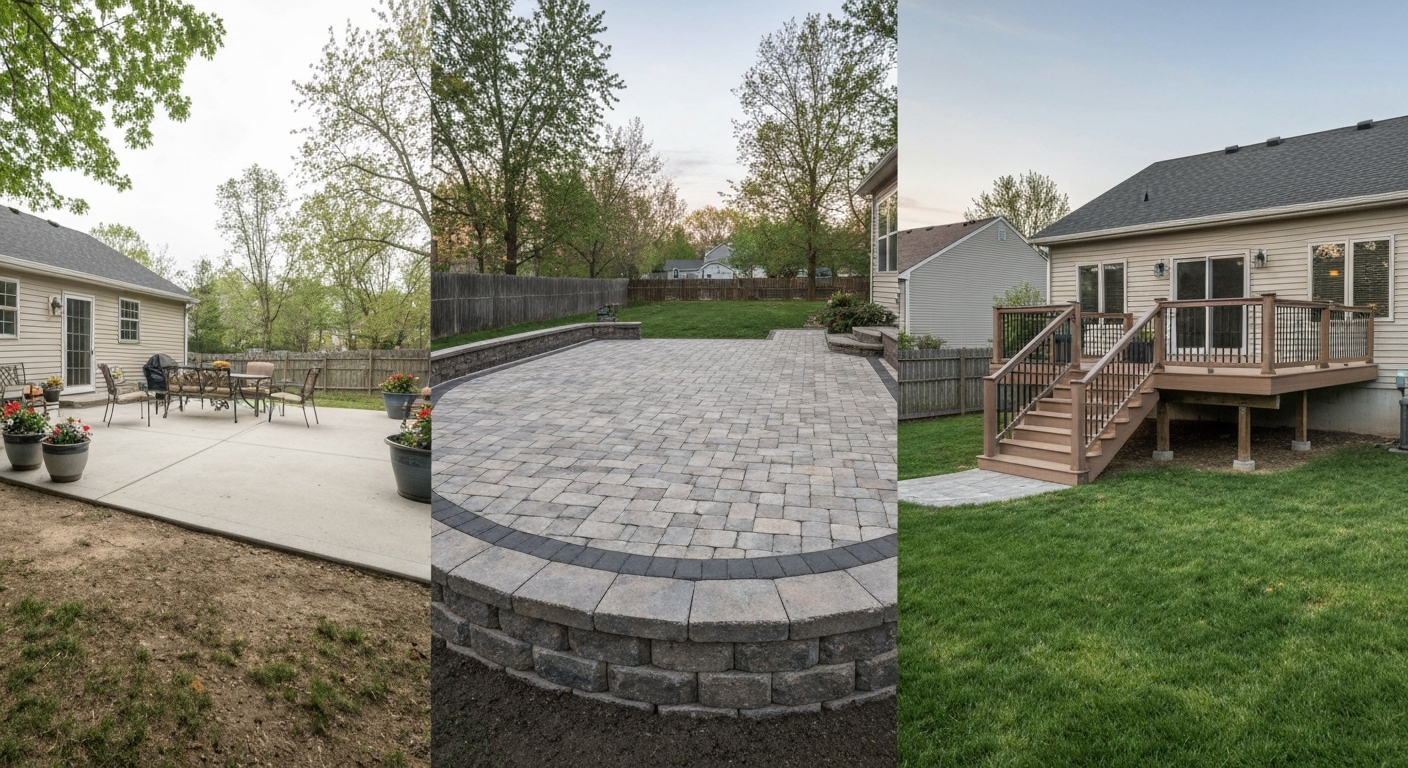
How much to deck a patio: per-sqft and 10x10–20x20 cost ranges, material breakdowns, DIY vs contractor guidance.

2026 cost ranges to build a patio deck by size and materials, with labor, site prep, and quote tips for accurate budgeti