
A garden patio in the US typically costs between $1,500 and $5,000 for a basic 12x12 installation, with mid-range projects landing around $3,000–$9,000 and premium finishes pushing well past $15,000. In the UK, expect to budget roughly £80–£160 per m² installed for most mainstream materials, while Ireland sits in a similar band at around €80–€160 per m² for standard builds. Those ranges shift significantly depending on material choice, site conditions, patio size, and where you live, so the rest of this guide breaks each cost driver apart so you can build a realistic number before you call a single contractor.
How much does a garden patio cost: Complete 2026 Cost Guide

Felix Carver
27 Jul 2026
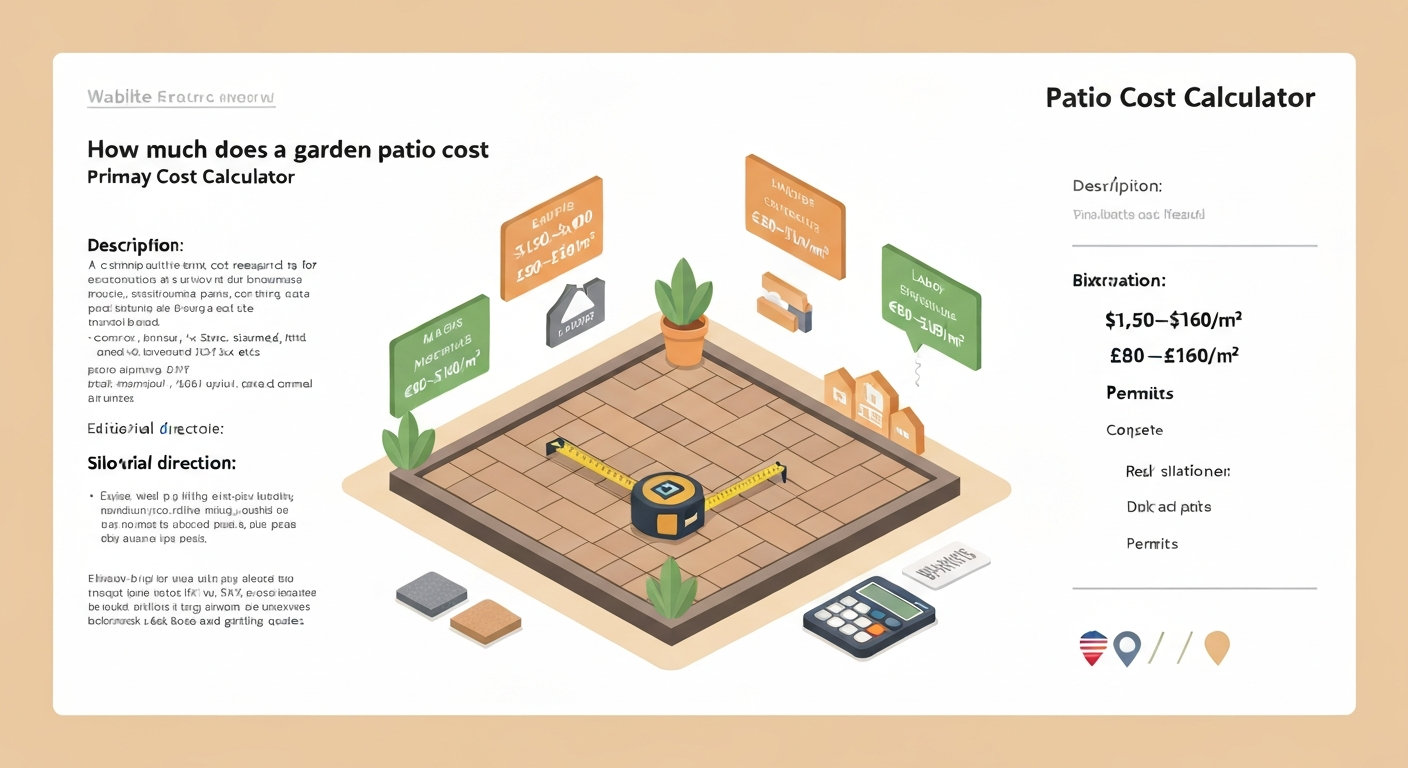
What drives the cost of a garden patio?
Six factors do the most work in setting your final price. Understand these and you'll be able to read a contractor quote intelligently instead of just accepting whatever number lands in your inbox.
- Size: cost scales almost linearly with square footage, though larger projects often attract a lower per-unit rate because mobilization costs are spread across more area.
- Site prep: a level, accessible garden on clay-free soil is cheap to prepare. A sloped garden, restricted access, tree roots, or an existing concrete slab to break out adds real money — sometimes $500–$2,000+ on a mid-size job.
- Material choice: plain poured concrete costs $4–$12 per sq ft installed in the US; natural stone pavers can reach $30–$50 per sq ft. The gap between the cheapest and most expensive finish is enormous.
- Labor: contractor rates vary by region and trade. In the US, hardscape installers typically charge $50–$100 per hour or quote per sq ft. UK landscapers commonly price £25–£45 per hour or use a day-rate of £200–£350.
- Additional features: steps, raised sections, lighting conduits, drainage channels, and built-in seating all add line items that can collectively double the base quote.
- Permits and inspections: most open garden patios at ground level don't require a permit in the US, but some municipalities require one for patios over a certain size or attached to the home. In the UK and Ireland, enclosed or roofed structures enter planning territory quickly.
Estimating cost per sq ft: a simple formula
The quickest way to ballpark your budget is: Total cost = (Patio area in sq ft) x (Installed cost per sq ft for your chosen material). For a 12x12 patio (144 sq ft) using standard concrete pavers at $12 per sq ft, that's 144 x $12 = $1,728 in materials and labor before extras. Add 10–15% for drainage, edging, and sealing, and another 10% contingency, and you're looking at roughly $2,100–$2,200 as a working budget. For stamped concrete at $18 per sq ft, the same 144 sq ft works out to $2,592 before extras, or around $3,100–$3,300 with finishing costs and contingency. These are rough guides, site prep, access, and regional labor rates will move the real number, but they give you a credible figure to test against contractor bids.
Sample budgets for common patio sizes
The table below uses US installed cost ranges per sq ft across three finish tiers: basic (plain poured concrete or basic concrete pavers), mid-range (stamped concrete or standard clay/brick pavers), and premium (natural stone, high-end pavers, or decorative finishes). These figures include excavation, base prep, material, and labor but exclude permits, specialty drainage, and features like steps or lighting.
| Patio Size | Sq Ft | Basic ($6–$10/ft²) | Mid-Range ($12–$18/ft²) | Premium ($20–$30/ft²) |
|---|---|---|---|---|
| 10x10 | 100 | $600–$1,000 | $1,200–$1,800 | $2,000–$3,000 |
| 12x12 | 144 | $865–$1,440 | $1,730–$2,590 | $2,880–$4,320 |
| 15x15 | 225 | $1,350–$2,250 | $2,700–$4,050 | $4,500–$6,750 |
| 20x20 | 400 | $2,400–$4,000 | $4,800–$7,200 | $8,000–$12,000 |
| 25x25 | 625 | $3,750–$6,250 | $7,500–$11,250 | $12,500–$18,750 |
For UK readers, a 20m² patio (roughly the equivalent of a 15x14 ft space) at standard Indian sandstone runs about £1,600–£2,600 installed based on £80–£130 per m². Porcelain in the same space costs £2,000–£3,600 at £100–£180 per m². Irish homeowners should apply €80–€160 per m² for most standard builds, with Dublin and other urban areas sitting at the higher end of that range.
Breaking down every cost line
Excavation and site preparation
Before any material goes down, the ground has to be prepared. For a standard patio this means stripping topsoil and vegetation, excavating to the correct depth (typically 150–250mm / 6–10 inches depending on material and load), and disposing of spoil. In the US, excavation for a 200 sq ft patio typically adds $300–$800 depending on soil type and haul distance. If you have an existing concrete slab to remove, factor in $1–$2 per sq ft for demolition and $200–$500 for a dumpster or removal fee. UK contractors generally include basic excavation in a per-m² installed price, but if there's a significant level change, a retaining wall, or tree root clearance, expect a separate day-rate charge on top, usually £250–£400 per day per operative.
Base materials: sub-base, sand, and compaction
A solid patio starts with a well-compacted sub-base. The standard approach in the US is 4–6 inches of compacted crushed stone (Class II road base or similar), topped with 1 inch of coarse sand for pavers or a concrete base for slabs. Materials for a 200 sq ft patio run around $150–$350 depending on stone cost in your area. Compaction equipment rental (plate compactor) costs $60–$120 per day if you're DIYing. In the UK, a 100mm MOT Type 1 sub-base is standard under pavers, followed by a sharp sand or semi-dry mortar bed. Supply costs for a 20m² patio typically run £80–£180 for the sub-base material. Skimping on the base is the number one cause of patio failure, sunken slabs, cracked concrete, and trip hazards all trace back to a poor or inadequately compacted sub-base.
Material costs by finish
This is where the biggest cost differences live. Here's what you're actually paying for each popular finish, broken into supply cost and typical installed cost in the US (per sq ft) and UK (per m²).
| Finish | US Supply (per ft²) | US Installed (per ft²) | UK Supply (per m²) | UK Installed (per m²) |
|---|---|---|---|---|
| Plain poured concrete | $1–$3 | $4–$12 | N/A (wet trade) | £50–£80 |
| Stamped/decorative concrete | $1–$3 + $5–$10 stamping | $8–$30 | N/A | £70–£120 |
| Concrete pavers/slabs | $2–$8 | $10–$25 | £15–£40 | £50–£140 |
| Clay brick pavers | $3–$8 | $12–$25 | £20–£45 | £80–£140 |
| Indian sandstone | $4–$10 | $15–$35 | £21–£28 | £80–£130 |
| Limestone / natural stone | $6–$15 | $20–$45 | £37–£58 | £110–£250+ |
| Glass-enclosed patio (conservatory/lean-to) | N/A | N/A | N/A | £8,000–£40,000+ (full structure) |
Plain poured concrete is the budget workhorse, cheap, fast to install, and reasonably durable. Stamped concrete gives you a decorative look for less than natural stone, but it's a surface treatment that can wear over time and is harder to repair than individual pavers. Clay brick pavers and Indian sandstone sit in the comfortable mid-range and age well. Limestone and premium natural stone are genuinely beautiful and long-lasting, but you pay for both the material and the skilled labor to cut and lay it accurately. Glass-enclosed patio structures (conservatories, lean-to glazed rooms) are an entirely different budget category, a small uPVC lean-to starts around £8,000 in the UK, while a quality orangery or insulated glazed room runs £12,000–£40,000 or more depending on specification and size.
Labor, contractor rates, and reading bids
US hardscape contractors typically price patios one of three ways: per sq ft (most common for straightforward jobs, usually $4–$12 for labor only), hourly ($50–$100 per hour depending on region and crew size), or as a lump-sum fixed price on larger projects. UK landscapers and paviours commonly use day rates of £200–£350 per operative or quote as a package installed cost per m². When you get a written quote, make sure it itemizes: excavation and disposal, sub-base material and supply, paving material supply, labor to lay, edging, jointing, and any drainage work. A quote that simply says 'supply and install patio' with one number is harder to compare against alternatives and easier to dispute if something goes wrong. Ask specifically: what depth of sub-base is included? Is disposal of excavated material included? Is the jointing compound included? These items are each worth $200–$600 on a typical job and are frequently left ambiguous in rough quotes.
Drainage, edging, jointing, sealing, and finishing
These finishing costs are easy to underestimate. A simple perimeter drainage channel on a 15x15 patio runs $300–$800 installed in the US, depending on channel type and connection point. Linear ACO-style drainage channels in Ireland have median installed rates of roughly €129–€259 per linear metre based on 2025 NTA schedule rates, so even 5 metres of channel adds €650–€1,300 to an Irish patio project. Edging restraints (aluminum, steel, or concrete kerb) cost $1–$3 per linear foot in the US and £5–£15 per linear metre in the UK for supply and fix. Polymeric jointing sand for pavers runs $40–$80 per bag (covers roughly 50–100 sq ft); mortar pointing for natural stone is a labor-intensive job that adds £3–£8 per m² or more. Sealing a concrete or paver patio adds $0.50–$2.50 per sq ft and should be repeated every 2–5 years. None of these items are glamorous, but skipping drainage on a garden patio that slopes toward the house is a mistake that costs far more to fix later.
Permits, inspections, disposal, and other soft costs
Most ground-level open patios in the US don't trigger a permit requirement, but rules vary by municipality. When permits are needed, costs range from $50–$500 depending on project value and local fee schedules. Inspections are generally included with the permit fee. Debris disposal is often overlooked: a 10-yard dumpster rental in the US runs $300–$600 including haul-away. In the UK, a skip for excavated material typically costs £150–£350 for a standard 4–6 yard skip. If your project involves a roofed or enclosed structure in the UK (like a glazed garden room), most conservatories fall within Permitted Development rights in England, but structures that are heated or thermally integrated with the home may require Building Regulations approval under Approved Document L. In Ireland, almost all extensions and enclosed structures require planning permission unless they qualify as exempted development under the Planning and Development Regulations. A Section 5 Declaration from your local authority is the practical way to confirm exempted status before you spend money on detailed design, fees and timelines vary by council.
Material comparison: cost, longevity, maintenance, and resale
| Material | Upfront Cost | Lifespan | Maintenance | Repairability | Resale Impact |
|---|---|---|---|---|---|
| Plain poured concrete | Low | 20–30 yrs (cracks likely) | Low — sweep/wash | Poor — cracks hard to patch invisibly | Neutral |
| Stamped concrete | Medium | 15–25 yrs | Medium — reseal every 2–3 yrs | Poor — color match difficult | Moderate positive |
| Concrete pavers | Low–Medium | 25–40 yrs | Low — occasional re-sand joints | Excellent — individual units replaceable | Moderate positive |
| Clay brick pavers | Medium | 30–50+ yrs | Low–Medium | Good — matching bricks available | Positive |
| Indian sandstone | Medium | 30–50 yrs | Medium — seal annually or biannually | Good — if same batch sourced | Positive |
| Limestone/premium stone | High | 50+ yrs | Medium–High | Moderate — cutting required | Strong positive |
| Glass-enclosed structure | Very High | 20–30 yrs (frames/glazing) | High — cleaning, frame checks | Complex | Variable — adds space, upkeep concerns |
Concrete pavers are the strongest all-rounder on this list. They're affordable, last decades, and if one unit cracks or stains badly you can pull it out and replace it without touching the rest of the patio. Natural stone scores well on longevity and resale but costs more upfront and needs proper sealing in wet climates. Stamped concrete looks good when new but has a reputation for surface wear after 10–15 years, especially in freeze-thaw climates, and patching it invisibly is genuinely difficult.
Installation vs DIY: what it actually costs and when to hire
DIY patio installation is realistic for concrete pavers and basic poured concrete slabs if you're comfortable with physical labor and patient enough to get the base right. A 12x12 paver patio done yourself can cost $400–$900 in materials (pavers, base stone, sand, edging, jointing sand) versus $1,700–$2,600 for a professional install, a saving of $800–$1,700. But that saving comes with caveats: you'll need a plate compactor (rent for $60–$120/day), a wet saw for cuts (rent $80–$150/day), and a full weekend or two of hard work. The base preparation is where most DIY patios fail. If you don't compact in 2–3 inch lifts and get the grade right for drainage, you'll have sunken or heaving pavers within 2–5 years. Poured concrete and natural stone are genuinely harder DIY projects. Concrete requires correct mix ratios, fast working time, and control joints placed correctly to manage cracking. Natural stone needs precise cutting and tight mortar joints, mistakes are visible and expensive to redo. If your project involves significant grading, drainage, or a patio larger than 200 sq ft, the math increasingly favors hiring a pro for the base work even if you supply and lay the surface yourself.
| Factor | DIY | Professional Install |
|---|---|---|
| Material cost (12x12 pavers) | $400–$900 | $700–$1,200 (contractor sourcing) |
| Labor cost | $0 (your time) | $700–$1,400 |
| Tool rental | $150–$300 | Included |
| Total estimated cost | $550–$1,200 | $1,400–$2,600 |
| Time required | 2–4 days (2 people) | 1–2 days (crew of 2–3) |
| Skill level needed | Moderate — base prep is critical | Handled by trade |
| Risk of rework | Medium–High if base poorly done | Low (warranty typical) |
How to price a patio for a contractor bid
If you want to check whether a contractor quote is reasonable, work through this calculation before you call anyone. It takes about 10 minutes and means you walk into the conversation informed. For a step-by-step worksheet and quick checks you can do yourself, see our guide on how to price a patio.
- Measure your patio area in sq ft (length x width). Add 10% for cuts and waste.
- Look up the supply cost of your chosen material per sq ft or per paver unit. Multiply by your adjusted area.
- Estimate sub-base materials: roughly 0.5 cu yd of crushed stone per 50 sq ft at 4-inch depth. Multiply by local stone cost (typically $25–$45 per cu yd in the US).
- Add a labor allowance: for pavers, budget $4–$8 per sq ft labor-only. For stamped concrete, $5–$12 per sq ft. For natural stone, $8–$15 per sq ft.
- Add edging ($1–$2 per linear ft), jointing ($0.50–$1 per sq ft for polymeric sand), and sealer ($0.50–$1.50 per sq ft).
- Add 10–15% for overhead and profit (standard contractor markup).
- Add 10% contingency for your own budget — not for the contractor's quote.
- Compare this number to the quotes you receive. A quote 20–30% above your estimate is normal for a busy, reputable contractor. A quote significantly below your estimate warrants careful scrutiny of what's included.
Evaluating contractor quotes: red flags and must-ask questions
Getting three quotes is the baseline. But knowing what to look for in each quote matters more than just picking the middle number.
- Red flag: a quote with no itemization. If it just says 'supply and lay patio — $3,500' with nothing else, push back and ask for a breakdown by line item.
- Red flag: no mention of sub-base depth or specification. This is the most commonly cut corner on cheap quotes.
- Red flag: no written warranty on workmanship. Reputable installers typically offer 1–5 years on settling and jointing work.
- Red flag: cash-only, very low deposit required, or pressure to sign the same day.
- Must ask: is disposal of excavated material included? This is $200–$500 and often omitted from base prices.
- Must ask: what brand and grade of jointing compound or mortar are you using? Cheap grout fails faster.
- Must ask: does the price include a fall/gradient away from the house? A patio that drains toward the building is a future damp problem.
- Must ask: are there any additional charges for hard digging, root clearance, or access restrictions?
- Negotiation tip: on larger jobs (20x20 and up), contractors often have more flex on material upgrades than on labor. Ask what it would cost to move from concrete pavers to Indian sandstone — the gap in the quote is sometimes surprisingly small compared with the material retail price difference.
Regional cost differences: US, UK, and Ireland
United States
Labor costs vary considerably across the US. The Northeast and West Coast (New York, Boston, San Francisco, Seattle) consistently price 20–40% above national averages. The Midwest and South are typically at or below the national midpoint. Material costs also shift by region, natural stone is cheapest in areas near quarries (parts of the Southeast and Mountain West), while delivery to urban Northeast or coastal California adds real cost. As a national benchmark, plain concrete installs at $4–$12 per sq ft, pavers at $10–$25 per sq ft, and premium natural stone at $20–$45 per sq ft for fully installed work.
United Kingdom
UK patio costs are typically quoted per square metre and include excavation, sub-base, and laying. London and the Southeast carry a 15–30% premium over the national average. A standard concrete slab patio runs £50–£80 per m² installed nationally; Indian sandstone lands at £80–£130 per m²; porcelain tiles at £100–£180 per m²; and premium natural stone (limestone, granite) at £110–£250+ per m². Industry-aggregated figures (2026) show concrete pavers supply-only ~£15–£40/m² and typical installed costs ~£50–£140/m² (see blank" rel="noopener noreferrer">Patio Laying Cost (Less.co.uk)). A typical 20m² rear-garden patio using Indian sandstone therefore costs around £1,600–£2,600 fully installed, while the same size in porcelain costs £2,000–£3,600. UK homeowners planning a glass-enclosed patio or garden room should budget from £8,000 for a basic uPVC lean-to conservatory up to £40,000+ for a well-specified orangery. For details on glazing, framing options, and typical UK prices, see how much does a garden glass patio cost.
Ireland
Irish patio costs broadly mirror the UK in structure but are quoted in euros. Standard builds run approximately €80–€160 per m², with basic concrete slabs at the lower end (€80–€110 per m²) and porcelain or premium stone at €110–€250 per m². Dublin commands a notable uplift over rural or regional pricing. Drainage is a consistent extra cost in Ireland given the wet climate, linear channel drainage adds €129–€259 per linear metre installed based on current NTA schedule rates, so even a modest run of 5–6 metres adds €650–€1,550 to a project budget. For a quick local guide on how much a patio costs in Ireland, see our detailed article on how much does a patio cost Ireland. Ireland's planning rules also mean that any enclosed or roofed garden structure requires careful checking against exempted development criteria, a Section 5 Declaration from your local authority is the safest way to confirm your position before committing to a design.
Patio vs deck: which makes more sense for your garden?
Patios and decks serve similar purposes but suit different sites, budgets, and preferences. Here's how to think through the choice.
| Factor | Patio | Deck |
|---|---|---|
| Typical installed cost (US) | $6–$30 per sq ft | $15–$35 per sq ft (pressure-treated to composite) |
| Best site conditions | Flat or gently sloping ground | Sloped ground, raised or multi-level sites |
| Lifespan | 25–50+ years (stone/pavers) | 15–30 years (wood); 25–40 yrs (composite) |
| Maintenance | Low to medium (seal, re-joint) | Medium to high (wood staining/sealing); lower for composite |
| Planning/permits | Rarely needed for ground-level patios | Often required; setback rules vary widely |
| Resale value | Adds moderate value; broad appeal | Adds value in right market; can deter some buyers |
| DIY difficulty | Moderate | Moderate to high (structural framing) |
The basic rule: if your garden is flat, a patio almost always wins on cost and longevity. If your garden slopes significantly, a deck lets you create usable level outdoor space without the mass earthworks a patio would require. In wet climates, stone or concrete pavers age better than timber decking, which needs regular maintenance to prevent rot and slipping. Composite decking narrows that gap considerably but at a higher upfront cost, comparable to a mid-range paver patio.
Real-world project scenarios
Scenario 1: basic 12x12 concrete paver patio (US)
A flat backyard, good access, no existing hardscape to remove. The homeowner chooses standard grey concrete pavers from a home center. Excavation and disposal: $350. Sub-base (crushed stone + sand): $200. Pavers (144 sq ft + 10% waste): $520. Edging: $80. Jointing sand: $45. Contractor labor (1.5 days, 2-person crew): $720. Total: approximately $1,915. A reasonable professional quote for this job sits in the $1,700–$2,400 range.
Scenario 2: mid-range 20x20 Indian sandstone patio (UK)
A 400 sq ft (roughly 37m²) rear garden patio in the East Midlands using calibrated Indian sandstone, standard access, level site. At £100 per m² installed (mid-range for this material and region), the base job is around £3,700. Add a 3-metre linear drainage channel at £200 per metre: £600. Pointing upgrade to resin-based jointing: £150. Sealing: £120. Total: approximately £4,570. A competitive quote in this scenario typically falls between £4,000 and £5,500 depending on contractor and specification.
Scenario 3: premium 25x25 natural stone patio with features (US)
A 625 sq ft limestone patio with a step down from the back door, a small built-in planter wall, and a drainage channel running to a dry creek bed. Material (limestone supply): $5,500. Sub-base and base prep (deeper excavation, geotextile, compacted stone): $1,200. Labor (experienced stone mason + helper, 4 days): $3,600. Drainage and edging: $900. Planter wall (materials + labor): $1,800. Sealing: $600. Permits: $150. Total: approximately $13,750. Realistic professional quotes for a project of this specification in a mid-cost US region run $12,000–$18,000.
Budgeting checklist and contingency planning
Use this checklist to make sure your budget covers everything before you sign a contract.
- Measure your patio area accurately. Include any steps, borders, or adjacent paths in your calculation.
- Decide on your material and get a current supply price from at least two suppliers — contractor-sourced material usually comes with a markup of 15–25%.
- Confirm site conditions: slope, access width, soil type, and whether any existing hardscape needs removal.
- Get three written, itemized quotes. Confirm each includes excavation, disposal, sub-base, edging, jointing, and a drainage fall away from the house.
- Check local permit requirements. In the US, call your local building department; in the UK, check with your local authority; in Ireland, consider a Section 5 Declaration if any roofed structure is involved.
- Include finishing costs: sealer ($0.50–$2.50/ft² or £5–£12/m²), any lighting conduit, and garden furniture clearance.
- Add 10–15% contingency on top of your total. Unexpected hard ground, drainage complications, and material delivery issues are common on garden projects.
- Plan your payment schedule: a deposit of 10–25% is normal before materials are ordered; avoid paying more than 50% before work starts.
- Factor in seasonal pricing: patio installers are busiest April–September. Booking in late autumn or winter often brings a 5–15% discount on labor.
Next steps: getting quotes and planning your project
Once you have a working budget in mind, the most useful thing you can do is run your numbers through a patio cost calculator to pressure-test your estimate before you talk to contractors. For an instant estimate on how much to patio garden, use our patio cost calculator to pressure-test your figures before contacting contractors. It takes 5 minutes and prevents you walking into a quote meeting without a baseline figure. From there, get at least three in-person quotes from local contractors, and ask each one to walk the site with you so any access or ground conditions are factored into their pricing, not added on afterward as variations. Before those meetings, put together a short project brief: your rough dimensions, preferred material, any drainage concerns, and your absolute budget ceiling. Contractors price more accurately and competitively when they have clear information upfront. If your project involves specific material choices like porcelain, Indian sandstone, or a glass-enclosed garden room, look at dedicated material cost guides to understand the full supply cost range independently of whatever a contractor quotes you. And if you're based in the UK or Ireland, regional pricing pages will give you a much sharper sense of what local labor rates look like, national averages are a reasonable starting point, but the actual number that lands in your inbox will reflect your specific region and the contractor's current workload. For a quick UK-specific estimate, see our guide on how much to patio a garden in the UK. For a focused UK cost breakdown, see our guide titled 'how much does a patio cost UK' for local price ranges and examples.
Glossary: patio terms worth knowing
- Sub-base: the compacted crushed stone layer beneath a patio surface that distributes load and prevents settling. Typically MOT Type 1 in the UK, Class II road base or gravel in the US.
- Bedding layer: the sand or mortar layer directly beneath paving units on which they are bedded and levelled.
- Plate compactor: a powered tool used to compact granular sub-base material in layers. Essential for a stable patio foundation.
- Polymeric jointing sand: a sand-based compound containing polymers that harden when wetted, used to fill joints between pavers and resist weed growth and ant activity.
- Mortar pointing: a traditional cement-based jointing method used primarily for natural stone and clay pavers. More durable than sand joints but harder to work and prone to cracking if not properly mixed.
- Fall/gradient: the deliberate slope built into a patio surface to direct water away from the house. Standard minimum is 1:80 (roughly 12mm per metre).
- Calibrated stone: natural stone that has been cut to a uniform thickness on the back face, making it easier to lay to a consistent level. Uncalibrated (riven) stone requires more time to lay accurately.
- Permitted Development (UK): a category of building works that can proceed without a full planning application, subject to conditions on size, height, and proximity to boundaries.
- Exempted development (Ireland): works that fall outside the requirement for planning permission under the Planning and Development Regulations, subject to specific criteria.
- Section 5 Declaration (Ireland): a formal ruling from the local planning authority confirming whether a proposed development constitutes exempted development.
- ACO drain / linear drain: a type of channel drainage system with a slot or grated surface used to collect and redirect surface water at the edge of a patio or driveway.
- Resin-bound paving: a permeable surface material made from aggregate bound with clear resin, increasingly popular as a patio or path surface for its smooth finish and drainage properties.
- Orangery: a heavily glazed garden room structure, traditionally more substantial than a conservatory, often featuring a solid roof lantern and brick or masonry base walls.
- Conservatory: a predominantly glazed extension to a home, typically with a polycarbonate or glass roof, used as a garden room or additional living space.
FAQ
How much does a garden patio cost (overall answer)?
Typical installed patio costs vary widely by material, finish and region. In the US expect rough installed ranges per sq ft: low $4–$6 (basic plain poured concrete), typical $6–$12 (standard poured, basic pavers), and high/decorative $12–$30+ (stamped concrete, premium pavers, natural stone). In the UK expect roughly £80–£160 per m² for mainstream installed patios; specific materials range lower or higher (see material breakdown). In Ireland expect roughly €80–€160 per m² for mainstream installed patios, with premium stone or Dublin-area uplifts pushing higher.
What are sample budgets for common patio sizes (10x10, 12x12, 20x20)?
Calculate by area and the per‑unit installed ranges. Example (US, using low/typical/high per ft²): - 10x10 (100 ft²): low $400 | typical $600–$1,200 | high $1,200–$3,000+ - 12x12 (144 ft²): low $576 | typical $864–$1,728 | high $1,728–$4,320+ - 20x20 (400 ft²): low $1,600 | typical $2,400–$4,800 | high $4,800–$12,000+ For UK/Ireland convert by area (m²). 100 ft² ≈ 9.29 m². Using a typical UK range £80–£160/m²: - 10x10 (≈9.3 m²): ~£740–£1,490 installed - 20x20 (≈37.2 m²): ~£2,980–£5,960 installed These are illustrative — final cost depends on sitework, drainage, edging and finish.
How do I itemize a patio budget (main line items to include)?
Include: excavation/site clearance; sub‑base (crushed stone), compaction; edge restraints/edging; paving material (concrete, pavers, stone); laying/setting mortar; labor; drainage/linear channels; fall and waterproofing where needed; pointing/sealing; waste disposal; permits/inspections; and optional extras (lighting, steps, seating walls, base preparation for heavy loads). Allocate a contingency of 10–20% for unexpected ground conditions.
What are typical per‑material installed cost ranges (US per ft² and UK/Ireland per m²)?
US installed (typical bands): - Plain poured concrete: $4–$8/ft² - Decorative/stamped concrete: $8–$20/ft² - Concrete pavers (standard): $10–$25/ft² - Brick pavers: $10–$30/ft² - Natural flagstone/stone: $15–$50+/ft² - High‑end treatments/glass‑enclosed rooms (US conservatory/orangery analog): project pricing varies widely—often $12k+ for small glazed rooms. UK/Ireland installed (per m² typical ranges): - Concrete slabs/flags: £50–£80/m² (supply+install low) up to £80–£140/m² typical - Porcelain/premium slab: £100–£180/m² - Indian sandstone: £80–£130/m² installed - Natural stone (limestone/ granite/heritage): £110–£250+/m² - Brick/block pavers: £80–£140/m² - Conservatory/glazed rooms (UK): small lean‑to from ~£8,000; orangery/insulated glazed rooms commonly £12,000–£40,000+ depending on spec.
What drives the cost differences between materials?
Key drivers: material supply cost (quarry vs factory), preparation needs (thicker base/ finer grading for stone), laying complexity (random flagstone or tight brick patterns take longer), mortar/pointing and sealing needs, edge and drainage detailing, and finish treatments (sealing, stamping, staining). Labor intensity and specialist trades for natural stone or complex patterns raise installed cost disproportionately.
How much does excavation, base and drainage cost?
Groundwork is often 20–40% of the job when significant excavation or poor ground exists. Typical unit examples: in the US expect excavation + sub‑base + compaction to add $1–$6/ft² depending on depth and access. In the UK/Ireland groundwork and linear drainage can add notable per‑m² costs — simple groundwork may be included in the typical installed ranges, but specialist linear drainage (e.g., ACO channels) can run €129–€259 per linear metre in Ireland (NTA schedule example) depending on type and installation.
Next Articles
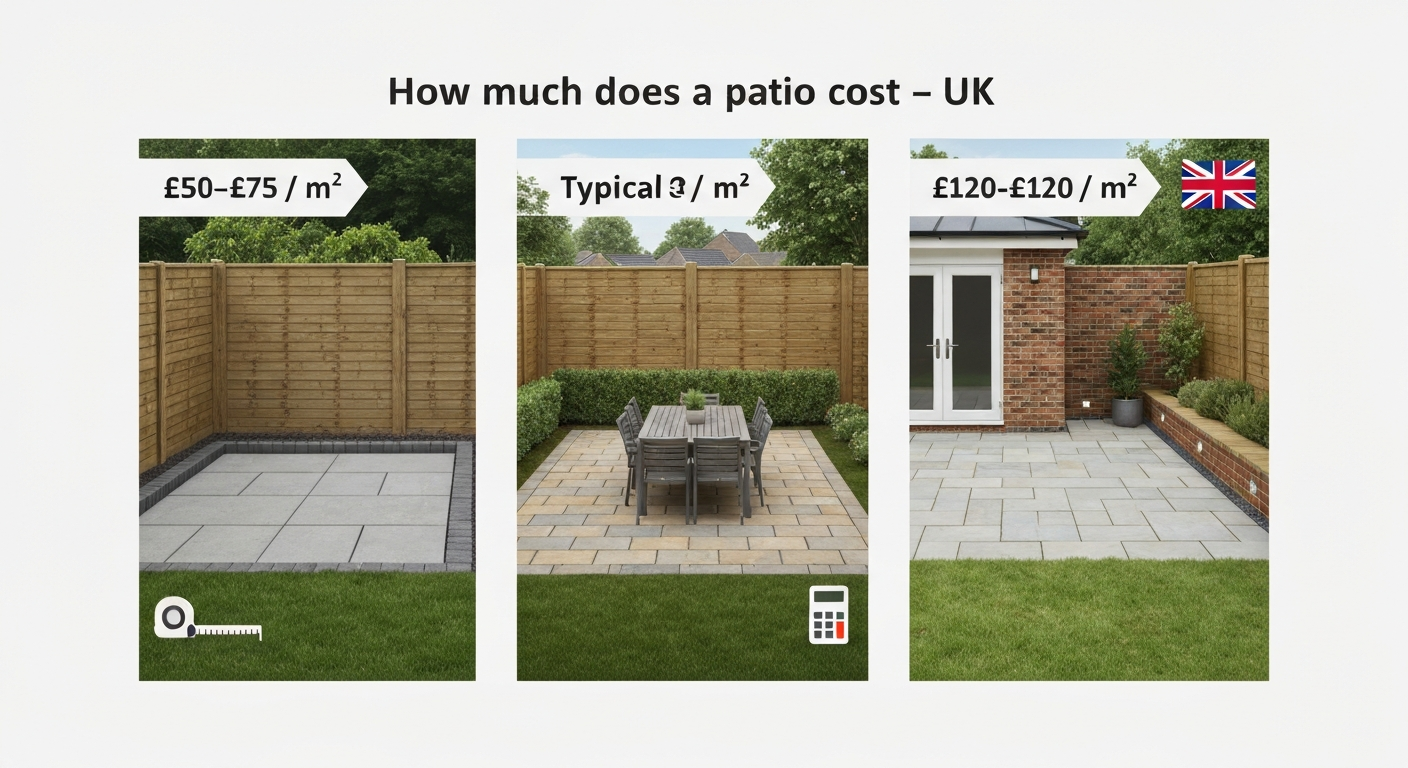
How Much Does a Patio Cost in the UK? Guide & Price Ranges
Patio cost UK: clear per m², size examples, material breakdowns, DIY vs pro costs and budget checklist.
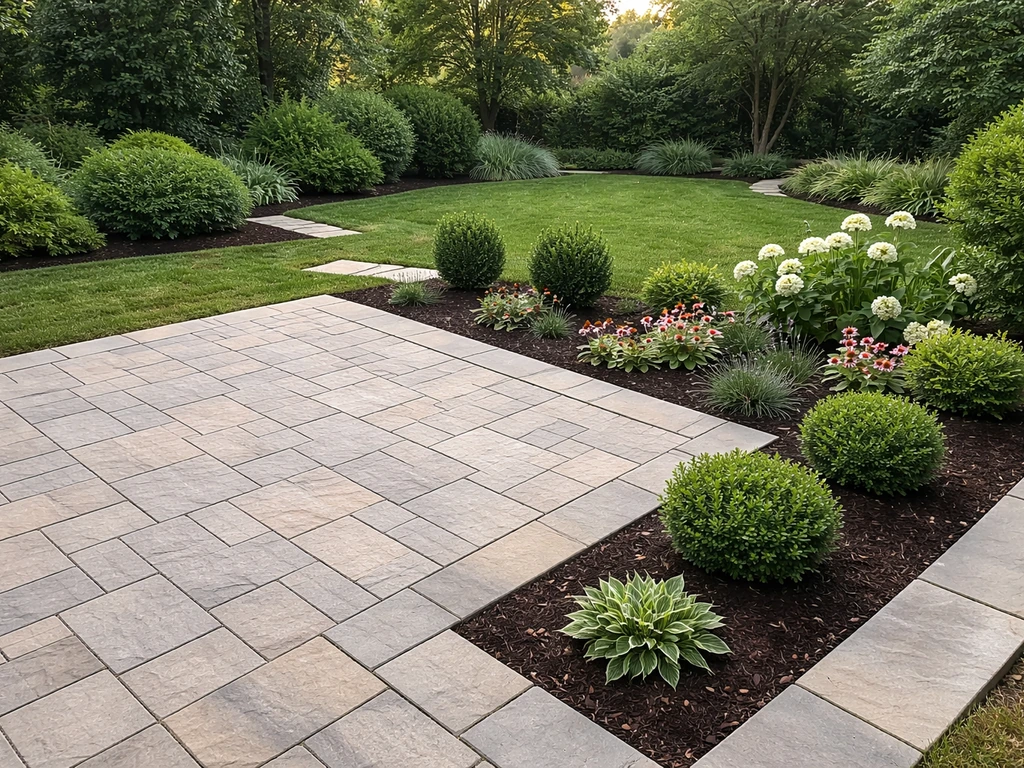
How Much to Patio Garden: Costs by Size and Materials
Patio garden costs by size and finish, with itemized breakdown, DIY vs pro tips, and quote-ready budgeting guidance.
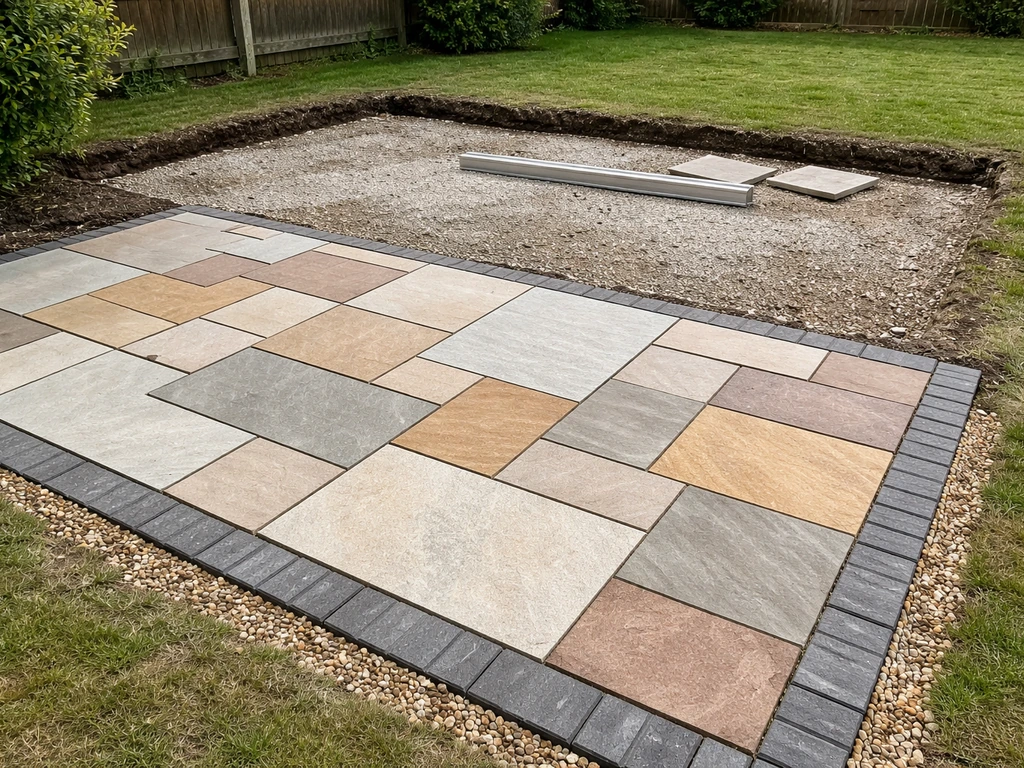
How Much to Patio a Garden in the UK? Costs and Breakdown
UK patio cost guide with per m² prices, example totals, and material breakdown for concrete, paving, stone, brick