
A typical patio in the UK costs somewhere between £70 and £180 per m² fully installed in 2026, which works out to roughly £6.50 to £16.70 per ft². For a standard 20 m² patio, that means budgeting anywhere from £1,400 (basic concrete slabs, simple groundwork) to £3,600 or more (porcelain or natural stone with proper sub-base preparation). The actual number depends on the material you choose, where you live, whether you're doing it yourself, and how much groundwork the ground needs. This guide breaks all of that down so you can build a realistic budget before you ring a single contractor.
How Much Does a Patio Cost in the UK? Guide & Price Ranges

Felix Carver
21 Jul 2026
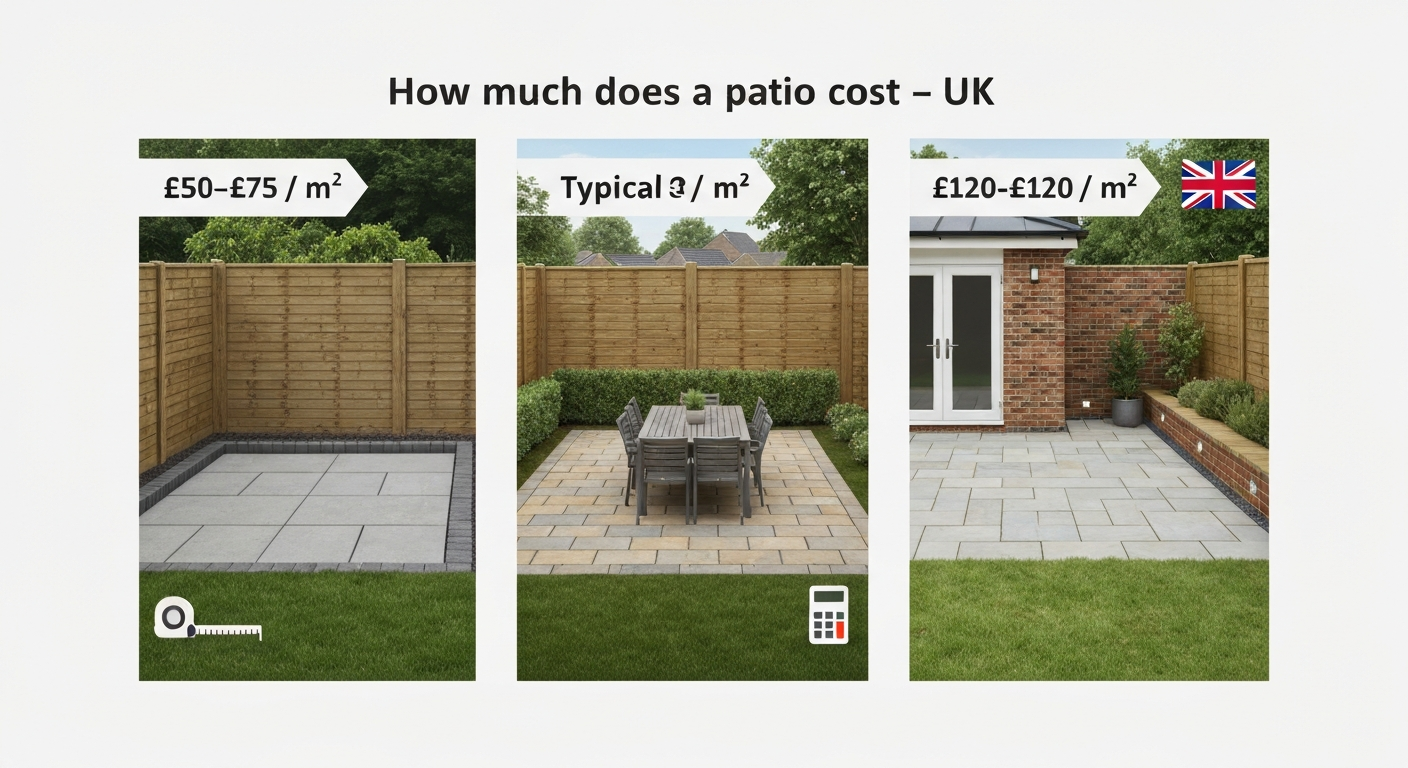
Headline UK patio cost ranges (per m² and per ft²)
The table below gives a clear low-to-high picture of fully installed patio costs in the UK for 2026. These are all-in figures: materials, labour, a standard 100mm compacted MOT Type 1 sub-base, and basic waste removal. They don't include major drainage works, significant levelling, or glazed structures.
| Cost tier | Per m² (installed) | Per ft² (installed) | What you typically get |
|---|---|---|---|
| Budget | £50–£75 | £4.65–£7.00 | Basic concrete pressed slabs, minimal site prep, no frills |
| Typical / mid-range | £75–£120 | £7.00–£11.15 | Block pavers, Indian sandstone, or porcelain on proper sub-base |
| High end | £120–£180+ | £11.15–£16.70+ | Premium natural stone, large-format porcelain, complex patterns, full drainage |
Most homeowners end up in the £80–£130/m² range once you factor in decent materials and a professional installation. The sub-£70/m² jobs exist, but they usually involve basic grey concrete slabs and a contractor cutting corners on the sub-base, which tends to cause sinking and cracking within a few years.
Cost examples for common patio sizes
Rather than quoting abstract ranges, here are worked cost estimates for the three sizes homeowners ask about most: 10x10, 12x12, and 20x20 (in feet). I've converted those to m² and applied the low, typical, and high bands from above.
10x10 patio (roughly 9.3 m²)
| Cost tier | Rate per m² | Estimated total |
|---|---|---|
| Budget | £50–£75 | £465–£700 |
| Typical | £75–£120 | £700–£1,115 |
| High end | £120–£180+ | £1,115–£1,675+ |
A 10x10 (roughly 9.3 m²) is a compact sitting area, fine for a bistro table and a couple of chairs. At the typical rate you're looking at around £700–£1,100. Worth knowing: contractors often have a minimum call-out or job cost of around £500–£800 even for small areas, so the per-m² rate can feel expensive on very small jobs.
12x12 patio (roughly 13.4 m²)
| Cost tier | Rate per m² | Estimated total |
|---|---|---|
| Budget | £50–£75 | £670–£1,005 |
| Typical | £75–£120 | £1,005–£1,608 |
| High end | £120–£180+ | £1,608–£2,412+ |
A 12x12 (13.4 m²) is probably the most common size for a medium garden. It comfortably fits a 4-seat dining set and a small lounger. At typical rates you're budgeting around £1,000–£1,600, which is where most single-storey extension patio quotes land.
20x20 patio (roughly 37.2 m²)
| Cost tier | Rate per m² | Estimated total |
|---|---|---|
| Budget | £50–£75 | £1,860–£2,790 |
| Typical | £75–£120 | £2,790–£4,464 |
| High end | £120–£180+ | £4,464–£6,696+ |
A 20x20 (37.2 m²) is a substantial project: large enough for an outdoor dining area, seating zones, and a BBQ station. At typical rates you're looking at £2,800–£4,500. At this size, material savings per m² start making a real difference, so it's worth comparing stone types carefully rather than defaulting to whatever looks nice in the showroom.
How to price a patio yourself
If you want to sense-check a contractor's quote, or just understand where the money is going, here's the basic framework most patio installers use. It's not rocket science, but there are a few gotchas that catch homeowners out. For a step-by-step method and quick calculator, see our guide on how to price a patio.
Step-by-step pricing framework
- Measure the area in m² (length x width). Add 10% waste for cutting and breakages, more (15%) for diagonal or complex patterns.
- Choose your material and find the supply-only price per m². Budget concrete slabs: £10–£35/m². Indian sandstone: £24–£60/m². Porcelain: £25–£65/m².
- Add your sub-base cost. A standard domestic patio needs 100mm of compacted MOT Type 1. Roughly 0.15 tonnes of Type 1 per m² (at 100mm depth). MOT Type 1 delivered is typically £30–£48/tonne in bulk; expect to pay more in small bags from a merchant.
- Add mortar/bedding and jointing sand/compound. Budget around £5–£10/m² for these materials depending on the system (wet mortar bed vs. loose-lay on grit sand).
- Add labour. Labour-only rates for laying patios run around £30–£70/m² depending on material complexity and region. Porcelain and cut-pattern work sits at the top end.
- Add extras: edging, drainage channels, skip or waste collection (typically £200–£400 for a medium skip), and any delivery charges.
- Total all costs and divide by m² to check whether the contractor's all-in quote is in a sensible range.
Worked example: 15 m² Indian sandstone patio, typical spec
| Cost element | Calculation | Estimated cost |
|---|---|---|
| Indian sandstone (supply) | 15 m² + 10% waste = 16.5 m² @ £40/m² | £660 |
| MOT Type 1 sub-base | 15 m² x 0.15 t = 2.25 t @ £40/t | £90 |
| Mortar and jointing | 15 m² @ £8/m² | £120 |
| Labour (laying) | 15 m² @ £50/m² | £750 |
| Edging and finishing | Allowance | £150 |
| Waste removal / skip | Mini-skip allowance | £250 |
| Delivery (slabs) | Pallet delivery | £75 |
| Total | £2,095 |
That's roughly £140/m² all in, which sits at the upper end of the typical range for Indian sandstone. If you get a quote around £1,800–£2,200 for a 15 m² sandstone patio, it's in the right ballpark. Below £1,400 and I'd be asking questions about the sub-base spec and whether waste removal is included.
Itemised cost breakdown: where the money actually goes
One thing I've noticed is that homeowners often focus entirely on the slab price and then get surprised by the rest of the invoice. Here's what a fully itemised patio cost looks like, with realistic ranges for each line.
| Cost element | Low | Typical | High | Notes |
|---|---|---|---|---|
| Materials (slabs/paving) | £10–£25/m² | £30–£50/m² | £55–£90/m² | Concrete, sandstone, porcelain respectively |
| Labour (laying) | £30/m² | £45–£55/m² | £65–£70/m² | Higher for porcelain/complex cuts |
| Sub-base (MOT Type 1) | £5–£8/m² | £10–£15/m² | £18–£25/m² | Depends on depth needed and ground condition |
| Excavation / groundwork | £5–£10/m² | £12–£18/m² | £20–£30/m² | More for poor/clay ground or large level change |
| Mortar / bedding / jointing | £4–£6/m² | £7–£10/m² | £12–£15/m² | Wet mortar vs. dry or resin joint systems |
| Edging restraints | £5–£10 per linear m | £12–£18 per linear m | £20–£35 per linear m | Concrete haunching or decorative edging |
| Drainage (basic channel) | Nil (if not needed) | £150–£350 | £400–£800+ | Linear drainage channel and connection |
| Waste disposal / skip | £150–£200 | £250–£350 | £400–£500+ | Depends on volume of excavated material |
| Materials delivery | £50–£75 | £75–£150 | £150–£300+ | Pallet/lorry delivery; big-and-bulky charges apply |
The hidden cost that catches people most often is excavation and waste. If your ground needs digging out 150mm+ for sub-base plus slab depth, you're generating a lot of spoil. A 20 m² patio excavated to 250mm depth produces around 5 m³ of material, which fills a medium skip quickly. Make sure any quote you get explicitly covers waste removal, because some contractors exclude it to make the headline number look lower.
Cost by patio type: which material fits your budget?
Different materials carry very different price tags, maintenance demands, and lifespans. The right choice depends on your budget, how much you want to maintain the thing, and what the garden looks like. Here's an honest comparison.
| Material | Supply-only (per m²) | Installed (per m²) | Typical lifespan | Maintenance |
|---|---|---|---|---|
| Concrete slabs | £10–£35 | £50–£90 | 15–25 years | Low: brush and occasional pressure wash |
| Block pavers (concrete) | £20–£45 | £80–£140 | 20–30 years | Low-medium: re-sand joints every few years |
| Indian sandstone | £24–£60 | £80–£160 | 20–30 years | Medium: seal annually, re-point periodically |
| Porcelain paving | £25–£65 | £90–£180 | 25–40+ years | Low: frost-proof, stain-resistant, easy to clean |
| Brick paving | £25–£50 | £85–£150 | 25–35 years | Medium: re-pointing needed, moss management |
| Flagstone (natural) | £35–£80 | £100–£180+ | 30–50+ years | Medium-high: irregular surface, needs sealing |
Concrete slabs
Concrete pressed slabs are the budget staple. Supply-only prices at big merchants like B&Q, Wickes, and Travis Perkins commonly run £10–£35/m² depending on size and finish. Installed, you're looking at £50–£90/m². They last 15–25 years before cracking becomes an issue, and they're easy to replace individually. The trade-off is that grey concrete slabs can look a bit utilitarian, though coloured and textured options have improved a lot. Good choice if budget is the primary concern.
Block pavers
Concrete block paving is popular for driveways and patios alike. Installed costs typically run £80–£140/m². Individual blocks can be lifted and relevelled if the surface settles, which is genuinely useful. The jointing sand needs topping up every few years to prevent weeds and keep the surface locked. Brands like Marshalls (their Argent range, for example) sit in the mid-market and offer good longevity.
Indian sandstone
Indian sandstone is probably the most popular natural stone for UK gardens at the moment. Calibrated (machine-cut to uniform thickness) sandstone is much easier to lay than uncalibrated, and it's what most installers quote for. Supply-only prices from stone retailers commonly run £24–£60/m²; installed you're looking at £80–£160/m². It does need sealing when new and re-sealing periodically, and the joints need re-pointing after a few years. But it looks warm and natural in a way concrete never quite manages.
Porcelain paving
Porcelain is the premium choice. Material prices from UK specialist merchants commonly run £25–£65/m² (depending on thickness, format, and brand), but installation costs are high because the slabs need specialist cutting, a very flat sub-base, and adhesive bedding rather than traditional mortar. Installed costs typically run £90–£180/m². The upside: porcelain is frost-proof, stain-resistant, and extremely low maintenance. It looks sharp in contemporary gardens. The downside: if you get one wrong (a cracked slab, a poorly levelled section), repairs are trickier and more visible than with natural stone.
Brick paving
Traditional brick gives a warm, classic look and works well with older or Victorian-era properties. Installed costs run £85–£150/m². Bricks are durable but the jointing mortar can crack and allow moss ingress over time, so budget for re-pointing every 5–10 years. Reclaimed brick can add authenticity but increases material costs and labour time significantly.
Flagstone (natural stone flags)
Natural flagstone: York stone, slate, limestone, and similar materials deliver a premium, unique finish. Supply-only costs from £35–£80/m² or more for premium/reclaimed stone; installed you'll often be at £100–£180/m² or beyond. Lifespans of 30–50 years are realistic with proper installation. The uneven surface texture requires careful sub-base preparation and is not suitable for flat, precision-cut designs. Worth the investment if you want something genuinely premium that will outlast the house.
Glazed and glassed-in patio costs
A glazed or glassed-in patio (sometimes called a garden room, verandah, or glass canopy) is a different beast from a standard laid patio. You're adding a structural overhead element, glazing, possibly side panels, and often an element of building control consideration. Costs rise substantially compared to a plain patio. For a detailed breakdown of glazing, structure, and base costs, see our guide on how much does a garden glass patio cost.
What a glazed patio structure typically costs
| Structure type | Typical installed cost | Notes |
|---|---|---|
| Glass canopy / lean-to roof (basic) | £1,500–£4,000 | Aluminium frame, polycarbonate or basic glass panels, fits to house wall |
| Timber or aluminium pergola with glass roof | £3,500–£8,000 | More substantial framing, toughened glass panels, optional LED lighting |
| Full glass verandah (aluminium frame, toughened glass) | £6,000–£15,000+ | Includes side glazing, guttering, integral drainage, foundation work |
| Fully enclosed garden room / glazed room | £12,000–£40,000+ | Structural frame, thermally broken glazing, insulation, electrics; often needs planning permission |
The base patio itself still needs to be included in your budget on top of the glazing structure. A properly laid patio beneath a glass canopy will need a slight fall (around 1:80 gradient) to drain rainwater away from the structure and the house. If you're considering this route, it's worth reading up on the specific costs of glassing in a patio separately, as the structural and glazing elements have their own cost drivers that are quite different from standard paving.
Glazing-specific extras to budget for
- Building regulations submission or permitted development check: £200–£600 depending on council and complexity
- Structural engineer sign-off if the canopy fixes to the house wall: £400–£800
- Integrated guttering and downpipe connection to drainage: £300–£600
- Thermal break upgrades (important for condensation control in year-round use): adds £500–£2,000 depending on structure size
- Electrical supply for lighting and sockets within a glazed structure: £400–£1,200 typically
- Any upgraded flooring under a glazed space (often owners choose porcelain for its weatherproof/easy-clean qualities here)
DIY vs hiring a professional: honest cost comparison
The honest answer is that DIY saves money on labour but is harder, slower, and riskier than it looks on YouTube. Labour typically accounts for 40–55% of the total installed cost, so the saving is real if you get it right. But a poorly laid patio (inadequate sub-base, wrong falls, poor jointing) will move, crack, and hold water within a few years.
| Factor | DIY | Professional installation |
|---|---|---|
| Labour cost | Nil (your time) | £30–£70/m² typically |
| Total cost on a 20 m² patio | £800–£1,800 (materials + hire) | £1,900–£4,500+ (all-in) |
| Time required (20 m²) | 3–6 days for a novice | 1–3 days for an experienced team |
| Skill level needed | Moderate-high: requires accurate levelling, compaction, cutting | Professional |
| Tools required | Plate compactor hire ( | Contractor supplies all |
| Risk of poor outcome | Higher: sub-base errors and drainage mistakes are common for first-timers | Lower if contractor is vetted |
| Guarantee / warranty | None (your own work) | Reputable contractors offer 1–5 year workmanship guarantee |
When DIY makes sense
DIY works well for smaller, simpler patios: concrete slabs on a reasonably flat, well-drained surface, basic rectangular shapes, no complex cuts. If you're confident using a plate compactor and have a long spirit level (or laser level), a 10 m² concrete slab patio is genuinely achievable. The sub-base is the critical step: 100mm of compacted MOT Type 1 laid correctly is what separates a patio that lasts 20 years from one that sinks in 5.
When to hire a contractor
Hire a professional for porcelain (specialist cuts, adhesive bedding, very unforgiving to mistakes), natural stone on uneven ground, anything involving significant groundwork or drainage, and any size above around 20 m² where small errors compound. For glazed structures, always use a specialist installer with structural experience and appropriate insurance.
Common DIY pitfalls
- Insufficient sub-base depth: 100mm compacted MOT Type 1 is the minimum for normal domestic use; skimping is the single most common cause of patio failure
- Incorrect falls: patios need a minimum 1:80 gradient away from the house to drain; a flat patio will hold water and cause damp problems
- Underestimating material quantities: always order 10–15% extra to account for cuts, breakages, and pattern waste
- Not haunching edging slabs in concrete: unrestrained edges creep outward over time
- Grouting too early: jointing compound or mortar applied before slabs have fully bedded can crack; typically wait 24–48 hours
- Overlooking cable and pipe routes: check for underground services before you dig, especially near the house
Regional price variations across the UK and Ireland
Where you live has a meaningful impact on what you'll pay, primarily through labour rates. Regional labour multipliers reported in Patio Laying Cost 2026 | Less (regional commentary on labour/day rates) show London & South East day rates for skilled landscapers around £300+/day, with Midlands, North, Scotland and Wales lower by varying margins. Materials are fairly consistent nationally (pallet delivery charges vary, but slab prices don't differ wildly by region), but contractor day rates and labour-only m² costs can vary by 30–40% between London and rural Scotland or Wales.
| Region | Typical installer day rate | Labour-only rate (per m²) | All-in cost premium/discount vs. national average | Notes |
|---|---|---|---|---|
| London & South East | £300–£450/day | £55–£70/m² | +20–30% above national average | Highest demand, highest wages, parking/access surcharges common |
| South West & East Anglia | £220–£320/day | £45–£60/m² | Broadly at national average | Some rural access/delivery surcharges |
| Midlands | £180–£280/day | £38–£55/m² | Around national average or slightly below | Competitive market, good contractor availability |
| North West & North East England | £160–£260/day | £32–£50/m² | 5–15% below national average | Yorkshire and Lancashire particularly competitive |
| Scotland | £160–£270/day | £32–£52/m² | 5–15% below national average (Central Belt); higher in rural areas | Highland/island locations can attract significant travel/delivery premiums |
| Wales | £150–£250/day | £30–£48/m² | 10–20% below national average | Some of the most competitive labour rates in the UK |
| Northern Ireland | £150–£250/day | £30–£50/m² | 10–20% below UK national average | Material imports can add cost; good local contractor availability |
| Republic of Ireland | €55–€90/m² (labour) | €90–€160/m² (installed) | Priced in EUR; typically comparable to UK Midlands in EUR terms | VAT at 13.5% on construction services; separate guide covers Ireland costs in detail |
What this means in practice
To put the regional variation in concrete terms: a 20 m² Indian sandstone patio that costs £2,800 in the East Midlands might cost £3,500–£3,800 for the same specification in inner London. That's not the contractor being greedy; it genuinely reflects higher wages, higher overheads, and often difficult access and parking logistics in urban areas. In Wales or the North East, that same job might come in at £2,400–£2,600. If you're in Scotland outside the Central Belt, get delivery costs confirmed upfront as pallet surcharges to rural postcodes can add £100–£300 to material costs alone.
Ireland-specific notes
For the Republic of Ireland, costs are denominated in euros and VAT at 13.5% applies to construction labour. Installed patio costs in Ireland broadly track UK Midlands rates when converted at current exchange rates, though imported stone (much Indian sandstone and Chinese porcelain is shipped via UK merchants) can carry additional freight cost. A separate detailed breakdown of Irish patio costs covers local rates, VAT treatment, and regional variation across Dublin, Cork, and rural counties. For a detailed breakdown of Irish pricing, VAT treatment, and regional variations, see how much does a patio cost Ireland.
Questions to ask any contractor before you sign
Getting three quotes is standard advice, but three bad quotes are no help. Here's what to ask to separate a professional from someone who'll disappear after the deposit clears.
- Is your quote all-in? Confirm it includes materials, labour, sub-base, waste removal, and any delivery charges. If any of these are excluded, ask for a written breakdown.
- What sub-base specification will you use? The answer should include depth (minimum 100mm compacted MOT Type 1 for domestic use) and whether they'll compact it mechanically.
- What falls will you build into the patio, and which direction? The answer should reference a minimum 1:80 gradient away from the house.
- Are you VAT registered, and will you provide a VAT invoice? Reputable trades are VAT registered above the threshold (~£90,000 turnover).
- What workmanship guarantee do you offer, and is it in writing? Aim for a minimum 1-year guarantee on workmanship.
- Can you provide references or show me recent local jobs? Most solid tradespeople are happy to do this.
- What is your waste and spoil disposal plan, and is it included in the quote?
- Who will be on site doing the work? Know if it's the person quoting or a sub-contracted team.
- Do you carry public liability insurance, and can you show me the certificate?
Patio vs decking: a quick cost trade-off
Some homeowners are choosing between a patio and a timber or composite deck. Decking typically costs £80–£160/m² installed for composite (low-maintenance) or £60–£120/m² for pressure-treated timber. That puts decking broadly in the same ballpark as a mid-range patio, but with different maintenance requirements. Timber decking needs annual oiling or staining; composite decking needs very little but costs more upfront. A stone or porcelain patio generally outperforms decking for longevity and fire resistance, and requires less ongoing maintenance. Decking is often preferred where the garden slopes significantly, as building up a level deck on joists avoids expensive groundwork. On flat ground with normal drainage, a patio is usually the better long-term value.
Your next steps before getting quotes
Before you start calling contractors, spend 20 minutes getting your ducks in a row. Measure your space accurately (length x width in metres). Decide on a material type based on the cost and maintenance trade-offs above. Set a realistic budget range using the per-m² figures and the worked examples for your approximate size. For a quick cost estimate, try our how much to patio garden guide for a simple calculator and example budgets. Use a patio cost calculator to get a quick sense-check estimate before you speak to anyone. Then get at least three written quotes that clearly itemise materials, labour, groundwork, and waste, and use the contractor checklist above to compare them properly. Going into that conversation with a realistic budget and the right questions gets you much better results than calling blind. For a clear answer to how much does a garden patio cost, check our detailed cost guide.
FAQ
How much does a patio cost in the UK (headline answer)?
Typical all‑in installed patio costs (2026) range from about £50–£120 per m² for budget finishes up to £100–£180 per m² for premium porcelain or high‑end natural stone. A realistic national band most sources use is roughly £70–£180/m² once materials, groundwork and labour are included.
How do those prices convert to per ft²?
Multiply m² prices by 0.093 (or divide by 10.764). Rough conversions: budget £50–£120/m² ≈ £4.60–£11.15/ft²; typical £70–£180/m² ≈ £6.50–£16.72/ft²; high end £100–£180/m² ≈ £9.29–£16.72/ft².
What would a few common patio sizes cost (worked examples)?
Sample all‑in installed costs (low–typical–high) using £/m² bands: 3×3m (9m²): £450–£1,620 (£50–£180/m²). 3.7×3.7m (approx 10x10ft ≈14m²): £700–£2,520. 3.7×3.7m (12×12ft ≈13.4m²): similar to 13–14m². 6×6m (20×20ft ≈36m²): £1,800–£6,480. Use the per‑m² band appropriate to your chosen material/finish to create exact totals.
How are patio costs broken down (itemised)?
Typical itemised components: materials (slabs/pavers/stone) 25–45% of total; labour (laying, jointing, pointing) 20–40%; sub‑base/hardcore and consolidation (MOT Type 1) 10–20%; edging, kerbs and restraints 5–10%; drainage and falls 3–8%; waste removal & deliveries 2–6%; site prep (excavation, removal of turf) varies widely depending on access and ground condition.
What are typical material cost ranges by patio type?
Supply‑only material signals (2026 examples): concrete slabs ~£10–£35/m²; porcelain tiles £25–£65/m²; calibrated natural stone (Indian sandstone/flag) £24–£60/m²; concrete block pavers £20–£50/m². Installed costs are higher because of specialist labour: concrete/paved patios often end up ~£50–£140/m²; porcelain and premium stone often £90–£180/m².
How much does groundwork (sub‑base) usually add?
A typical domestic patio uses ~100mm compacted MOT Type 1; supplied bulk material prices are often £30–£48/tonne (bulk). Groundwork installation (supply, spreading and compacting) typically adds £10–£30/m² depending on thickness, access and whether deeper preparation or extra excavation is needed.
Next Articles
How Much to Patio Garden: Costs by Size and Materials
Patio garden costs by size and finish, with itemized breakdown, DIY vs pro tips, and quote-ready budgeting guidance.
How Much to Patio a Garden in the UK? Costs and Breakdown
UK patio cost guide with per m² prices, example totals, and material breakdown for concrete, paving, stone, brick
How Much Does It Cost to Glass in a Patio? Prices
Get patio glass cost ranges per sq ft and example totals, plus price drivers and a quote-ready checklist.