
Pricing a patio comes down to four numbers: material cost per square foot, labour cost per square foot, site preparation (excavation, base, compaction), and any extras like permits or drainage. Add those together for your square footage and you have a working budget. For most US homeowners in 2026, an installed patio runs roughly $14 to $40 per sq ft all-in depending on material. Market/contractor‑compiled guides like "How Much Does a Paver Patio Cost (2026 guide), LoveMyPatioClub (market/contractor‑compiled)" report national installed paver patio ranges of roughly $14–$40 per ft² (and explicitly separate low material-only prices from installed costs) blank" rel="noopener noreferrer">How Much Does a Paver Patio Cost (2026 guide) — LoveMyPatioClub (market/contractor‑compiled). UK homeowners typically see £40 to £120 per m² installed, with Ireland broadly similar. This guide walks you through every line item so you can build a realistic estimate before you call a single contractor. If you want a quick estimate of how much to patio garden for your size and material choices, use the patio cost calculator included in this guide.
How to Price a Patio: Step-by-Step Costs, Sizes & Tips

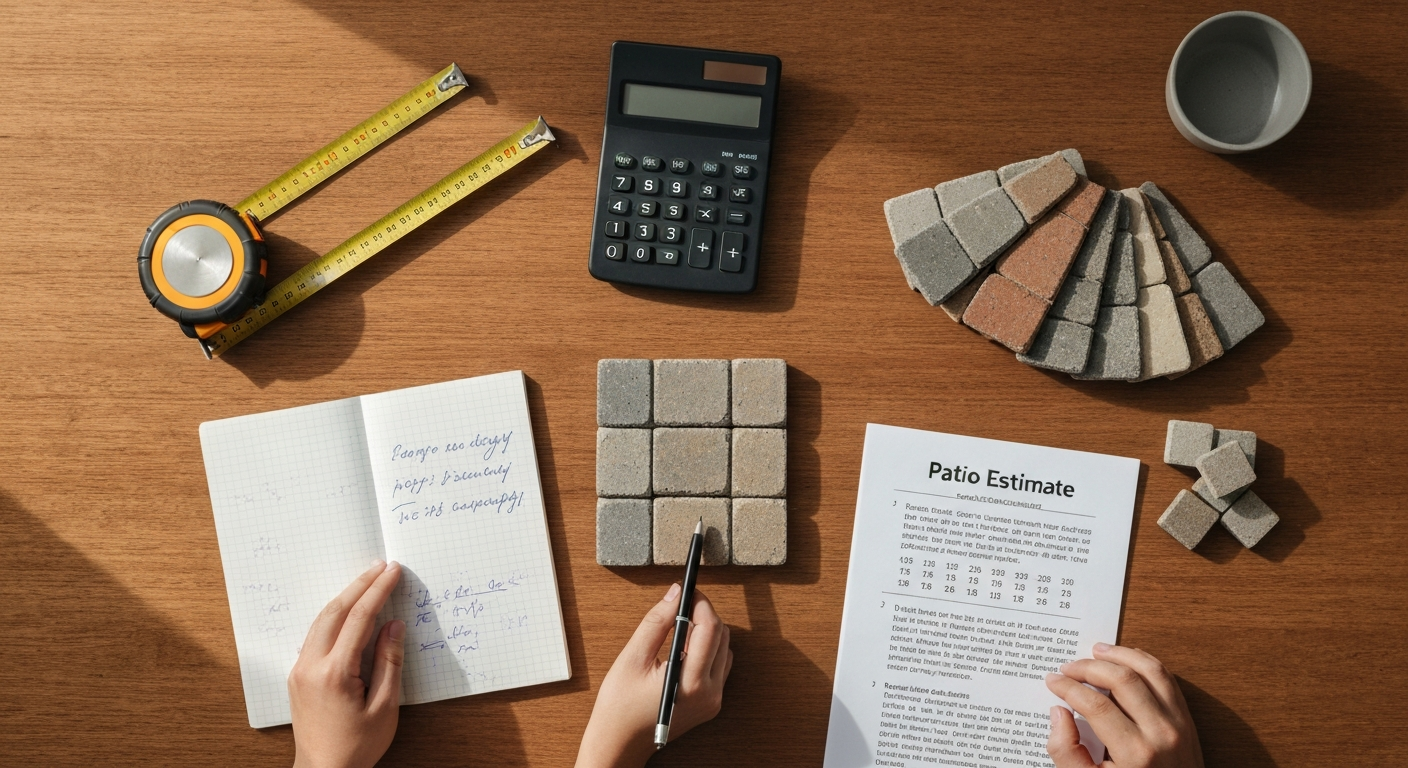
What this guide covers and who it's for
This is a working resource for homeowners who are planning a new patio or replacing an existing one and want to understand exactly where the money goes before they start collecting quotes. It covers ground-level patios in concrete (poured and stamped), pavers, brick, flagstone, and natural stone, as well as glazed or glass-in enclosures. Whether you're in the US, the UK, or Ireland, the pricing method is the same: you build the estimate line by line, then apply regional adjustments. The cost tables in this guide and the data behind the Patio Cost Calculator are drawn from current (2026) contractor surveys, builders' merchant pricing, and construction estimating benchmarks, so the numbers you see reflect what real projects cost right now, not five years ago.
If you're trying to decide whether to glass in a patio or build an open garden patio, the sections on add-ons and permit requirements are especially relevant. If you're wondering how much does a garden glass patio cost, see the detailed breakdown for glass-enclosed patios to compare glazing, framing, and installation costs. The step-by-step pricing method and the contractor rate breakdown near the end are useful whether you're budgeting your own project or trying to sense-check a quote you've already received.
Quick cost snapshot before you go deeper
Before diving into the detail, here are the headline ranges to orient your budget. If you need a quick answer to how much does a garden patio cost, check the headline ranges above and use the Patio Cost Calculator to get a tailored estimate. These are fully installed costs (materials plus labour plus standard base prep) for typical residential projects. They do not include permits, demolition of an existing surface, or major add-ons like drainage systems or lighting.
| Patio type | US installed (per sq ft) | UK installed (per m²) | Typical 12×12 ft US total |
|---|---|---|---|
| Poured concrete | $6–$12 | £40–£65 | $860–$1,730 |
| Stamped concrete | $12–$22 | £60–£110 | $1,730–$3,170 |
| Concrete pavers | $14–$25 | £55–£95 | $2,020–$3,600 |
| Brick pavers | $14–$22 | £50–£90 | $2,020–$3,170 |
| Flagstone / irregular natural stone | $18–$35 | £75–£140 | $2,590–$5,040 |
| High-end natural stone / porcelain | $22–$40+ | £85–£160+ | $3,170–$5,760+ |
These are national midpoints. Your actual number will shift based on your region, site conditions, and the specific contractor you choose. Use the ranges as a sanity check: if a quote falls well below the low end, ask what is not included.
Step-by-step pricing method: building your estimate line by line
Think of this as a workbook. Every patio estimate has the same five categories. Work through each one, assign a dollar (or pound) figure, and your total estimate builds itself. Skipping a category is how people end up $1,500 over budget.
Step 1: measure your patio and add waste
Measure the actual patio area in square feet or square metres. For a simple rectangle it's length times width. For irregular shapes, break the area into rectangles, calculate each, and add them. Then add 10% for material waste on cuts (15% for diagonal patterns or irregular shapes like flagstone). This is your ordering quantity, not just your net area. Getting this wrong is the most common DIY budgeting mistake.
Step 2: materials cost
Pull the per-sq-ft (or per-m²) material price for your chosen surface, multiply by your ordering quantity, and add delivery. In the UK, basic concrete paving packs from B&Q or Wickes typically run £25 to £33 per m² for 450×450 concrete slabs, while porcelain paving at Wickes lists around £30 to £31 per m² and Marshalls-branded packs range from roughly £22 to £43 per m² depending on product. In the US, standard concrete pavers retail at $2 to $8 per sq ft for material only, with natural stone and premium porcelain running higher. Always get a delivered price, not just the sticker price at the merchant.
Step 3: base and sub-base materials
Every patio needs a compacted sub-base. For pavers and slabs you typically need 4 inches (100 mm) of compacted hardcore or Type 1 crushed stone plus a bedding layer of sand or mortar. In the UK, MOT Type 1 aggregates typically cost £30 to £55 per tonne delivered (or £35 to £68 per bulk bag depending on region and quantity). In the US, gravel and crushed stone runs roughly $15 to $50 per cubic yard delivered. Budget approximately 0.12 to 0.15 cubic yards of base material per sq ft of patio at 4-inch depth, or about 0.10 to 0.12 m³ per m² in metric. Add a layer of geotextile membrane beneath the base where soil conditions require it: light weed-suppression fabric runs as low as £0.85 per m² retail in the UK, while heavy-duty woven geotextile for separation costs more.
Step 4: labour cost
Labour is usually the biggest single line item. A straightforward paver installation (excavate, base, bedding, lay, joint, compact) typically takes 6 to 12 crew-hours per 100 sq ft, based on commonly used estimating benchmarks. At US professional installer rates of $50 to $80 per hour per person, that means roughly $3 to $10 per sq ft in labour alone before any markup. Complex patterns, tight access, poor subgrade, or drainage work all push labour hours up. In the UK, day rates for a two-person landscape crew typically run £250 to £450 per day. If a contractor quotes a single per-sq-ft price, ask them to break out labour versus materials so you can compare quotes fairly.
Step 5: site preparation, permits, and add-ons
Site prep (excavation and spoil removal) is often quoted separately or bundled into the labour line. Budget it explicitly. Permits and inspections are easy to forget and are covered in detail in their own section below. Add-ons like drainage channels, edging, lighting, and covers should each be a separate line, not absorbed into a vague contingency. A realistic contingency for an average residential patio is 10 to 15% of the sub-total.
Sample estimate worksheet
| Line item | How to calculate | Example: 200 sq ft paver patio (US) |
|---|---|---|
| Surface materials (incl. 10% waste) | Area × 1.10 × material $/sq ft | 220 sq ft × $4.50 = $990 |
| Base aggregate (4" depth) | Volume (yd³) × delivered $/yd³ | 2.5 yd³ × $30 = $75 |
| Bedding sand | Area × 1" depth volume × rate | $40 |
| Geotextile membrane | Area × £/m² or $/sq ft | $30 |
| Labour (excavation + installation) | Crew-hrs × hourly rate | 24 hrs × $65 = $1,560 |
| Edging / restraints | Linear feet × rate | 60 lf × $4 = $240 |
| Permit fee | Fixed or per-project | $150 |
| Spoil disposal (skip / haul) | Volume × disposal rate | $200 |
| Contingency (12%) | Sub-total × 0.12 | $398 |
| TOTAL ESTIMATE | $3,683 |
Materials cost breakdown by patio type
The surface material is the most visible cost variable, but it also has the widest range. Here is a practical breakdown for each major patio type, with the factors that push the price up or down.
Poured concrete
Material-only cost for ready-mix concrete delivered is roughly $1.50 to $3.50 per sq ft (4-inch slab). Installed, poured concrete patios run $6 to $12 per sq ft in the US. The price moves based on slab thickness (4 vs. 6 inches), reinforcement (mesh or rebar), finish type (broom, trowel), and whether you need control joints cut. A broom-finish 4-inch slab is the lowest-cost hard-surface patio option available.
Stamped concrete
Stamped concrete is poured concrete with texture and colour added at the finishing stage. Installed costs typically range from $12 to $22 per sq ft nationally in the US. The price premium over plain concrete reflects the stamps, release agents, colour hardeners, and the extra skill required. A second colour accent or a custom border pattern can push costs toward the high end of the range or beyond. Stamped concrete is generally cheaper than the natural stone it mimics, but it will eventually crack and the repairs are visible.
Concrete pavers
Concrete pavers are the most popular mid-range option in both the US and UK. Material cost runs $2 to $8 per sq ft in the US for standard manufactured pavers, depending on thickness, profile, and brand. Installed, expect $14 to $25 per sq ft. In the UK, standard concrete paving slabs from major merchants (B&Q, Wickes, Travis Perkins) typically land at £25 to £43 per m² for materials only. Key price factors: paver size (smaller units mean more pieces and more labour), pattern complexity (herringbone costs more to lay than running bond), and whether the perimeter needs a soldier course.
Brick pavers
Genuine clay brick pavers typically cost $0.50 to $2.50 per unit, which works out to roughly $3 to $8 per sq ft for material. Installed cost runs $14 to $22 per sq ft, with brick offering good durability and a classic aesthetic. Price factors include clay vs. concrete brick, tumbled vs. straight-edged finish, pattern, and whether you're sourcing reclaimed brick (which adds both character and labour time for cleaning/sorting).
Flagstone
Flagstone (irregular-cut natural stone laid in a mosaic pattern) typically runs $3 to $10 per sq ft for materials and $18 to $35 per sq ft installed. The wide labour range reflects the skill and time involved in fitting irregular pieces with tight joints. Dry-laid flagstone over compacted aggregate is less expensive than mortar-set flagstone over a concrete slab, but the mortar-set version is more stable in wet climates or high-traffic areas. In the UK, natural stone paving (Indian sandstone, slate, limestone) is widely available; expect to pay roughly £40 to £80 per m² for stone supply alone.
Natural stone and premium porcelain
Cut or calibrated natural stone (granite, limestone, slate, travertine) and large-format porcelain tiles represent the premium end. Materials run $5 to $20 per sq ft and higher, with installed costs commonly $22 to $40+ per sq ft. In the UK, porcelain paving listed at merchants like Wickes runs around £30 per m² at the entry level, with premium Italian large-format porcelain running considerably higher. These materials require precise base prep and skilled installation; cutting errors on a £60 per m² porcelain tile are expensive. Their advantage is durability and low maintenance over a long lifespan.
Size examples with worked calculations
Pricing a specific size is straightforward once you have your per-sq-ft numbers. The table below shows worked examples at common patio sizes using a mid-range paver patio in the US as the base scenario ($20 per sq ft installed all-in, including base, labour, and standard site prep, but excluding permits and demolition).
| Patio size | Square footage | Low estimate ($14/sq ft) | Mid estimate ($20/sq ft) | High estimate ($30/sq ft) |
|---|---|---|---|---|
| 10×10 ft | 100 sq ft | $1,400 | $2,000 | $3,000 |
| 12×12 ft | 144 sq ft | $2,020 | $2,880 | $4,320 |
| 16×16 ft | 256 sq ft | $3,580 | $5,120 | $7,680 |
| 20×20 ft | 400 sq ft | $5,600 | $8,000 | $12,000 |
| 10×20 ft | 200 sq ft | $2,800 | $4,000 | $6,000 |
| 12×24 ft | 288 sq ft | $4,030 | $5,760 | $8,640 |
To run the same math for UK project sizes: take the m² area, apply your per-m² installed rate, and add 10 to 15% for waste on materials. For UK-specific pricing and worked examples, see our page on how much to patio a garden in the UK which shows typical per‑m² rates and regional adjustments. For a deeper look at UK-specific rates, planning rules, and regional variations, see our guide on how much does a patio cost UK. A 20 m² garden patio at a mid-range installed rate of £75 per m² works out to £1,500 for materials and labour, plus site prep, skip hire, and any permit fees on top. The per-unit math never changes; what changes is the rate you plug in.
One important note on the 10×10 size: at 100 sq ft, many contractors have a minimum job charge (often $1,200 to $1,500 in the US or £800 to £1,200 in the UK) that means your per-sq-ft effective cost will be higher than the table rate. Mobilisation, setup, and equipment are largely fixed costs regardless of whether the patio is 80 sq ft or 200 sq ft.
Site preparation and base costs
Site prep is the line item that most budget estimates leave out or underestimate. It's also where site-specific conditions create the biggest cost surprises, which is why you should always get a contractor to walk the site before finalising any quote.
Excavation and spoil removal
A standard patio requires excavating 6 to 10 inches (150 to 250 mm) of material to achieve the correct finished height after base, bedding, and surface layers. For a 200 sq ft patio at 8 inches of dig depth, that's roughly 4.9 cubic yards of spoil. In the UK, a mini-digger hire typically runs £80 to £200 per day for a micro or standard mini-digger. A 6-yard builder's skip to remove spoil typically costs £150 to £350 depending on region (London and the South East are at the higher end). In the US, excavation labour is often billed at $50 to $75 per hour for a mini-excavator and operator. Tight access (a narrow side gate, a city garden, a hillside) drives labour hours significantly higher.
Sub-base and compaction
After excavation, a compacted sub-base of crushed stone or MOT Type 1 is the foundation of a long-lasting patio. The standard minimum is 4 inches (100 mm) compacted for a pedestrian-only patio, and 6 inches (150 mm) if the patio will take vehicle access or if the subgrade is clay or poorly draining soil. Skimping on base depth is the most common reason patios develop uneven spots, sinking, and drainage problems within a few years. Plate compactor hire adds roughly £60 to £100 per day in the UK. In the US, most contractors include compaction equipment in their overhead.
Drainage, retaining walls, and problem sites
Flat, well-drained sites with good subgrade are the baseline assumption in most standard pricing. Add these scenarios to your estimate if they apply to your site. A simple linear drainage channel (ACO or similar) can add $10 to $20 per linear foot to the project cost. A retaining wall to create a level patio on a slope typically runs $15 to $35 per sq ft of wall face, depending on material and height. Clay-heavy soil may require a deeper base or a geotextile separation layer to prevent subgrade migration into the aggregate. If your patio connects to the house and water management is a concern, consulting a drainage specialist before laying is cheaper than lifting and relaying a sunken patio two years later.
Permits, planning rules, and what they cost
Most straightforward ground-level patio projects do not require a permit in the US, the UK, or Ireland, but there are important exceptions that can catch you out. Getting this wrong does not just cost money in fines: unpermitted work can complicate a house sale.
US permit requirements
In the United States, requirements vary by municipality. A plain ground-level patio (poured concrete or pavers at or near grade) generally does not require a building permit in most jurisdictions. Exceptions include: patios that are attached to or structurally connected to the house, raised platforms or elevated decks, patios in HOA-governed communities, and anything with electrical work (for lighting or heaters). When a permit is needed, expect to pay $50 to $250 for a basic residential patio permit, plus potentially a site inspection fee of $50 to $100. Always check with your local building department before assuming no permit is needed.
UK planning rules (England)
In England, most rear and ground-level patio work is permitted development, meaning no planning application is needed. However, there are clear exceptions. Any raised platform exceeding approximately 300 mm above ground level requires a planning application. Properties in conservation areas, Article 4 direction zones, or listed buildings have additional restrictions. The most commonly triggered rule for UK homeowners: replacing or creating a front garden hard surface larger than 5 m² with an impermeable material (standard concrete or most pavers) requires planning permission, unless the surface drains to a permeable area within the property. Permeable pavers or a gravel finish can sidestep this requirement entirely, which is worth knowing if you are pricing a front driveway or front garden patio. Always check with your local planning authority or the Planning Portal before starting work in a restricted zone.
Ireland and other regions
In Ireland, a rear garden patio at ground level is generally exempt development under the Planning and Development Act, but the same principles apply: raised structures, front gardens, and properties in protected areas may require permission. For a focused breakdown of regional pricing and common Irish-specific costs, see an expanded guide on how much does a patio cost ireland. Exemption conditions (area limits, height restrictions) should be verified with your local authority before starting. Permit application fees in Ireland typically run €34 to €65 for standard exemption queries and considerably more for full planning applications. Regional cost differences for the whole patio budget in Ireland are significant, and patio costs in Ireland can reflect both labour market conditions and imported material costs.
UK cost indexing note
The BCIS All-in Tender Price Index recorded approximately 3. BCIS, Tender Price Index note (2026) estimated roughly 3.2% annual tender price inflation in early 2026 for the All‑in Tender Price Index BCIS — Tender Price Index note (2026). 2% annual tender price inflation in early 2026 for UK construction broadly, which means prices from guides published even 12 months ago may under-represent current costs. When using any benchmark figure for a UK project, add a modest inflation uplift and always get a fresh local quote for comparison. Regional variation within the UK is substantial: London and the South East consistently price 15 to 30% above the national average, while parts of the North and Scotland can run below the midpoint.
How contractors price a patio job
Understanding how a professional contractor builds a quote helps you evaluate what you're being charged and spot quotes that have left things out. Here is the standard methodology.
Labour hours and crew productivity
Contractors use labour productivity figures to estimate hours. For a standard paver patio (excavate, base, bedding, lay, joint, compact), a common industry rule of thumb is 6 to 12 crew-hours per 100 sq ft. At the lower end (6 hours per 100 sq ft) you have ideal conditions: flat site, good access, simple pattern, well-draining subgrade. At the upper end (12 hours per 100 sq ft) you have: tight access, clay soil requiring extra base depth, diagonal or irregular patterns, or complex drainage integration. This productivity range is built into estimating frameworks like RSMeans, which express labour as hours per unit (square foot, linear foot) by crew composition and conditions.
Hourly rates and burdened crew costs
A contractor's quoted hourly rate is not the same as a worker's wage. The burdened rate adds payroll taxes, insurance (liability and workers' comp), benefits, vehicle and equipment costs, and company overhead, before any profit margin. In the US, professional paver and landscape installers typically bill $50 to $80 per installer-hour. A two-person crew working 8 hours at $65 per person is $1,040 in labour for that day's field work. On top of that, the contractor applies a markup on materials (typically 15 to 25% above their own supply cost) and an overhead-and-profit percentage (commonly 10 to 20% of the project subtotal). In the UK, day rates for a two-person landscape crew typically run £250 to £450 depending on experience, region, and what's included.
Sample contractor quote build-up (200 sq ft paver patio, US)
| Item | Calculation | Cost |
|---|---|---|
| Paver materials (supply cost) | 220 sq ft × $4.00/sq ft | $880 |
| Materials markup (20%) | $880 × 0.20 | $176 |
| Base aggregate | 2.5 yd³ × $35 delivered | $88 |
| Bedding sand | 1 yd³ × $40 | $40 |
| Edging restraints (60 lf) | 60 × $3.50 | $210 |
| Labour: excavation (4 hrs × $65 × 2 crew) | 8 crew-hrs × $65 | $520 |
| Labour: base + install (16 hrs × $65 × 2 crew) | 32 crew-hrs × $65 | $2,080 |
| Equipment (plate compactor, wheelbarrows) | Allowance | $120 |
| Spoil disposal | 1 skip / haul | $200 |
| Sub-total | $4,314 | |
| Overhead and profit (15%) | $4,314 × 0.15 | $647 |
| QUOTED PRICE | $4,961 |
This works out to roughly $24.80 per sq ft, which sits comfortably within the typical installed paver range of $14 to $40. If a quote comes in significantly below this structure, ask which line items have been removed. Common omissions in low quotes: spoil disposal, plate compactor hire, edging, and any drainage allowance.
Contingency and change orders
Most professional contractors include a contingency allowance (5 to 10% of the project) for conditions that cannot be fully assessed until excavation begins: unmarked utilities, unexpected tree roots, subgrade conditions worse than anticipated, or bad weather delays. This is legitimate and reasonable. Make sure you understand what triggers a change order and at what point you authorise additional spend: get it in writing before work starts.
DIY vs. professional installation: honest cost comparison
DIY installation can cut the total cost of a paver patio by 40 to 60% in a straightforward scenario, because labour is the largest single cost component. However, those savings come with real risks and genuine hidden costs.
| Factor | DIY | Professional install |
|---|---|---|
| Labour cost | Your time (zero cash cost) | $4–$11/sq ft |
| Material cost | Retail price (higher per unit) | Trade/wholesale price (10–20% lower) |
| Equipment | Hire costs (compactor, digger) | Usually included in contractor overhead |
| Skill requirement | Moderate to high (base prep is critical) | Handled by experienced crew |
| Risk of mistakes | Re-doing base work costs full materials again | Most contractors warranty workmanship |
| Time required | 200 sq ft: 2–4 weekends for most DIYers | 200 sq ft: typically 1–2 days for a crew |
| Best suited for | Simple rectangular patios, motivated DIYer with help | Complex shapes, poor site conditions, premium materials |
The biggest DIY gotcha is base preparation. The surface is the visible part, but the base is what determines whether your patio lasts 3 years or 30. Underprepared bases lead to settlement, heaving (in freeze-thaw climates), and weed invasion through joints. If you are going DIY, spend the money on proper compacted base depth and do not skip the plate compactor.
Patio vs. deck: cost and trade-off comparison
Patios and decks often compete for the same backyard budget. A ground-level deck in pressure-treated wood typically costs $15 to $35 per sq ft installed in the US, which overlaps significantly with patio pricing. Composite decking runs $25 to $50 per sq ft installed. So a patio is not always cheaper than a deck, especially at the entry level.
| Factor | Patio (concrete/pavers) | Deck (wood/composite) |
|---|---|---|
| Installed cost range (US) | $6–$40/sq ft | $15–$50/sq ft |
| Lifespan | 25–50+ years (stone/concrete) | 15–30 years (composite); less for wood |
| Maintenance | Low (occasional sealing/weeding) | Moderate to high (staining, board replacement) |
| Permit requirements | Often none for ground-level | Usually required; structural inspection needed |
| Sloped sites | Requires grading/retaining work | Can span grade changes with framing |
| Feel and use | Hard surface, furniture-stable | Softer feel, flexible framing options |
| Resale value | Good, especially stone/quality pavers | Good, especially in deck-heavy markets |
The practical answer: if your site is relatively flat, a patio almost always delivers better long-term value per dollar. If your site has significant grade change (more than 18 to 24 inches over the patio footprint), a deck can be cheaper than the retaining walls and grading required to create a level patio surface.
Common add-ons and their costs
These extras are frequently excluded from headline patio quotes but often end up on the final invoice. Build them into your budget from the start.
- Demolition and removal of existing patio: $1 to $5 per sq ft in the US (add skip hire cost in the UK, roughly £150 to £350 for a standard skip)
- Patio edging and restraints: $2 to $6 per linear foot (steel, aluminium, or concrete kerb)
- Drainage channel (ACO linear drain): $10 to $20 per linear foot installed
- Outdoor lighting (low-voltage path or in-patio lights): $200 to $700 installed for a small system; line-voltage systems cost considerably more
- Patio heaters (gas or electric fixed): $400 to $1,200 for a good-quality fixed overhead heater installed
- Pergola or shade structure over patio: $3,000 to $12,000 depending on size and material (timber vs. metal vs. kit)
- Glass-in or glazed patio enclosure: typically $10,000 to $30,000+ for a fully framed glass structure; lean-to glazed roofs are at the lower end of this range
- Sealing/jointing compound for pavers: $0.50 to $1.50 per sq ft for polymeric sand and sealant
- Steps from patio to garden or house: $500 to $2,000 per run depending on material and width
Regional cost adjustments: what to expect by location
Labour markets and material delivery costs vary significantly by geography. As a rough guide, US cities with high construction labour costs (San Francisco, New York, Seattle, Boston) will run 20 to 40% above the national averages shown in this article. Southern and Midwestern states are generally closer to the midpoint or below. In the UK, London and the South East consistently run 15 to 30% above the UK national midpoint, while Scotland, Wales, and the North of England are often at or below mid-range. In Ireland, material costs reflect import logistics and a smaller contractor market, and prices per m² tend to be higher than equivalent UK provincial rates.
In the UK, BCIS tender price data for early 2026 shows approximately 3.2% annual construction price inflation, which means costs from older guides will understate current reality. When using any published benchmark, treat it as a floor, not a ceiling.
Getting accurate local quotes: a practical checklist
Once you have a working budget estimate, you are in a much stronger position to evaluate contractor quotes. Here is the checklist I recommend before you sign anything.
- Measure your patio area accurately and confirm the square footage before requesting any quotes, so all contractors are quoting the same job
- Decide on your surface material before getting quotes: asking contractors to quote 'something nice' will get you incomparable numbers
- Check permit requirements with your local authority or Planning Portal (UK) before the contractor does: it shows you're informed and avoids surprises mid-project
- Get at least three quotes and ask each contractor to itemise materials, labour, base prep, and disposal separately
- Ask each contractor to specify base depth and compaction method: a quote that skimps on base depth is not a fair comparison to one that specifies 150 mm compacted Type 1
- Confirm what is excluded: demolition, drainage, edging, permits, and spoil removal are the most common omissions
- Check the contractor's workmanship warranty and whether it covers settlement or joint failure
- For UK projects, verify the contractor is VAT-registered if quoting above the VAT threshold; unregistered quotes on large jobs can indicate cash-in-hand working
- Use the Patio Cost Calculator to cross-check your estimate against current national and regional benchmarks for your specific material and size before accepting a quote
- Build a 10 to 15% contingency into your approved budget, not just your estimate
The single most useful thing you can do before getting quotes is to arrive with a clear spec: material type, area in sq ft or m², any known site challenges, and a realistic budget range. Contractors give better, more accurate quotes when the scope is clear, and you will find it much easier to compare three quotes against each other when they are all answering the same question.
FAQ
What step-by-step method should I use to estimate and price a patio job from start to finish?
Step 1: Define scope and size — measure patio footprint (length × width) and note elevations, access, obstructions, and intended finish (concrete, pavers, natural stone, glazed roof). Step 2: Materials list — paving units (m² or ft²), bedding sand/mortar, sub‑base aggregate (Type 1/MOT or crushed stone), geotextile membrane, edging units, jointing compound/sealer. Step 3: Site‑prep allowances — excavation depth (typically 150–300 mm depending on finish), spoil removal (skips/hire), temporary protective measures. Step 4: Drainage & groundworks — falls, channels, soakaway/permeable surfacing if required. Step 5: Labour estimate — convert productivity rules (crew‑hours per ft² or m²) to labour hours, apply labour rates and on‑costs. Step 6: Permits & compliance — check local planning/permitted development (UK: front gardens >5 m² with impermeable surfacing need permission unless permeable or drains to permeable area). Step 7: Add‑ons & extras — lighting, heating, covers, planter beds, retaining walls. Step 8: Contractor markup & profit — add overhead and profit (typical contractor markup 10–30% on total direct costs depending on company size and risk). Step 9: Contingency — add 5–15% contingency for unknowns. Step 10: Produce final quote and compare at least 3 local quotes using identical scope checklist.
How do I calculate material quantities and costs?
Measure area in m² or ft². Paving units: area = length × width. Sub‑base: typical compacted thickness 75–150 mm for pedestrian patios; calculate volume = area × depth (m³) then convert to tonnes or yd³ using local bulk density. Bedding layer: 25–40 mm of sharp sand or mortar bed. Geotextile: area plus overlap (add ~5–10%). Add edges/kerbs length for linear units. Use merchant/unit prices to estimate material cost lines, and include delivery. For UK examples use merchant prices (porcelain paving ~£22–£44/m² depending on product; basic concrete packs ~£25–£33/m²). For US use big‑box ranges (concrete pavers ~$2–$8/ft² material).
What are realistic per‑type installed cost ranges (per sq ft / per m²) for common patio surfaces?
Installed costs vary by country, site conditions and finish quality. Typical installed ranges (broad guidance): - Basic concrete slab/poured: UK ~£50–£90/m²; US ~$6–$15/ft². - Stamped/poured decorative concrete: UK ~£70–£120/m²; US ~$8–$20/ft². - Concrete pavers (installed): UK ~£70–£130/m²; US ~$14–$40/ft². - Brick pavers: UK ~£80–£150/m²; US ~$15–$45/ft². - Flagstone/natural stone: UK ~£100–£250+/m²; US ~$20–$60+/ft². - High‑end porcelain tiles: UK ~£90–£200/m²; US ~$18–$50/ft². Use the lower end for straightforward, accessible jobs and the high end for complex access, retaining, drainage, pattern cutting or premium materials.
Can you give per‑size price examples for common patio sizes (10×10, 12×12, 20×20)?
Assuming mid‑range paver installation: - 10×10 ft (100 ft² / 9.3 m²): US mid range ~$1,800–$2,500; UK mid range ~£700–£1,200. - 12×12 ft (144 ft² / 13.4 m²): US mid ~$2,500–$3,800; UK mid ~£1,000–£1,700. - 20×20 ft (400 ft² / 37.2 m²): US mid ~$6,000–$12,000; UK mid ~£3,000–£6,000. These examples assume normal access, no major retaining or drainage work and a mid‑range material. Adjust upward for premium stone, complex patterns or difficult access. Always convert between ft² and m² consistently when comparing quotes.
How should I adjust prices regionally, especially for the UK and Ireland?
Adjust for local labour and material markets, and recent tender inflation. In the UK: London and South East typically 10–30% higher than national averages; remote/rural areas often lower. Factor BCIS/tender indexes for inflation (recent modest annual tender inflation observed). Material merchant prices (Wickes, Travis Perkins, B&Q) give product benchmarks; use local merchant quotes for large volumes. For Ireland, expect similar patterns but check local suppliers and waste/skip and plant hire costs. Also factor planning/permeability rules in England for front gardens (impermeable surfacing >5 m² may need permission unless mitigations are used).
How do contractors typically build a price (labour hours, markup, profit)?
Contractors convert scope into work packages with unit productivities (labour‑hours per m² or ft²) using historical crew productivity (RSMeans‑style). Example rule‑of‑thumb: 6–12 crew‑hours per 100 ft² for a straightforward paver patio (0.06–0.12 crew‑hours/ft²). Multiply crew hours by installer hourly billing rate (which factors wage, taxes, insurance and overhead) to get labour cost. Add direct material and subcontractor costs, plant hire, disposal, and permits. Apply company overhead and profit (commonly 10–30% markup on direct costs). Add contingency for unforeseen ground conditions. Document assumptions in the quote (materials, thickness, drainage).
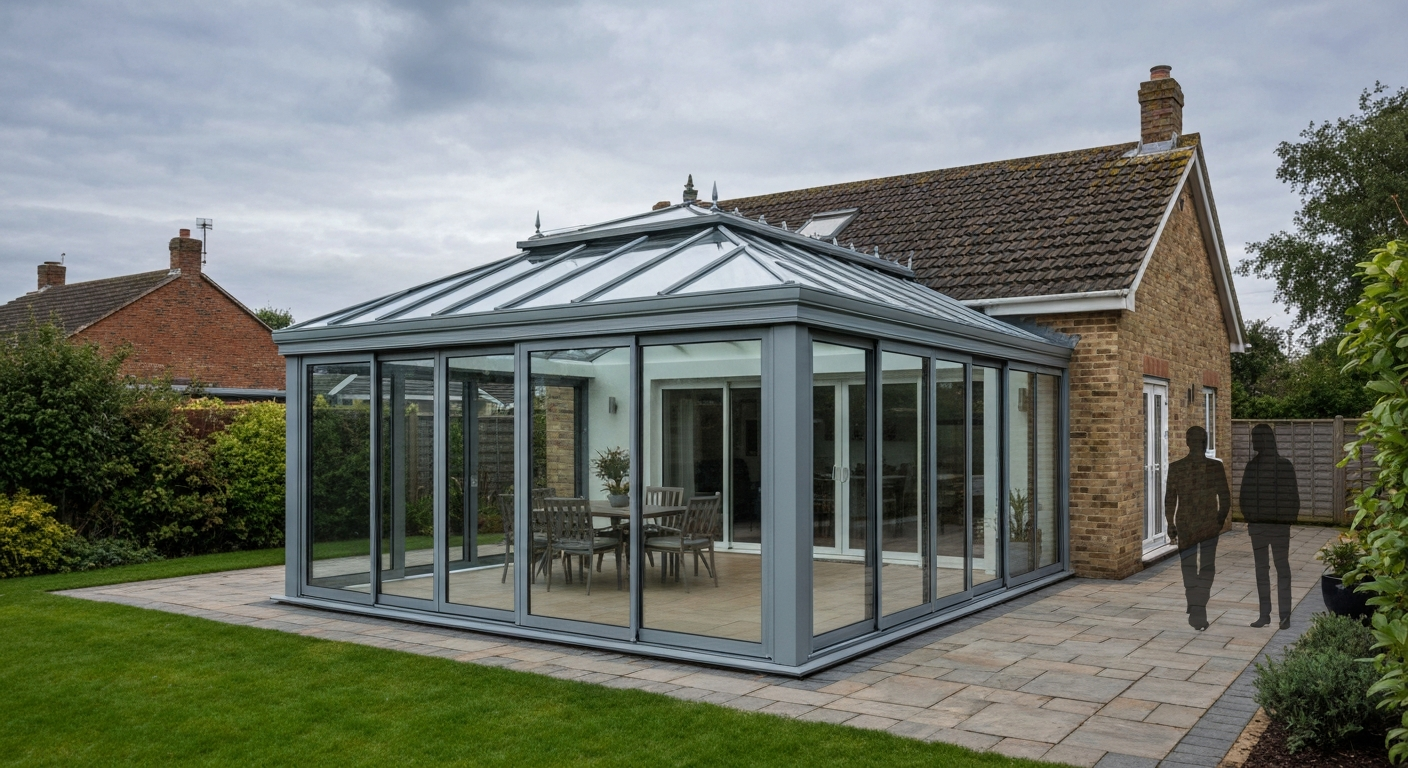
Garden glass patio costs explained: per sq ft and size examples, line-item budgets, DIY vs contractor, UK/Ireland notes.
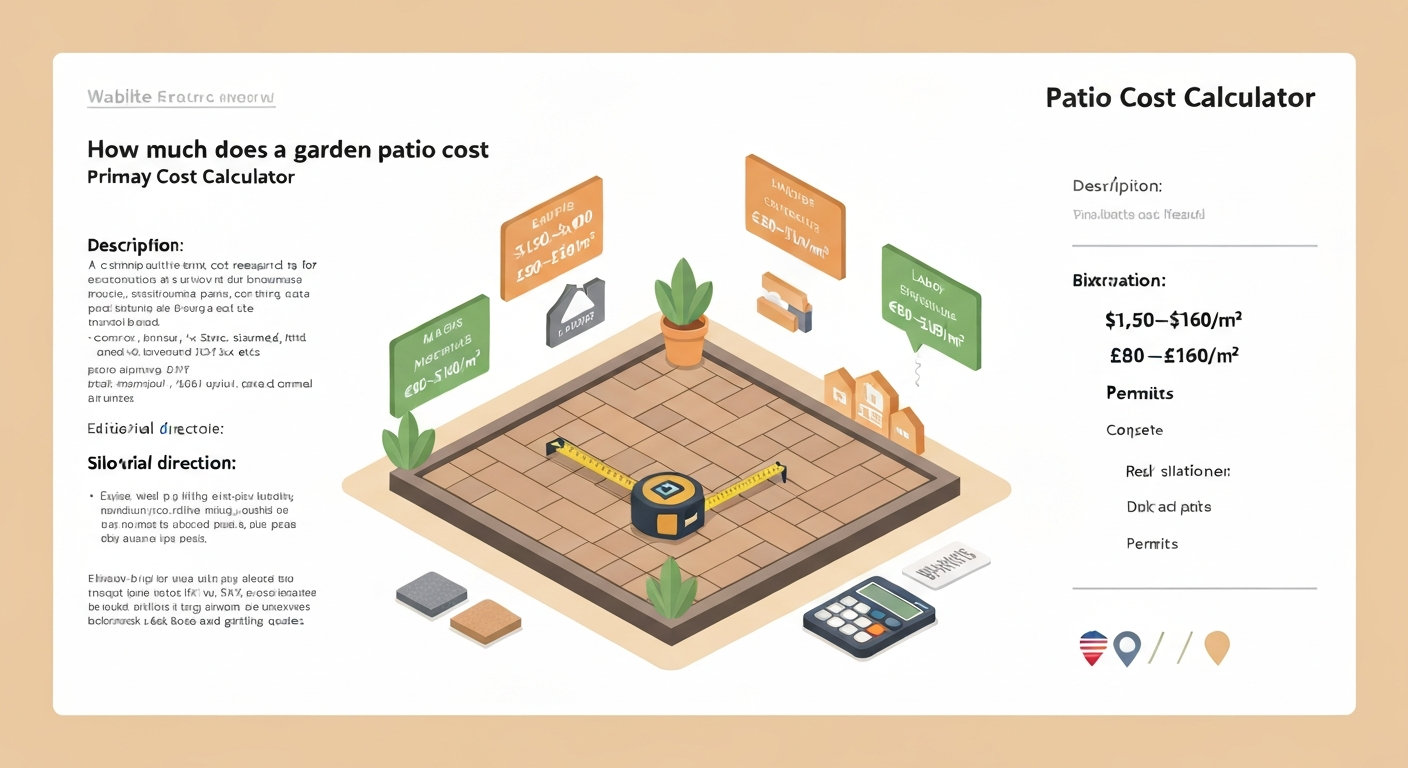
How much does a garden patio cost? Real-world price ranges, sample budgets, per-material costs & DIY vs contractor tips.
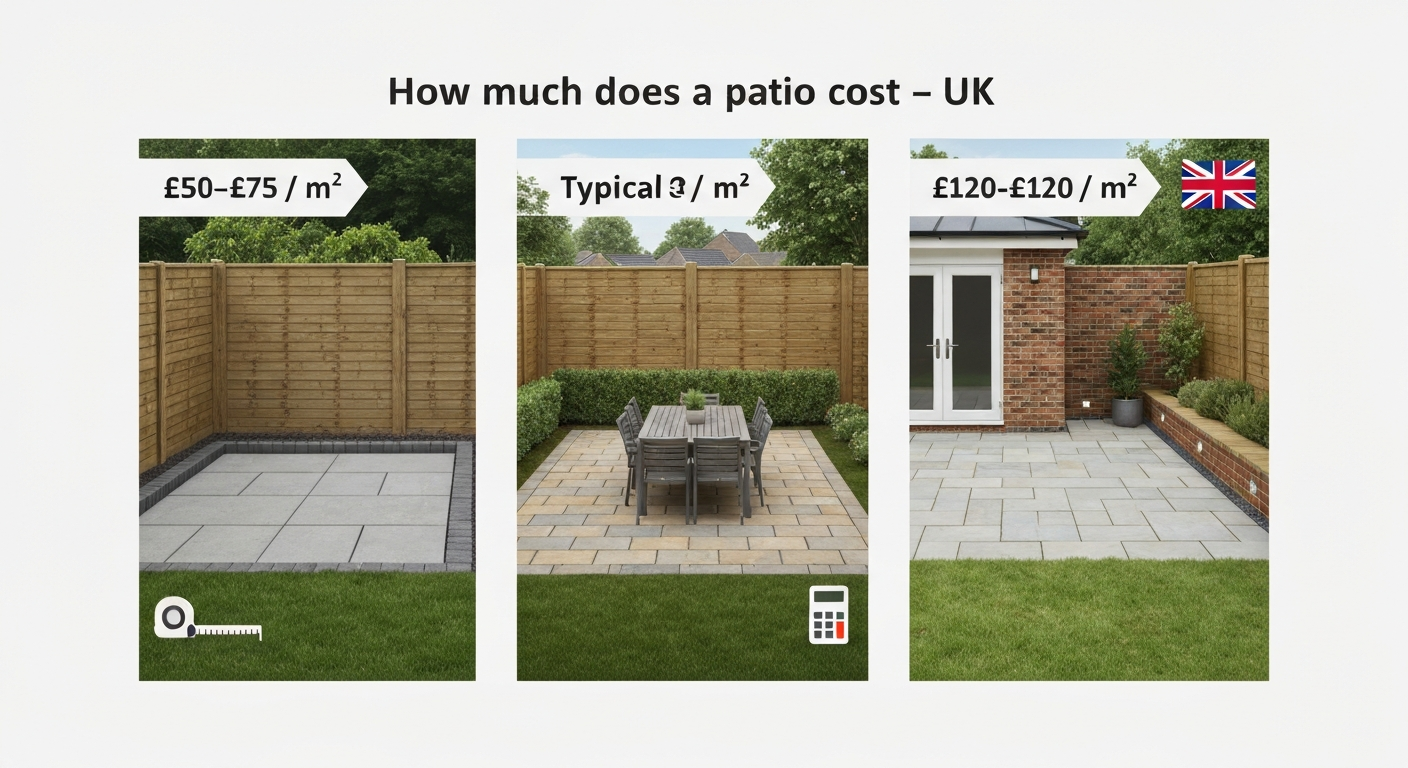
Patio cost UK: clear per m², size examples, material breakdowns, DIY vs pro costs and budget checklist.