
A gravel patio runs roughly $3 to $10 per square foot installed for most residential projects, putting a 200-square-foot patio in the $600 to $2,000 range. That is genuinely the most affordable hard-surface patio option available, and for the right yard and lifestyle, it looks great and holds up well. Pea gravel and plain crushed stone sit at the low end of that range, while decorative washed stones with a proper compacted subbase and metal edging push toward the top. If you are budgeting for a quick backyard refresh versus a long-term landscape investment, that $3–$10 window is where your planning should start.
How Much Does a Gravel Patio Cost: Real Prices & Estimates

Felix Carver
23 Jul 2026
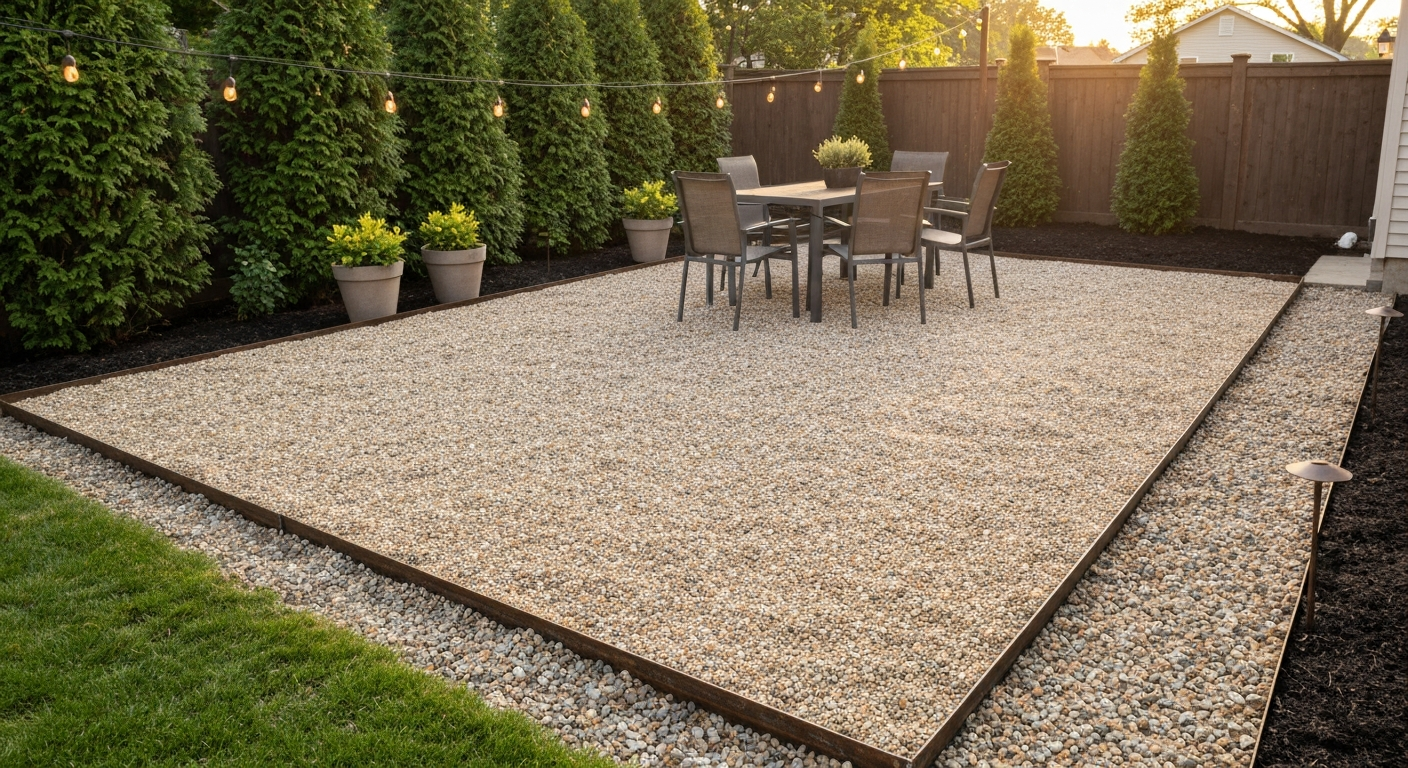
Quick cost summary
Here is the full spectrum of what homeowners actually pay for a gravel patio, from materials-only DIY to a professionally installed patio with all the extras. The numbers below reflect 2026 national pricing across multiple cost aggregators.
| Scenario | Per Sq Ft | 200 Sq Ft (10x20) | 144 Sq Ft (12x12) | 400 Sq Ft (20x20) |
|---|---|---|---|---|
| DIY materials only | $1.00–$2.50 | $200–$500 | $144–$360 | $400–$1,000 |
| Professional install (low-end) | $1.50–$4.00 | $300–$800 | $216–$576 | $600–$1,600 |
| Professional install (mid-range) | $4.00–$7.00 | $800–$1,400 | $576–$1,008 | $1,600–$2,800 |
| Professional install (high-end) | $7.00–$14.00 | $1,400–$2,800 | $1,008–$2,016 | $2,800–$5,600 |
The low-end installed figures align with Angi's published $1–$4 per square foot range for simple pea-gravel or crushed-stone installs. Fixr's wider $6–$14 range reflects projects with proper drainage layers, steel edging, geotextile fabric, and decorative stone finishes. Most real-world mid-market projects land in that $3–$10 synthesis range. Use the high end if you are in a high labor-cost metro area or your site has drainage or access challenges.
What actually drives the cost
Four factors account for almost every dollar difference you will see in contractor quotes: the gravel type you choose, the site preparation required, whether you add a proper subbase, and labor in your region. A contractor in San Francisco is paying their crew more than $18.50 per hour (the BLS median wage for landscaping workers) after burden and markup, while a solo operator in rural Ohio might quote much closer to that baseline. Here is a line-by-line look at where the money goes.
- Gravel material: $25–$75 per cubic yard bulk delivered, depending on stone type. Decorative washed pea gravel sits at the upper end; utility crushed stone at the lower end.
- Delivery fee: typically $75–$150 per truckload, regardless of order size. Small orders pay more per yard.
- Landscape fabric / geotextile: $0.10–$0.30 per square foot for weed-barrier fabric.
- Crushed-stone subbase: adds $1.50–$3.00 per square foot when done properly (material plus compact).
- Edging (plastic, steel, or aluminum): $1–$4 per linear foot installed.
- Excavation and grading: $1–$3 per square foot depending on depth and soil type.
- Labor for spreading and compacting: typically charged at $25–$60 per hour per worker.
- Permits: usually not required for a gravel patio, but check local rules if your yard has drainage or grading implications.
- Hauling / soil disposal: $100–$300 depending on excavation depth and dump fees.
Size matters too, but not in a linear way. A contractor mobilizing to your property has a fixed cost no matter what. A 100-square-foot patio might cost $8–$12 per square foot installed simply because the travel and setup fees get spread over fewer square feet. A 400-square-foot project usually gets a better per-foot rate. If your budget is tight, going slightly larger often costs less per square foot, not more.
Gravel patio costs: crushed stone and crushed rock
Standard crushed stone (limestone, granite fines, or decomposed granite) is the workhouse of gravel patios. It compacts better than rounded pea gravel, which makes it more stable underfoot and less prone to shifting. Decomposed granite in particular packs almost like pavement when properly installed and is a popular choice in dry climates.
Bulk pricing for common construction gravels runs roughly $15–$75 per ton or $20–$105 per cubic yard before delivery, depending on stone type and region. For a typical patio, you need 2–4 inches of finished depth. Using the standard formula: cubic yards needed = (area in ft² × depth in inches ÷ 12) ÷ 27. For a 200-square-foot patio at 3-inch depth, that works out to about 1.85 cubic yards of topping material, plus another 2+ cubic yards for a 3-inch compacted subbase layer.
| Patio Size | Sq Ft | Gravel Needed (3" top) | Subbase (3") | Est. Installed Cost |
|---|---|---|---|---|
| 10x10 | 100 | ~0.93 yd³ | ~0.93 yd³ | $300–$700 |
| 12x12 | 144 | ~1.33 yd³ | ~1.33 yd³ | $430–$1,000 |
| 10x20 | 200 | ~1.85 yd³ | ~1.85 yd³ | $600–$1,400 |
| 16x16 | 256 | ~2.37 yd³ | ~2.37 yd³ | $768–$1,800 |
| 20x20 | 400 | ~3.70 yd³ | ~3.70 yd³ | $1,200–$2,800 |
One cubic yard of crushed stone weighs roughly 1.35 tons (about 2,700 lb), so a 400-square-foot project with a combined 6 inches of material needs close to 10 cubic yards, or about 13.5 tons total. Bulk suppliers typically deliver by the yard, and most minimum orders are 1–2 yards. Budget the $75–$150 delivery fee on top of material costs.
DIY vs. professional for crushed stone patios
This is one of the most genuinely DIY-friendly patio types. The main tools you need are a plate compactor (rentable for about $75–$150 per day), a wheelbarrow, and some basic edging stakes. If you already own or can rent the compactor, your cost for a 200-square-foot crushed-stone patio could be as low as $200–$500 in materials plus $100–$150 in rentals. Hiring a landscaper for the same project typically runs $600–$1,400 depending on site conditions. The labor savings are real, but the physical work is significant: excavating 4–5 inches of soil from 200 square feet means moving roughly 3–4 tons of dirt.
Pea gravel patio costs
Pea gravel is the soft, rounded, pleasantly crunchy option. It is comfortable underfoot (even barefoot), drains beautifully, and is easy to top up over time. The trade-off is that it shifts and spreads more than crushed stone, so edging and a good subbase are not optional, they are essential.
Washed 3/8-inch pea gravel costs about $30–$55 per ton in bulk (delivered), or $45–$80 per cubic yard. If you are buying bags from a home improvement store, expect to pay roughly $6–$7 per 0.5-cubic-foot bag (based on current Home Depot pricing for bagged pea gravel). Bagging is fine for very small projects but gets expensive fast: a 200-square-foot patio at 2-inch depth needs about 1.23 cubic yards, which is roughly 66 bags at $6–$7 each, or $400–$460 in bags alone versus $55–$100 in bulk.
Full pea gravel patio cost breakdown
| Cost Component | DIY Estimate (200 sq ft) | Pro Estimate (200 sq ft) |
|---|---|---|
| Excavation (4–5" depth) | $0 (your labor) | $200–$400 |
| Crushed-stone subbase (3" compacted) | $75–$150 materials | $150–$350 installed |
| Landscape fabric / geotextile | $20–$40 | $40–$80 installed |
| Pea gravel topping (2–3") | $60–$120 bulk | $120–$250 installed |
| Edging (steel or aluminum) | $60–$120 materials | $120–$300 installed |
| Plate compactor rental | $75–$150 | Included in labor |
| Delivery fee | $75–$150 | Included or $75–$150 |
| Total estimate | $365–$730 | $705–$1,530 |
This Old House recommends excavating 4–5 inches of soil, laying and compacting a 2–4-inch crushed-stone subbase in lifts, adding landscape fabric, then topping with 2–4 inches of pea gravel. That methodology is reflected in the cost breakdown above. Skipping the subbase is the most common DIY shortcut and the main reason pea-gravel patios get lumpy and spongy within a year or two.
A quick coverage check: one cubic yard covers about 162 square feet at 2-inch depth, 108 square feet at 3-inch depth, or 81 square feet at 4-inch depth. For a standard 12x12 patio (144 square feet) with a 2-inch topping, you need about 0.9 cubic yards of pea gravel, roughly one full yard when accounting for waste and settling.
Poured concrete patio costs
Plain poured concrete runs $4–$12 per square foot installed nationally. A basic broom-finished 200-square-foot concrete slab typically costs $800–$2,400, with regional labor rates doing most of the work in that spread. Concrete is permanent, low-maintenance once cured, and structurally superior to gravel for furniture, grills, and heavy use. It is also harder to DIY because ready-mix delivery has a narrow pour window and finishing concrete well takes real skill.
| Patio Size | Sq Ft | Low (Basic Broom Finish) | Mid | High (Decorative Finish) |
|---|---|---|---|---|
| 10x10 | 100 | $400–$600 | $700–$900 | $1,000–$1,200 |
| 12x12 | 144 | $576–$864 | $1,000–$1,300 | $1,440–$1,728 |
| 10x20 | 200 | $800–$1,200 | $1,400–$1,800 | $2,000–$2,400 |
| 20x20 | 400 | $1,600–$2,400 | $2,800–$3,600 | $4,000–$4,800 |
Finishing options are where concrete costs branch out significantly. A plain broom finish is the cheapest option and gives the slab a non-slip texture. Exposed aggregate (where the surface is washed to reveal the stone in the mix) adds $1–$3 per square foot. A salt finish adds a subtle pitted texture for a modest premium. These finishing choices are mostly cosmetic and do not affect structural performance, so they are an easy place to trim budget if needed.
Hidden cost to watch: concrete needs control joints every 8–12 feet to prevent cracking, and on sloped sites you will need proper drainage grading. Permits are more commonly required for concrete than for gravel, especially if the slab is attached to the house. Budget $50–$200 for permit fees depending on your municipality.
Stamped concrete vs. plain concrete
Stamped concrete uses textured mats pressed into fresh concrete to mimic stone, brick, or wood patterns, and integral or topical color is added to complete the look. It costs $8–$18 per square foot installed on average, versus $4–$12 for a plain slab. On a 400-square-foot patio, that is a price difference of $1,600–$2,400 more for stamped versus basic. Whether that premium is worth it depends on how much aesthetic impact you want without the ongoing maintenance of natural stone.
| Concrete Type | Per Sq Ft | 200 Sq Ft Estimate | 400 Sq Ft Estimate | Key Consideration |
|---|---|---|---|---|
| Plain broom-finish | $4–$8 | $800–$1,600 | $1,600–$3,200 | Lowest cost, functional, durable |
| Exposed aggregate | $5–$10 | $1,000–$2,000 | $2,000–$4,000 | Slight texture upgrade, modest premium |
| Stamped (single color) | $8–$14 | $1,600–$2,800 | $3,200–$5,600 | Decorative, mimics stone or brick |
| Stamped (multi-color + sealer) | $12–$18 | $2,400–$3,600 | $4,800–$7,200 | High-end look, requires resealing every 2–3 yrs |
The main gotcha with stamped concrete is long-term maintenance. The sealer that makes it look rich and vivid needs to be reapplied every 2–3 years at a cost of $0.50–$1.50 per square foot, or the surface fades and can become slippery when wet. A stamped 400-square-foot patio might need $200–$600 in resealing every few years. That is not a dealbreaker, but it is a real ongoing cost that plain concrete does not have.
Paver patio costs: concrete and brick pavers
Paver patios cost more upfront than gravel or concrete but offer one significant practical advantage: individual pavers can be lifted and reset if settling occurs, without breaking up a whole slab. Concrete pavers typically run $12–$20 per square foot installed; brick pavers run $15–$25 per square foot. High-end or custom patterns, including herringbone or basket weave, sit at the top of that range due to the additional labor for precise cutting and layout. HomeWyse's mid-market modeling puts brick and concrete pavers in the low-to-mid $20s per square foot for a fully installed project, which aligns with what most contractors actually quote.
| Paver Type | Unit Cost (per sq ft) | Installed Cost (per sq ft) | 200 Sq Ft Total | 400 Sq Ft Total |
|---|---|---|---|---|
| Concrete pavers (standard) | $2–$6 | $12–$20 | $2,400–$4,000 | $4,800–$8,000 |
| Brick pavers | $3–$8 | $15–$25 | $3,000–$5,000 | $6,000–$10,000 |
| Permeable pavers | $5–$10 | $18–$30 | $3,600–$6,000 | $7,200–$12,000 |
| Porcelain/tile pavers | $6–$15 | $20–$35 | $4,000–$7,000 | $8,000–$14,000 |
Labor is the biggest cost driver for pavers. The material itself is not dramatically more expensive than concrete ingredients, but the installation process is time-intensive: excavate, compact a gravel subbase, set a sand-setting bed, lay each unit individually, cut edges, compact the finished surface, and sweep polymeric sand into the joints. That last step is jointing. Polymeric sand sets semi-rigid in the joints, resisting weed growth and ant intrusion. It costs $25–$50 per bag (each bag covers roughly 25–50 square feet depending on joint width) and is almost always worth doing properly rather than using regular sand. Repointing settled or washed-out joints on an existing paver patio is a common follow-up project once you have owned a paver patio for several years.
Natural stone and flagstone patio costs
Natural flagstone is the premium end of the patio materials market. Installed costs typically range from $15 to $35 per square foot, and high-end projects with complex patterns or premium stone like Pennsylvania bluestone or Arizona sandstone can push past $40 per square foot. The material itself runs $2–$8 per square foot for common flagstone varieties, but the labor intensity drives the total cost. Every piece needs to be individually fitted, cut, and leveled, it is slow, skilled work.
| Stone Type | Material Cost (per sq ft) | Installed Cost (per sq ft) | Notes |
|---|---|---|---|
| Irregular flagstone (random) | $2–$5 | $15–$25 | Most affordable natural stone option |
| Cut/dimensional flagstone | $4–$8 | $20–$30 | Cleaner look, more cutting labor |
| Pennsylvania bluestone | $5–$9 | $22–$35 | Popular in Northeast; premium material |
| Slate | $4–$8 | $18–$30 | Smooth finish; can be slippery when wet |
| Travertine | $5–$10 | $22–$40 | Elegant, softer stone; regional availability varies |
Pattern choice matters a lot for labor cost. Random (dry-laid) irregular flagstone is the most labor-efficient because you are fitting organic shapes rather than cutting precise dimensions. A tight, cut-joint pattern with uniform spacing takes significantly longer to install and requires a wet saw for precise cuts. A 200-square-foot random-pattern flagstone patio might take a skilled mason 2–3 days; the same area in a tight-cut uniform pattern could take 4–5 days.
Setting method also affects price. Dry-laid flagstone (set on compacted sand or crushed stone) costs less to install and allows for natural drainage, but individual stones can shift over time, especially in freeze-thaw climates. Mortar-set flagstone on a concrete slab is more permanent and stable but adds $2–$5 per square foot to the cost and eliminates permeability. In cold climates, mortar-set stone on an improper subbase can crack and heave, so the base prep matters even more.
If your existing flagstone or paver patio has joint failure, crumbling mortar, washed-out sand, or gaps that are letting weeds through, repointing or regrouting is almost always more cost-effective than full replacement. The same logic applies to settled concrete slabs that have sunk due to soil erosion underneath; mudjacking (pumping grout beneath a sunken slab to raise it) is a fraction of the cost of tearing out and repaving. For specific pricing, see our guide on how much does mudjacking patio cost.
Gravel vs. everything else: which material fits your budget
Here is a direct side-by-side comparison so you can see exactly where gravel stands relative to every other common patio surface. These are national mid-market installed ranges for 2026.
| Material | Installed Cost (per sq ft) | DIY-Friendly? | Durability | Maintenance | Best For |
|---|---|---|---|---|---|
| Pea gravel / crushed stone | $1–$10 | Yes (easiest) | Moderate (shifts, settles) | Top-ups, weed control | Budget builds, informal spaces |
| Plain poured concrete | $4–$12 | Hard | High | Low (sealing optional) | Clean, functional patios |
| Stamped concrete | $8–$18 | No | High | Reseal every 2–3 yrs | Decorative, stone-look surface |
| Concrete pavers | $12–$20 | Moderate | Very high | Repoint joints every 5–10 yrs | Long-term, repairable patio |
| Brick pavers | $15–$25 | Moderate | Very high | Repoint joints; occasional resetting | Classic look, durable |
| Random flagstone | $15–$25 | Moderate | High | Repoint mortar or reset stones | Natural aesthetic, premium look |
| Cut flagstone / bluestone | $22–$35+ | No | High | Similar to flagstone | High-end outdoor living spaces |
For most homeowners who want to maximize outdoor living space on a tight budget, gravel is the honest recommendation. It installs faster, costs less, and for a patio that will mostly hold outdoor furniture, a firepit, or a casual seating area, it performs fine. If you want something permanent that looks sharp with minimal upkeep for 20+ years, concrete pavers at $12–$20 per square foot installed are arguably the better lifetime value despite the higher upfront cost.
Regional price differences and how to adjust your estimate
Labor rates vary by 30–50% across U.S. regions, and material freight costs add more variability for bulk stone. The BLS median wage for landscaping workers is $18.50 per hour nationally, but after payroll burden, insurance, overhead, and markup, a landscaping contractor's effective billing rate is typically $45–$85 per hour per crew member. A three-person crew in California might bill at a combined rate that is 40% higher than the same crew in the Midwest.
- Northeast and West Coast (especially CA, NY, MA): add 25–50% to national mid-range estimates.
- Southeast and South Central (TX, TN, GA): roughly at or slightly below national averages for labor.
- Midwest (OH, IN, MI): often 10–20% below national average for labor.
- Mountain West (CO, UT): near national average but material freight can add cost in rural areas.
- Pacific Northwest (WA, OR): labor similar to California in metro areas; lower in rural areas.
The best way to calibrate for your area is to get three quotes from local contractors. Online calculators (including the tools on this site) can set realistic expectations before you call anyone, so you walk into those conversations knowing whether a quote is competitive or inflated.
Repair and redo options: when not to start from scratch
Before pricing a brand-new patio, it is worth knowing when an existing surface can be repaired rather than replaced. Full patio replacement is a significant expense regardless of material, and many problems have targeted fixes that cost far less. If you're considering that route, see our detailed guide on how much to replace a patio for typical replacement costs and decision factors.
- Gravel patio spreading or going thin: add a fresh 1–2 inch layer of gravel and reset edging. Material cost only, typically $0.50–$2.00 per square foot.
- Sunken concrete slab (due to soil erosion): mudjacking can raise it back to level for a fraction of full replacement cost. This is one of the most underutilized options homeowners overlook.
- Crumbling or missing mortar joints in flagstone or brick: repointing (tuck-pointing) fills and reseals joints without disturbing the surface. Repointing a 200-square-foot patio typically costs $300–$700 professionally.
- Washed-out polymeric sand in paver joints: re-sanding and compacting can often be done DIY for $50–$150 in materials on a standard-size patio.
- Outdated or damaged surface: retiling an existing concrete slab with outdoor porcelain or stone tile is a real option if the slab is structurally sound — often cheaper than pouring a new surface.
- Full replacement (redo): when drainage has failed, the subbase has failed, or more than 30–40% of a paver or stone field has shifted beyond simple repair, full replacement becomes the right call.
A good rule of thumb: if the foundation (subbase and drainage) is sound and the damage is cosmetic or limited to joints and surface material, repair. For guidance on the specific cost of repairing paver joints, see how much to repoint patio. If the subbase has failed or the slab has cracked through at multiple points, budget for replacement.
Budgeting checklist before you get quotes
Use this list to make sure you are comparing quotes accurately when contractors come out. A quote that excludes half of these items may look cheap but will balloon during the project.
- Measure your intended patio area accurately (length × width in feet) and note any irregular shapes.
- Check your site's drainage: does water pool here after rain? If yes, expect drainage work to add cost.
- Note how much excavation is needed: is this a flat yard or does grading work need to happen?
- Decide on subbase depth requirement: cold climates need deeper subbase to handle freeze-thaw.
- Choose your edging material: plastic, aluminum, steel, or concrete curb — get this priced in.
- Ask specifically about geotextile fabric inclusion: it is often quoted as an add-on.
- Clarify whether material delivery fees are included or separate in each quote.
- Ask about soil disposal: who hauls the excavated dirt and what does that cost?
- Check whether a permit is required for your project type and municipality.
- Get a warranty or guarantee on labor, especially for paver or stone installation.
Next steps to get an accurate local quote
The numbers in this article are planning-level estimates based on national data. Your actual quote will depend on your specific site, local labor rates, and which contractor you choose. The most effective approach: use a cost calculator to set your baseline budget before calling anyone, then get three in-person quotes. If you want a quick estimate of how much it costs to redo a patio, try our redo-patio cost calculator for a localized, project-specific price range how much does it cost to redo a patio. When you have quotes in hand, you will immediately recognize whether you are being priced fairly or not. A quote that is 40% higher than the national mid-range without a clear reason (difficult access, poor drainage, premium materials) is worth questioning.
If you are comparing a gravel patio against concrete, pavers, or flagstone for the same space, the per-square-foot tables in this article give you a realistic cost comparison before anyone sets foot in your yard. For specifics on tiled patios and typical per-square-foot pricing, see our guide on how much does it cost to tile a patio. Factor in your priorities: budget, longevity, maintenance tolerance, and how formal you want the finished space to look. Gravel wins on upfront cost almost every time. Pavers win on longevity and repairability. Concrete wins on low maintenance once installed. There is no universally wrong answer, only the one that fits your budget and how you use your backyard.
FAQ
Quick answer: How much does a gravel patio cost per square foot and overall for a homeowner?
Typical planning range for a gravel (including pea gravel) patio is roughly $1–$10 per square foot installed depending on finish and scope. Practical mid‑market planning: $3–$7/ft². Very simple DIY topdressing can approach $1/ft² (materials only); fuller professional installs with base, edging and drainage commonly run $2–$6/ft²; complex installs or decorative gravels can reach $6–$10+/ft².
What are realistic low–mid–high cost ranges for common patio sizes (10×10, 12×12, 20×20)?
Approximate installed cost ranges (low / mid / high): - 10×10 (100 ft²): $100 / $350 / $1,000. - 12×12 (144 ft²): $144 / $500 / $1,440. - 20×20 (400 ft²): $400 / $1,600 / $4,000. These banded values reflect: low = basic DIY materials or very light contractor scope; mid = typical contractor install with compacted base, edging and fabric; high = decorative gravel, added drainage/hauling, higher labor rates or premium stone.
How do gravel patio costs compare to other patio materials (concrete, pavers, stone, brick, flagstone)?
Relative installed cost per ft² (typical national planning ranges): - Gravel/pea gravel: $1–$10 (practical $3–$7). - Poured concrete (plain): $4–$12. - Stamped concrete: higher end of concrete. - Concrete pavers: $12–$30. - Brick pavers: mid to high $10s–$30s. - Natural flagstone: $15–$35+. Gravel is generally the lowest‑cost hardscape option; concrete and pavers cost more because of materials, labor, base preparation and pattern work.
Line‑item cost drivers I should budget for (what affects the final price)?
Main line items that drive cost: - Site prep/excavation — removing vegetation, roots, old patio, and grading. - Subbase (crushed stone) — typically 2–4" compacted. - Bedding/top gravel (pea gravel) — 2–4" finished depth. - Landscape fabric/geotextile — weed control and separation. - Edging (metal, timber, plastic, paver edge) — keeps gravel contained. - Compaction and equipment (plate compactor, tamping). - Drainage solutions (French drain, slope work) where needed. - Hauling/disposal — removing old material and delivery fees for bulk rock. - Labor (crew hours) — varies regionally and by crew skill. - Permits/inspections — local codes sometimes require permits. Each item can swing a project from a low DIY cost to professional mid/high ranges.
Specifics for pea‑gravel patios: materials and typical costs by line item
Typical elements and sample price bands (national planning): - Pea gravel material (bulk delivered): ~$45–$80/yd³ (bagged retail roughly $4–$7 per 0.5 cu ft bag). Coverage rule: 1 cu yd covers ≈324 ft² at 1" depth. - Crushed‑stone subbase (bulk): ~$25–$50/yd³ plus compaction. - Landscape fabric: small cost per ft² (few cents to $0.50/ft² depending on product). - Edging: $1–$6/ft (plastic low end, metal or timber higher). - Compaction/equipment rental or contractor equipment: $50–$200/day rental or included in labor. - Labor/professional installed pea‑gravel patio: commonly $1.50–$4.50/ft² for straightforward installs; with base, edging and prep expect $2–$6/ft². DIY materials‑only estimate for pea gravel top and basic prep: ~$1.00–$2.50/ft².
DIY vs professional installation — how much can I save and what tradeoffs exist?
Savings: DIY can cut labor costs (often 40–70% of installed price) — so a mid project that would cost $1,600 professionally might be $400–$900 in materials for DIY. Tradeoffs: - Time and skill: excavation, correct base compaction and edge installation are critical; mistakes lead to settling, washout and weeds. - Equipment: you may need to rent a plate compactor, wheelbarrows and buy edging or fabric. - Permits/inspections: contractor knowledge avoids code issues. - Warranty and finish: pros provide consistency, drainage solutions and cleaner edges. For small, simple patios DIY is often feasible; for sloped sites, drainage problems or when removing an old patio, hiring pros is recommended.
Next Articles
How Much to Point a Patio Costs by Size and Surface
Costs to point a patio by size and surface, with DIY vs pro pricing, materials, scope options, and contractor questions.
How Much to Repoint a Patio Cost Guide by Size and Type
Patio repointing costs by size and material, DIY vs pro pricing, labor vs materials, and a quote comparison checklist.
How Much Does It Cost to Redo a Patio? Complete Guide
Budget patio redo costs by option and size, with concrete pavers and stone price ranges, labor factors, and quote checkl