
Tiling a patio typically costs between $8 and $30 per square foot installed, which puts a common 12x12 patio (144 sq ft) somewhere between $1,150 and $4,300 all-in. The wide range comes down to your tile choice, substrate condition, local labor rates, and whether you go DIY or hire a contractor. Porcelain pavers on a solid concrete slab at the low end of labor markets can land around $10–$14/sq ft installed. Premium large-format natural stone with a herringbone pattern in a high-cost city can push past $25–$30/sq ft. The sections below break all of that down so you can build a realistic number before you ever call a contractor.
How Much Does It Cost to Tile a Patio: Costs, Estimates & Guide

Felix Carver
13 Aug 2026
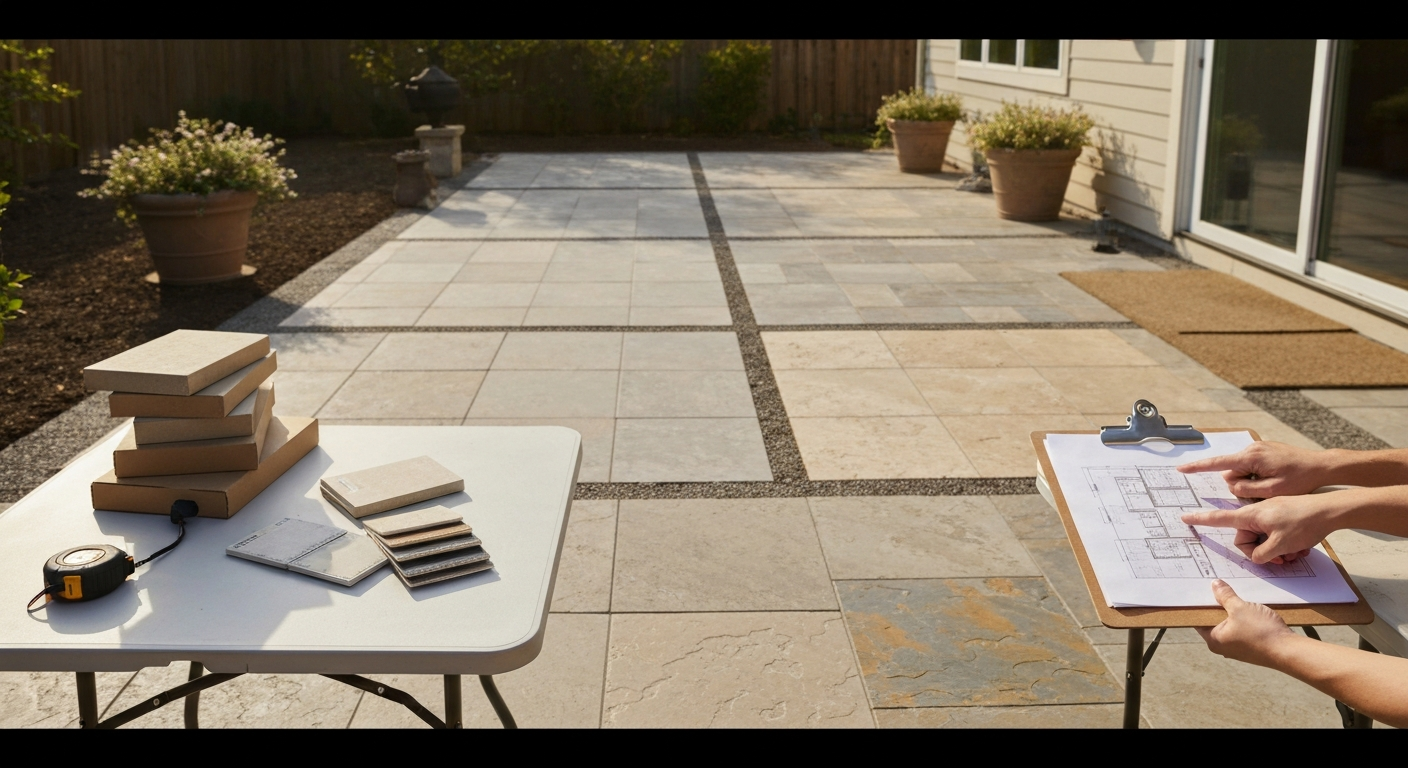
Quick cost summary: what to expect when tiling a patio
The single biggest lever on cost is tile material. Standard ceramic or basic porcelain tiles run $2–$8 per sq ft in materials. Porcelain pavers (the thick 2cm variety commonly used outdoors) run $5–$16/sq ft at retail, with distributor list prices on premium lines like Daltile Xteriors 2CM sitting around $16/sq ft delivered. Natural stone (travertine, slate, sandstone, limestone) ranges from roughly $3 to $15+ per sq ft depending on species and cut. Labor adds another $4–$15/sq ft for standard installations, jumping to $15–$25/sq ft for large-format tile, complex patterns, or difficult substrate conditions. Add base preparation, removal of old material, grout, sealer, and a waste buffer, and a fully loaded installed cost of $10–$20/sq ft is a realistic planning target for most residential projects.
- Materials only (tile): $2–$16/sq ft depending on product
- Labor only: $4–$15/sq ft for standard work; up to $25/sq ft for complex jobs
- Base prep (concrete grinding, leveling, membrane): $1–$4/sq ft
- Removal and disposal of old surface: $1–$3/sq ft
- Grout, thinset, sealer, consumables: $0.50–$2/sq ft
- Waste factor (materials overage): 10–20% of tile cost
- Typical all-in range: $8–$30/sq ft installed
Cost per square foot by tile material and pattern
The table below uses current retail and distributor pricing for materials alongside typical contractor labor rates. The installed total assumes a flat, reasonably sound concrete slab that needs only minor prep, no removal, and a straight-lay pattern. Add 15–20% to labor if you want diagonal, herringbone, or any complex layout.
| Tile Type | Material Cost (per sq ft) | Labor Cost (per sq ft) | Typical Installed Total | Notes |
|---|---|---|---|---|
| Basic ceramic (glazed) | $2–$5 | $4–$8 | $6–$13 | Indoor-rated tiles not suitable outdoors; use frost-rated ceramic only |
| Outdoor porcelain (standard) | $4–$10 | $4–$10 | $8–$20 | Most popular choice; durable, low maintenance |
| Porcelain pavers 2CM | $7–$16 | $6–$15 | $13–$31 | Heavy, thick pavers; extra labor for weight and alignment |
| Travertine | $5–$12 | $5–$12 | $10–$24 | Needs sealing; filling required for tumbled finish |
| Slate | $5–$10 | $5–$12 | $10–$22 | Natural variation; some splitting risk in freeze-thaw zones |
| Sandstone / limestone | $3–$10 | $5–$12 | $8–$22 | Softer stones; seal annually in wet climates |
| Quarry tile | $8–$17 | $4–$10 | $12–$27 | Extremely durable; common in commercial applications |
| Straight lay (any tile) | — | Baseline rate | Use rates above | ~80–120 sq ft/day productivity for installer |
| Diagonal lay (+15% labor) | — | +15% on labor | Add ~$0.75–$2/sq ft | ~60–90 sq ft/day |
| Herringbone / complex (+25–35% labor) | — | +25–35% on labor | Add ~$1.50–$4/sq ft | ~20–50 sq ft/day |
Total cost examples for common patio sizes
These examples assume professional installation on an existing concrete slab in reasonable condition, straight-lay pattern, no old tile removal, standard grout and sealer, and a 10% waste buffer. They are designed as planning benchmarks, not quotes. Your actual number will shift based on the regional adjustments covered in the next section.
| Patio Size | Square Footage | Budget Scenario (porcelain, basic) | Mid-Range (porcelain pavers 2CM) | Premium (natural stone, complex pattern) |
|---|---|---|---|---|
| 10×10 | 100 sq ft | $800–$1,300 | $1,500–$2,500 | $2,500–$4,000 |
| 12×12 | 144 sq ft | $1,150–$1,900 | $2,200–$3,600 | $3,600–$5,800 |
| 16×16 | 256 sq ft | $2,050–$3,300 | $3,800–$6,400 | $6,400–$10,200 |
| 20×20 | 400 sq ft | $3,200–$5,200 | $6,000–$10,000 | $10,000–$16,000 |
| 20×40 | 800 sq ft | $6,400–$10,400 | $12,000–$20,000 | $20,000–$32,000 |
A few things to notice in those numbers. First, the per-sq-ft cost is fairly stable across sizes once you are past 100 sq ft because contractor mobilization fees get diluted. Second, the jump from basic porcelain to a premium natural stone with pattern work roughly doubles your cost. If budget is tight, the biggest savings come from choosing standard porcelain over stone and sticking with a straight-lay grid rather than a diagonal or herringbone pattern.
Line-item cost breakdown: what you are actually paying for
Most contractor quotes bundle everything into a single per-sq-ft number, which makes it hard to spot where your money is going or where you can save. Breaking it down line by line also helps you compare bids more accurately when one quote seems unusually low.
Tile materials
This is the most visible cost and the easiest to shop. Porcelain tiles rated for outdoor use (PEI IV or V, frost-rated) start around $4–$6/sq ft at big-box stores and climb to $10–$16/sq ft for premium 2CM pavers at tile distributors. Tile flooring cost guide (material price ranges overview) summarizes national material-only retail ranges of roughly $2–$15 per sq ft for tiles, from basic ceramic/porcelain up to premium natural stone. Always order 10% extra for a straight lay, 15% for diagonal, and up to 20% for herringbone or rooms with many cuts. Leftover tile stored flat is cheap insurance against future repairs.
Labor
The Bureau of Labor Statistics puts the median wage for tile and stone setters at around $25/hour (roughly $52,000/year as of the 2024/2025 reporting period). Contractors bill out at $50–$100+/hour after overhead and profit, which translates to $4–$15/sq ft for standard work. Productivity benchmarks matter here: an experienced setter can do 80–120 sq ft per day on a straight lay but drops to 20–50 sq ft per day on herringbone or mosaic patterns. That slower pace is why complex patterns cost noticeably more in labor even when the material cost is the same.
Base preparation
Tile needs a flat, stable, crack-free substrate. On an existing concrete slab, prep typically includes grinding high spots, filling low spots or cracks, and installing an uncoupling membrane (like Schluter DITRA) to prevent tile cracking from slab movement. Membrane material alone runs $2.80–$4.00/sq ft at manufacturer pricing. Full base prep including grinding and membrane installation typically adds $1–$4/sq ft to the project total. If the slab is badly cracked or sunken, you may be looking at mudjacking or slab repair before tiling even starts, which is a separate cost category worth planning for.
Removal and disposal
Removing existing tile, pavers, or another hard surface adds $1–$3/sq ft. Heavy pavers or thick mortar beds are on the higher end. Disposal fees vary by municipality but budget $150–$400 for a standard haul-away on a 200–400 sq ft project. Some contractors include this in a flat line item; others itemize it, so ask explicitly.
Thinset mortar
Polymer-modified thinset like Custom Building Products VersaBond runs $15–$40 for a 50 lb bag at retail, and a 50 lb bag covers roughly 50–100 sq ft depending on tile size and trowel notch. On a 200 sq ft patio you might use 3–5 bags, so the material cost is $45–$200. For large-format tile or heavy 2CM pavers, use a large-notch trowel and expect coverage to be on the lower end. This line item is relatively small but should not be skipped in your estimate.
Grout and sealant
Standard sanded cementitious grout (MAPEI Keracolor and similar) runs $17–$40 for a 10–25 lb bag. For a 200 sq ft patio with standard joint width you will likely use 2–4 bags. Epoxy grout, which is far more stain and chemical resistant outdoors, costs $50–$100+ per kit but is worth it in harsh climates or high-traffic areas. Tile sealer adds another $30–$80 for a gallon that covers 200–500 sq ft depending on porosity. Budget $0.50–$2/sq ft for grout and sealer combined, with epoxy grout pushing you to the high end.
Permits and inspections
Most municipalities do not require a permit for resurfacing an existing patio with tile. Permits become more likely if you are building a new concrete slab, adding drainage, or the project is part of a larger addition. When required, permit fees typically run $50–$300 for residential patio work. Call your local building department before assuming you are exempt, because doing unpermitted work that later gets flagged can complicate a home sale.
Tools and equipment rental
If you DIY, tool costs add up fast. A wet tile saw rental runs $50–$80/day. An angle grinder with diamond blades for cuts adds $25–$50. A mixing paddle, notched trowels, grout float, spacers, and knee pads add another $50–$100 in consumables. If you need a concrete grinder for slab prep, plan $75–$150/day in rental. For a first-time installer, budget $300–$600 in tools and rentals for a 100–200 sq ft project.
Waste and overages
Industry practice is to order 10% extra tile for straight lay, 15% for diagonal cuts, and 15–20% for herringbone or complex patterns. On a 200 sq ft patio using $10/sq ft tile, a 15% waste buffer adds $300 to the material bill. Do not skip this because running short mid-project and finding the same dye lot tile weeks later is genuinely difficult. Round up to the nearest full box.
Regional adjustments and contractor rate ranges
Where you live can shift your installed cost by 30–60% versus the national average. Labor is the main driver. RSMeans city cost indexes document location factors for over 1,000 North American cities, and the spread is wide. A project costing $15/sq ft installed at the national average might run $10–$11/sq ft in a lower-cost rural area of the Southeast or Midwest and $20–$24/sq ft in San Francisco, New York City, or Boston.
| Region | Labor Cost Modifier vs. National Average | Practical Effect on a $15/sq ft Installed Project |
|---|---|---|
| San Francisco / NYC / Seattle | +40–60% above average | Installed cost ~$21–$24/sq ft |
| Chicago / Denver / Boston | +15–30% above average | Installed cost ~$17–$20/sq ft |
| National average baseline | 1.0x | $15/sq ft |
| Phoenix / Nashville / Charlotte | 5–15% below average | Installed cost ~$13–$14/sq ft |
| Rural Southeast / Midwest | 20–35% below average | Installed cost ~$10–$12/sq ft |
Material costs are more stable regionally because tile ships nationally and big-box pricing is fairly uniform. The gap really opens up in labor. When getting quotes in a high-cost market, it is worth checking whether a contractor from a neighboring lower-cost suburb will travel to your job. For larger projects (300+ sq ft), the savings can justify the extra drive time on their end.
To get accurate quotes, call at least three licensed contractors. Give each of them the same project scope: square footage, tile type, whether you supply tile or they do, substrate condition, and whether removal is needed. Inconsistent scoping is the main reason homeowners get quotes that seem wildly different but are actually comparing different jobs.
DIY vs. professional installation: cost, time, skill, and the real risks
The honest answer is that DIY patio tiling saves money but has meaningful failure risks if you skip steps. The most common DIY failure is tiling over a cracked or unsound slab without proper prep, which leads to cracked and popping tiles within one or two freeze-thaw cycles. If you go DIY, the prep work is where you cannot cut corners.
| Factor | DIY | Professional |
|---|---|---|
| Materials cost | $4–$16/sq ft (same as pro) | $4–$16/sq ft (same) |
| Labor cost | $0 (your time) | $4–$15/sq ft |
| Tool/rental cost | $300–$600 one-time for 100–200 sq ft | Included in labor rate |
| Typical all-in cost | $5–$12/sq ft for materials + tools | $10–$30/sq ft installed |
| Time required (100 sq ft) | 2–3 full days (including prep) | 1–2 days for a 2-person crew |
| Skill level required | Moderate-to-high; slab prep is critical | Professional certification/experience |
| Workmanship warranty | None | Typically 1–2 years on labor |
| Risk of failure | Higher without experience | Lower; contractor carries liability |
| Best for | Confident DIYers, simple layouts, sound slab | Complex patterns, large areas, poor substrate |
The savings from DIY on a 12x12 patio (144 sq ft) are real: you might spend $700–$1,200 in materials and tools versus $1,500–$3,500 professionally installed. But if you crack 20% of your tiles in year two because the slab moved under an improperly installed membrane, you will spend more fixing it than you saved. The uncoupling membrane step (DITRA or equivalent) and proper thinset coverage (back-butter large tiles) are the two steps most first-timers underexecute.
If you want to save money while still getting professional results, consider a hybrid approach: hire a contractor for slab prep and waterproofing, then do the tile-setting yourself. Some contractors will take work in stages like this, especially in slower seasons.
Repair vs. replace: when to regrout, repoint, mudjack, or start over
Before committing to full tile replacement, it is worth asking whether a repair is the cost-effective answer. The key question is whether the problem is surface-level or structural. Surface problems (cracked grout, stained joints, a few cracked tiles) are almost always cheaper to repair. Structural problems (sunken slab, widespread tile delamination, heaved frost damage) usually mean replacement or major intervention.
Regrouting
If your tile is in good shape but the grout is cracked, crumbling, or badly stained, regrouting is the right call. For detailed pricing and factors that affect the job, see our guide on how much does it cost to regrout a patio. Professional regrouting (removing old grout with an oscillating tool and applying new grout) typically costs $1.50–$4/sq ft in labor plus $0.50–$1.50/sq ft in materials. On a 150 sq ft patio that is $300–$825 all-in, compared to $1,500–$4,500 for a full retile. The job makes sense as long as the tiles themselves are sound and properly bonded.
Repointing
Repointing is the masonry equivalent of regrouting: cleaning out and refilling deteriorated mortar joints on pavers, stone, or brick-style tile installations. For specific pricing guidance on repointing and related pointing work, see how much to point a patio. Costs are similar to regrouting, typically $1–$3/sq ft for materials and labor. It is a high-value repair when the issue is just joint deterioration rather than movement or delamination.
Mudjacking a sunken slab
If your tiled patio has sections that have sunk or become uneven due to soil settlement, mudjacking (pumping a grout slurry under the slab to lift it) can fix the foundation problem without tearing out the tile. Mudjacking typically costs $3–$6/sq ft for the affected area, sometimes as little as $500–$1,500 for a small sunken section. For a deeper dive into pricing, read our guide on how much does mudjacking patio cost, which breaks down per-square-foot rates, minimums, and what affects the final bill. That is often significantly cheaper than full slab demolition and replacement before retiling, which can run $6–$12/sq ft just for the concrete work.
Patching individual tiles
Replacing individual cracked or chipped tiles is economical when you have matching tile in storage (another reason to keep leftover tile). Professional tile replacement runs roughly $50–$200 per tile including labor, grout, and disposal. If you have 5–10 damaged tiles out of 100 sq ft and the rest are fine, patching is obviously the right answer. The calculus shifts toward full replacement when more than 25–30% of tiles are damaged, when the dye lot is unavailable, or when the damage indicates a systemic substrate failure.
When full replacement makes sense
Full replacement becomes cost-effective when the existing installation has widespread delamination (tiles hollow-sounding when tapped across more than 30–40% of the surface), when the slab underneath is severely cracked or sunken in multiple areas, or when the tile is simply outdated and a full redo is desired anyway. In those cases, the cost of repairs often approaches or exceeds replacement cost, and you end up with a patchy result rather than a fresh surface. If you are weighing a full redo, the total project cost guidance above applies. For specific figures on how much to replace patio, see our detailed replacement cost guide. For a detailed breakdown of full replacement pricing, see our guide on how much does it cost to redo a patio.
How tiled patios compare to other patio options
Tile is not always the right answer. It is one of the better-looking options at mid-range price points, but it has real competition from concrete, pavers, natural stone, stamped concrete, brick, flagstone, gravel, and decks. Here is an honest side-by-side comparison.
| Patio Type | Installed Cost Range (per sq ft) | Durability | Maintenance Level | Best For |
|---|---|---|---|---|
| Tile (porcelain/ceramic) | $8–$30 | High (if installed right) | Low-Medium (seal stone types) | Clean modern look, existing concrete slab |
| Concrete (plain) | $5–$10 | High | Low | Budget patios, large areas |
| Stamped concrete | $12–$22 | Medium-High | Medium (reseal every 2–3 yrs) | Decorative look at mid-range cost |
| Concrete pavers | $10–$20 | Very high | Low-Medium | Flexible, repairable, classic look |
| Brick | $12–$22 | High | Low-Medium | Traditional aesthetics, cold climates |
| Natural stone (irregular) | $15–$30 | Very high | Medium (weed, seal) | Premium natural look |
| Flagstone | $15–$35 | Very high | Medium | Rustic/organic designs |
| Gravel | $1–$4 | Medium | Medium (top-up, weed) | Budget option, drainage-friendly areas |
| Wood deck | $15–$35 | Medium (wood) / High (composite) | High (wood) / Low (composite) | Elevated spaces, irregular terrain |
| Composite deck | $20–$45 | High | Low | Low-maintenance elevated outdoor living |
If you already have a concrete slab and want to upgrade the look, tile is one of the most cost-effective upgrades available because you skip the slab cost. If you are starting from bare ground, the equation changes: now you need the slab first ($5–$10/sq ft for a standard 4-inch concrete pad), which pushes your total well above options like pavers that can go directly on a compacted gravel base. A gravel patio is by far the cheapest option if aesthetics are flexible and drainage is a priority. For detailed pricing on that option, see how much does a gravel patio cost. Flagstone and natural stone deliver the most premium look but carry the highest cost and some of the most demanding installation requirements.
Decks deserve a mention because they come up constantly in the tile-vs-deck comparison. A wood deck starts at $15–$20/sq ft and a composite deck can run $25–$45/sq ft installed, so they are not inherently cheaper than a tiled patio. Decks make sense when your yard is sloped, when you want elevated outdoor living, or when soil conditions make a concrete slab impractical. On flat ground with an existing slab, tile or pavers almost always beat a deck on cost.
How to budget accurately before you get quotes
The steps below walk you through building a realistic project budget before you talk to a single contractor. Having this number gives you a reference point for evaluating quotes and prevents you from being anchored by the first bid you receive.
- Measure your patio in square feet. Include any irregular corners or cutouts separately.
- Choose your tile type and find the retail price per sq ft from a local supplier or big-box store. Add 10–20% for waste depending on your pattern choice.
- Assess your substrate. If you have an existing concrete slab, tap tiles in different areas to check for hollow spots. Note any cracks wider than 1/8 inch — those need repair before tiling.
- Decide on layout pattern. Straight lay is cheapest. Every step toward a complex pattern adds labor cost.
- Estimate labor: use $6–$10/sq ft as a starting point in average labor markets, adjusted up by 30–50% in high-cost cities or for complex patterns.
- Add line items for: membrane/underlayment ($2–$4/sq ft), thinset and grout ($0.50–$1.50/sq ft), sealer ($0.25–$0.50/sq ft), and removal if applicable ($1–$3/sq ft).
- Add a 10–15% contingency on the total for surprises (substrate issues, broken tile during cuts, grout color changes).
- Get three itemized quotes and compare them line by line, not just total price.
A simple sample budget for a 12x12 patio (144 sq ft) using mid-range porcelain pavers in an average labor market looks like this: tile materials at $9/sq ft plus 15% waste buffer ($1,490 total), uncoupling membrane at $3/sq ft ($432), thinset and grout at $1/sq ft ($144), sealer at $0.40/sq ft ($58), labor at $8/sq ft ($1,152), and a 10% contingency ($328). Total: approximately $3,600. That is a realistic mid-range planning number, not a worst-case scenario.
Using a patio cost calculator before you start shopping gives you a baseline that adjusts for your size, material, and region. It also makes it much easier to spot when a quote is missing something (like removal or membrane) versus when one contractor is simply priced higher for the same scope.
FAQ
What is the typical cost to tile a patio per square foot and total for common sizes?
Installed cost (materials + labor + basic prep) typically ranges: • Budget ceramic/standard outdoor tile: $8–$15 per sq ft • Porcelain pavers/outdoor 2cm porcelain: $12–$30 per sq ft • Natural stone (travertine/limestone/slate): $15–$35+ per sq ft • High‑complexity installs (large format, diagonal, herringbone, elevated substrates): $20–$45+ per sq ft Example totals (installed, rounded): • 10x10 (100 sq ft): $800–$4,500 • 12x12 (144 sq ft): $1,150–$6,480 • 20x20 (400 sq ft): $3,200–$18,000 These bands include material and typical contractor labor; high-end stone or very complex jobs exceed the top ranges.
How do material-only prices compare for common patio tile types?
Typical material-only retail ranges: • Porcelain pavers/outdoor porcelain: $5–$16+/sq ft (premium 2cm pavers mid‑teens) • Ceramic outdoor tile/quarry: $2–$15/sq ft • Natural stone (travertine/flagstone/limestone): $3–$15+/sq ft (premium stone higher) • Underlayment/membranes (e.g., Schluter DITRA): ~$2.80–$4.00/sq ft • Thinset/grout/sealers/consumables: variable — plan $0.50–$3+/sq ft depending on product (epoxy/sealer raises cost). These are retail sticker prices; contractor purchasing may be lower or include markup.
What is a clear cost breakdown I should budget for?
Typical cost components to include: • Materials (tiles, underlayment, thinset, grout, sealant) — 30–60% of installed cost • Labor/installation — 30–50% (depends on complexity and local wages) • Base prep (excavation, compacted gravel/sand, subbase, geotextile) — $1–$6+/sq ft depending on depth and drainage needs • Removal/disposal of existing surface — $2–$8+/sq ft if needed • Grout/sealant & finishes — $0.50–$6+/sq ft • Permits/inspections — varies by municipality (often $0–$500) • Tools/rental (tile saw, compactor) — small rental fees or included by contractor • Waste/overage (10–20% tile waste depending on pattern). Always get line‑item quotes.
How should I adjust estimates for my region or city?
Use local labor and material availability as the main driver. Tools: • Apply a city/location factor (RSMeans City Cost Index) or ask local contractors for unit rates • Labor rates for tile setters nationally center near median ~$25/hr, but local contractor billing rates typically result in $4–$25+/sq ft labor depending on complexity • Expect 10–30% higher costs in high‑cost metro areas and lower in rural/low‑cost regions. Request three written local quotes to see regional variation.
What are typical contractor labor-rate ranges and productivity to plan time?
Labor ranges and productivity: • Typical installed labor-only bands: $4–$15/sq ft for standard outdoor tile; porcelain pavers or complex jobs can be $4–$25+/sq ft • Productivity per installer per day: standard tile straight lay ≈80–120 sq ft/day; large format/heavy pavers ≈40–80 sq ft/day; complex patterns ≈20–50 sq ft/day • Use these to estimate duration: a 400 sq ft standard job might take 3–6 installer‑days; complex patterns will take longer.
DIY vs professional: how do costs and time compare?
DIY pros and cons: • DIY material cost lower (no labor markup), but you must buy/rent tools (tile saw, compactor, mixing tools). Expect material + rentals maybe 60–80% of contractor installed cost if competent. • Time: DIY takes much longer — a 100–400 sq ft job could consume many weekends; installers are faster and produce consistent waterproofing/drainage. • Risk/cost of mistakes: improper substrate prep or drainage can cause failures requiring costly repairs. For simple flat patios with small tiles and basic prep, experienced DIYers can save money; for large areas, heavy pavers, complex patterns, or elevated/structural substrates, hire pros.
Next Articles
How Much Does It Cost to Regrout a Patio: Realistic Guide
How much does it cost to regrout a patio? Get national price ranges, per-sqft estimates and DIY vs. pro costs.
How Much Does a Gravel Patio Cost: Real Prices & Estimates
How much does a gravel patio cost: $500–$6,000 total ($2–$12/ft²); DIY vs pro, materials, sizes and repair costs.
How Much to Point a Patio Costs by Size and Surface
Costs to point a patio by size and surface, with DIY vs pro pricing, materials, scope options, and contractor questions.