
A professionally built wooden patio (or wood deck-style patio) typically runs $30 to $60 per square foot installed in 2026, which puts a 10x10 at roughly $3,000–$6,000, a 12x12 at $4,300–$8,600, and a 20x20 at $12,000–$24,000. Budget projects using basic pressure-treated lumber can come in closer to $25/sq ft, while premium hardwoods like ipe or mahogany can push costs past $80/sq ft installed. Most homeowners end up spending somewhere between $8,000 and $20,000 for a standard backyard wood deck build. A gable patio will typically fall in a similar overall range, but the added structure and roof supports can change the total price standard backyard wood deck build.
How Much Does a Wooden Patio Cost? 2026 Price Guide

Felix Carver
22 Jun 2026
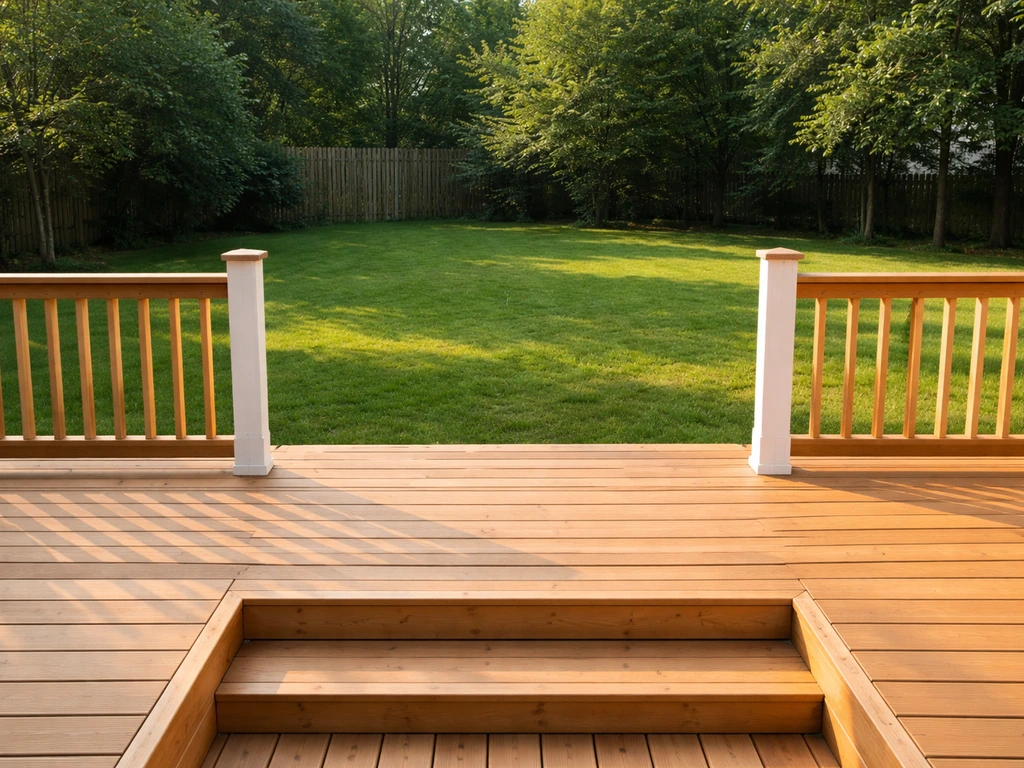
Wood patio costs by size and material type
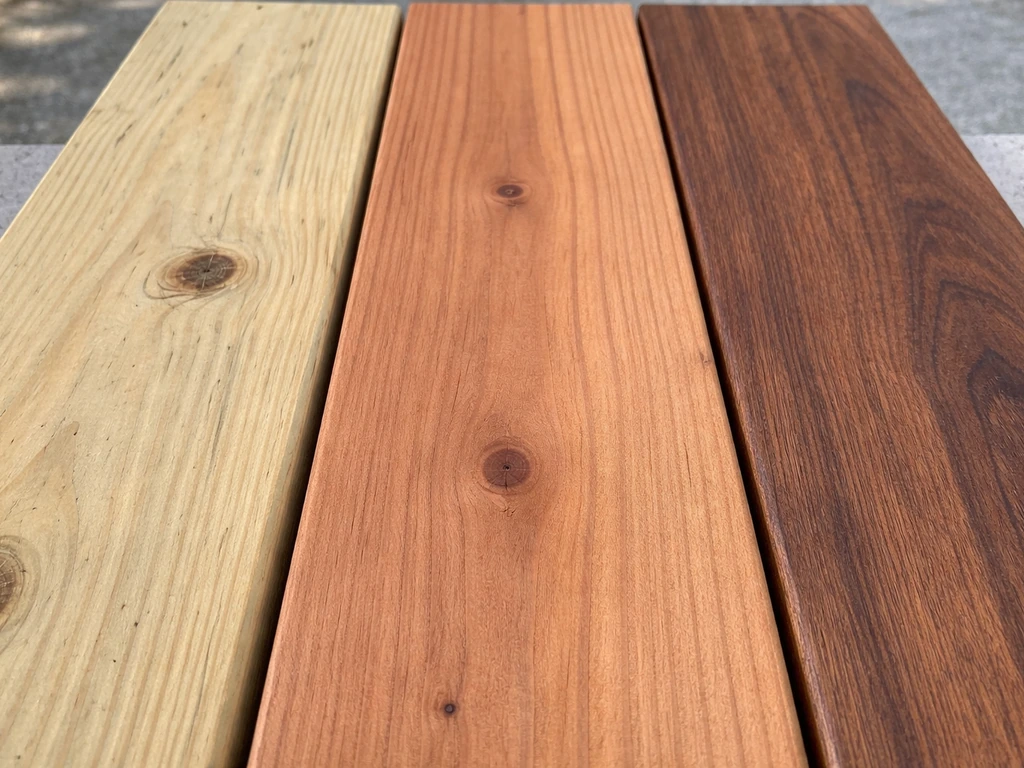
Size is the most obvious cost driver, but material choice is a close second. Pressure-treated (PT) pine is the budget baseline. Mahogany, cedar, and ipe push costs up fast. Here's how the math shakes out across common sizes using a $30–$60/sq ft installed range, with a high-end column for premium wood.
| Size | Square Footage | Budget PT Wood ($25–$35/sq ft) | Mid-Range Wood ($40–$55/sq ft) | Premium Hardwood ($60–$80/sq ft) |
|---|---|---|---|---|
| 10x10 | 100 sq ft | $2,500–$3,500 | $4,000–$5,500 | $6,000–$8,000 |
| 12x12 | 144 sq ft | $3,600–$5,000 | $5,750–$7,900 | $8,600–$11,500 |
| 16x16 | 256 sq ft | $6,400–$9,000 | $10,200–$14,100 | $15,400–$20,500 |
| 20x20 | 400 sq ft | $10,000–$14,000 | $16,000–$22,000 | $24,000–$32,000 |
| 12x24 | 288 sq ft | $7,200–$10,100 | $11,500–$15,800 | $17,300–$23,000 |
Pressure-treated pine is by far the most popular choice and the easiest on the wallet. Cedar sits in the middle ground: it's naturally rot-resistant and looks great, but costs more than PT. Mahogany planks alone run about $8–$11 per square foot in materials before a single nail is driven. Ipe (Brazilian hardwood) is even pricier but incredibly durable. If you're going with a premium hardwood, plan to spend at least $60 per square foot installed, often more.
Material type quick reference
| Wood Type | Approx. Material Cost (sq ft) | Durability | Maintenance Level | Best For |
|---|---|---|---|---|
| Pressure-treated pine | $3–$6/sq ft | Good (15–25 yrs) | Moderate (stain every 2–3 yrs) | Budget builds |
| Cedar | $5–$9/sq ft | Very good (20–30 yrs) | Low-moderate | Mid-range natural look |
| Redwood | $7–$12/sq ft | Very good | Low-moderate | West Coast projects |
| Mahogany | $8–$11/sq ft | Excellent | Moderate | Premium aesthetics |
| Ipe (Brazilian hardwood) | $10–$15/sq ft | Outstanding (40+ yrs) | Low (but harder to work) | High-end longevity builds |
Where the money actually goes: materials vs. labor vs. extras
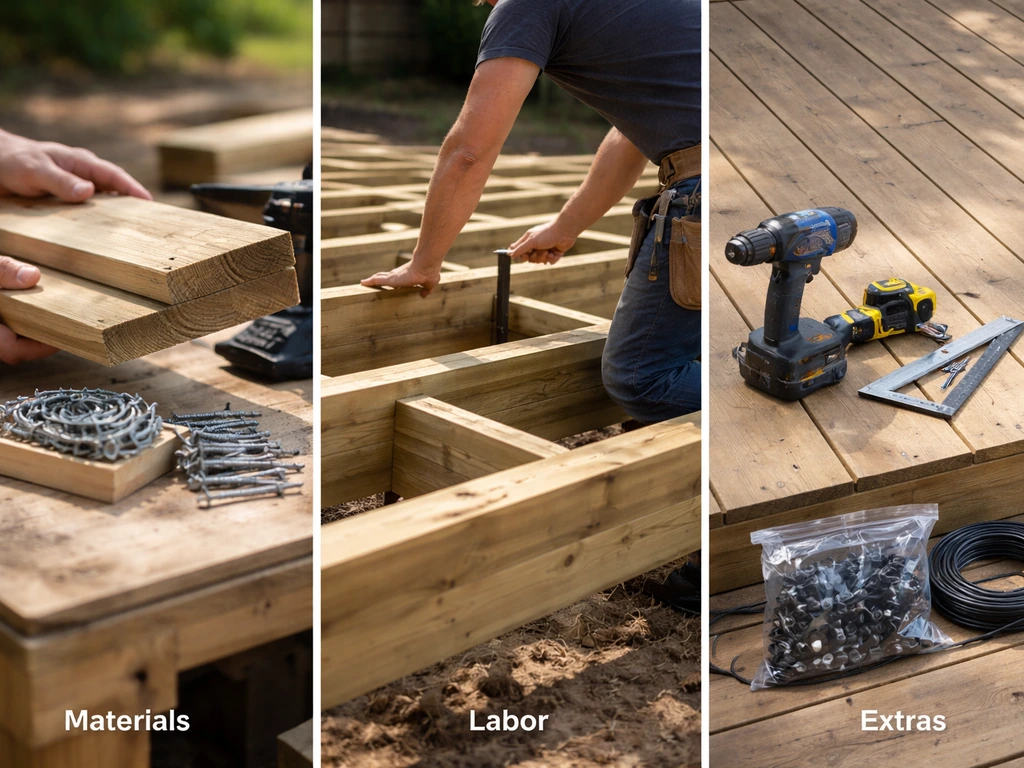
Here's a reality check that surprises a lot of homeowners: labor typically eats up 50–70% of the total installed cost of a wood deck. TimberTech/AZEK’s installation guide emphasizes that proper joist spacing and installing deck screws into joists are required for deck performance labor typically eats up 50–70% of the total installed cost of a wood deck.. That means on a $15,000 project, $7,500–$10,500 could be going to the crew. Materials are only a fraction of the final number, which is why upgrading from PT pine to cedar often adds less to your total bill than you'd expect.
Typical cost breakdown for a 200 sq ft pressure-treated wood patio/deck
| Line Item | Estimated Cost | Notes |
|---|---|---|
| Decking boards (surface) | $600–$1,200 | PT pine; cedar/hardwood adds cost |
| Framing lumber (joists, beams, posts) | $500–$900 | Typically $3–$8/sq ft for footings + framing |
| Fasteners, hardware, joist hangers | $100–$250 | Often underestimated in DIY budgets |
| Footings/concrete | $200–$600 | More in cold climates (frost-line depth) |
| Stain, sealer, or finish | $150–$400 | Essential for PT and cedar longevity |
| Railings (if needed) | $800–$3,000+ | $20–$150 per linear foot depending on style |
| Steps/stairs | $300–$1,200 | Per flight; more for complex configurations |
| Labor | $3,500–$7,000 | ~50–70% of total installed cost |
| Permits | $350–$1,800 | Varies widely by jurisdiction |
| Demo/removal of old surface | $500–$1,500 | If replacing existing concrete or old deck |
| Total estimate (200 sq ft, basic) | $6,200–$16,000+ | Wide range reflects site complexity |
Railings are one of the sneakiest budget busters. If your deck is more than 30 inches above grade, the IRC requires guardrails at a minimum height of 36 inches. A basic wood railing might run $20–$40 per linear foot, but cable, glass, or ornamental iron can hit $100–$150 per linear foot. On a 12x12 deck, you could easily have 30+ linear feet of railing, which adds $600 to $4,500 depending on what you choose. Always get railing quoted as a separate line item.
What makes the price go up (or way up)
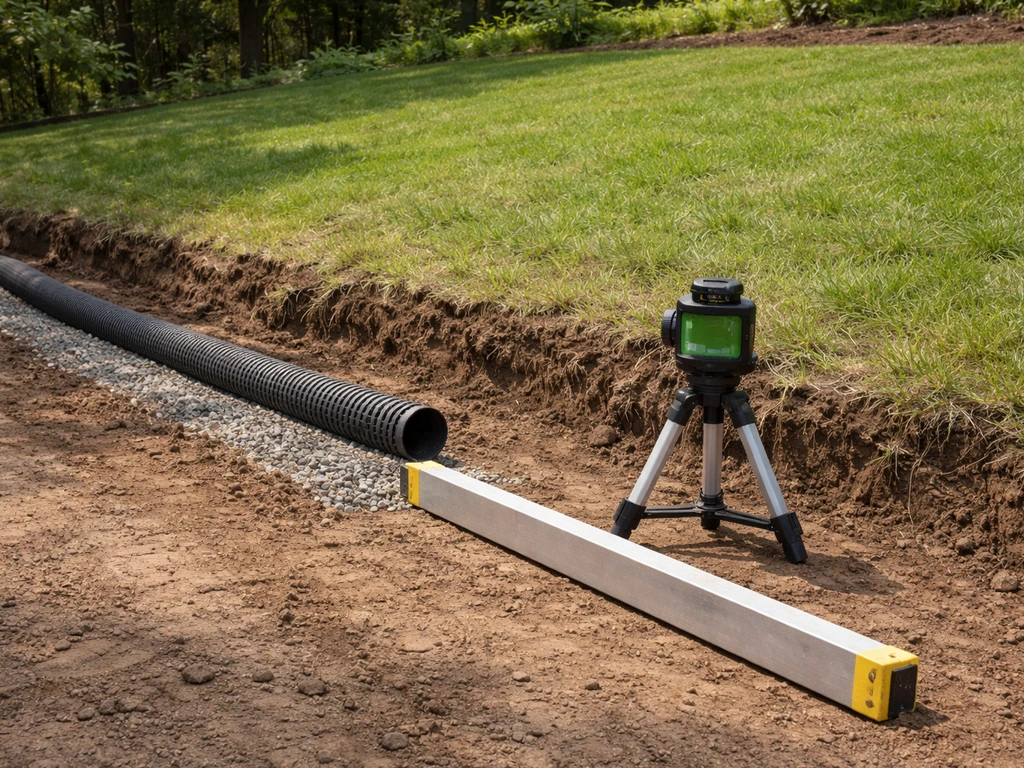
The base per-square-foot number assumes a fairly flat site, a single-level rectangle, no demo, and a simple railing. Real yards rarely cooperate. Here are the factors that move the number most significantly.
Site preparation and grading
If your yard slopes, expect to pay more. Grading, leveling, and drainage work can add $500–$3,000 before a single board goes down. Poor drainage under a wood deck causes early rot, so this isn't a line item to skip. Contractors in wet climates often add gravel beds or drainage channels under the structure.
Footings and frost depth
In cold climates, footings must extend below the local frost line to prevent the structure from heaving and shifting in winter. In Minnesota or Maine, that might mean digging 4–5 feet down. In Georgia or Texas, 12 inches may be sufficient. Local building departments set these requirements, and your contractor must follow them. Deeper footings mean more concrete, more labor, and more time. Budget footing costs at $3–$8 per square foot of deck as part of the structural package.
Design complexity
A rectangle is cheap. A multi-level deck with curved edges, built-in benches, multiple stair flights, and a pergola overhead is not. Each non-rectangular angle adds cutting labor. Each level requires its own framing. Custom shapes can add 20–40% to an otherwise straightforward quote. If you want to control cost, keep the shape simple and add features one at a time.
Permits and inspections
Most jurisdictions require a permit for any deck or elevated wood patio. Permit fees commonly run $350–$1,800 depending on your city or county and the size of the project. Some areas also require engineered drawings, which add another $300–$800. Never skip the permit. Unpermitted decks can create serious problems when you try to sell your home and can void homeowner's insurance coverage if something goes wrong.
Demo and removal
Replacing an existing concrete patio or old deck? Add $500–$1,500 for demo and hauling. Concrete removal is on the higher end. Old wood deck teardown is usually faster but still adds cost. Ask contractors to include demo as a separate line item so you can compare bids apples-to-apples.
DIY vs. hiring a contractor: what you actually save
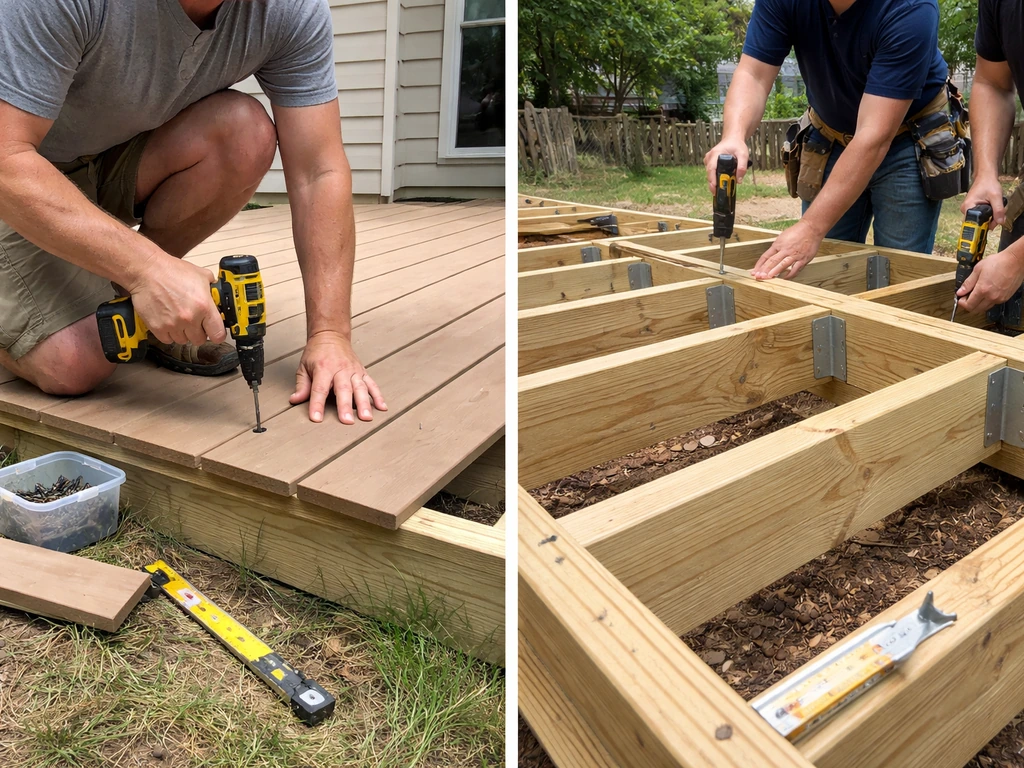
Going DIY can theoretically save you $3,500–$10,000 in labor on a mid-size project. That's real money. But the savings come with some equally real risks and costs that don't get talked about enough.
- Permits still apply. A DIY deck needs the same permit as a contractor-built one, and most jurisdictions will inspect the footings before you pour concrete. You can't skip this step.
- Tools add up. If you don't own a circular saw, miter saw, drill, post-hole digger, and level, you're renting or buying. Budget $300–$800 for a full tool rental run.
- Mistakes in framing are expensive. Joists are typically spaced 16 inches on center per standard framing practice. Getting spacing wrong means redoing it or having a bouncy deck that won't pass inspection.
- Footing errors can be catastrophic. Footings poured too shallow will heave. Footings undersized for the load will crack. If you're not confident here, hire at least the footing work out.
- Time cost is real. A contractor crew can frame and deck a 12x12 in 2–3 days. A first-time DIYer might take 3–4 weekends, assuming no re-dos.
- Finishing is often skipped by DIYers. Staining and sealing a PT wood deck within the first year is critical. This is a $150–$400 step that DIYers frequently postpone until the wood starts cracking.
The sweet spot for DIY savings is usually a simple, ground-level or low-profile deck on flat ground with no railing requirement. On a project like that, a capable DIYer can build a solid 12x12 for $1,800–$3,500 in materials (PT pine), saving $3,000–$5,000 compared to a contractor quote. The more elevated, complex, or code-intensive the project, the more the gap between DIY and contractor cost narrows when you account for risk, time, and corrective work.
Regional pricing and how to sanity-check a bid
Labor rates vary enough by region that the same 200 sq ft deck could cost $8,000 in rural Mississippi and $18,000 in coastal California or the Northeast. Material costs fluctuate too based on local supplier pricing and lumber market swings. Use these benchmarks as a reality filter when reviewing contractor quotes.
| Region | Typical Installed Cost (per sq ft) | Notes |
|---|---|---|
| Southeast (AL, MS, TN, AR) | $22–$40/sq ft | Lower labor rates; lower permit costs |
| Midwest (OH, IN, MO, KS) | $28–$48/sq ft | Mid-range; frost-line footings add cost |
| South Central (TX, OK, LA) | $25–$45/sq ft | Competitive labor; mild climate reduces footing depth |
| Mid-Atlantic (MD, VA, PA, NJ) | $35–$60/sq ft | Higher permit costs; stricter code enforcement |
| Northeast (NY, CT, MA, ME) | $40–$70/sq ft | High labor rates; deep frost lines; strict permits |
| Mountain West (CO, UT, ID) | $32–$58/sq ft | Altitude/frost varies; moderate labor |
| Pacific Coast (CA, WA, OR) | $40–$75/sq ft | High labor; strong demand; code complexity |
How to read a contractor quote
A trustworthy bid will break out materials and labor separately, and include line items for footings, decking boards, framing, fasteners, permit fees, and any demo. If a contractor hands you a single lump-sum number with no breakdown, ask for the itemized version before you sign anything. You want to know what happens to your bill if lumber prices shift between quote and build date (material escalation clauses are common right now).
- Get at least 3 quotes. Per-square-foot prices between reputable contractors often vary by $8–$15 on the same project.
- Ask whether the permit is included or billed as a pass-through. Some contractors mark up permit fees; others don't.
- Confirm railings and stairs are in the quote, or confirm they're explicitly excluded so you know what you're comparing.
- Ask about the wood grade and treatment level. There's a difference between #2 PT and premium select grade cedar. Make sure every bidder is quoting the same spec.
- Check if sealing/staining is included. Many bids cover installation only, and the finish coat is a separate invoice.
- If the bid seems low, ask what's not included. Low bids often omit footings, permit fees, or haul-away.
Planning your budget: wood deck vs. other patio options
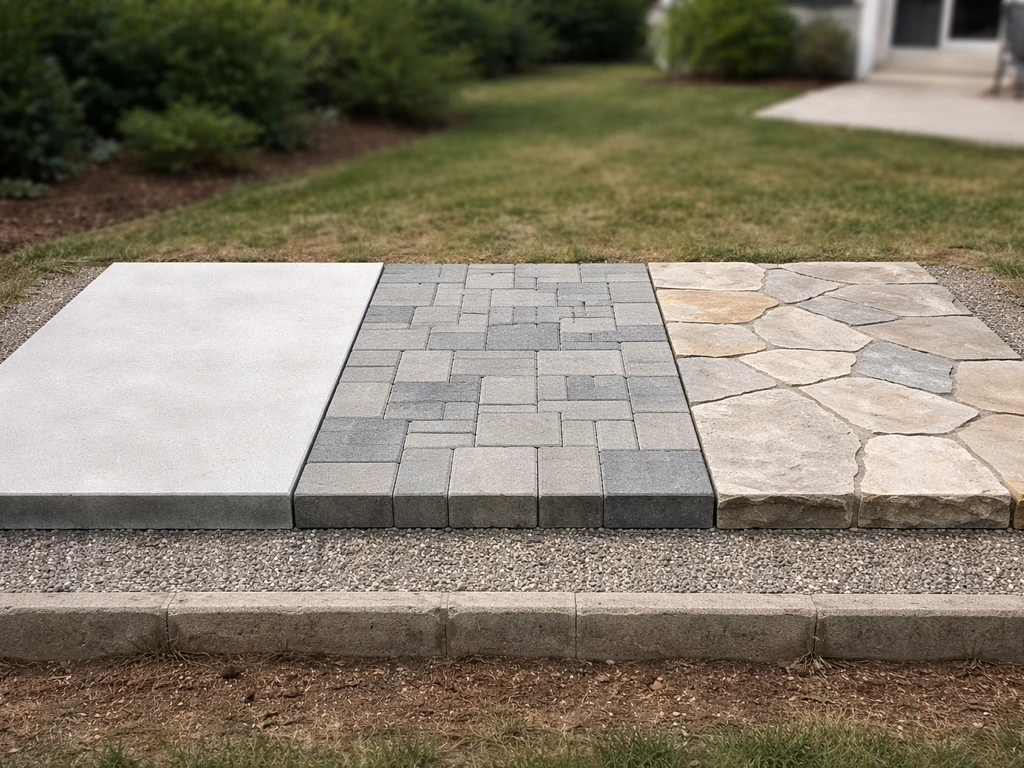
If you're still deciding between a wood deck-style patio and other surfaces, cost isn't the only factor, but it's a big one. This is also a useful way to estimate how much it will cost to cover your patio for your space and material choice how much will it cost to cover my patio. Wood is typically mid-range upfront but carries ongoing maintenance costs (staining or sealing every 2–3 years, board replacement over time). A 25-year cost-of-ownership model often shows wood decks costing more over time than concrete or pavers, even though wood is cheaper to build initially in many cases.
| Surface Type | Installed Cost Range (per sq ft) | Maintenance | Lifespan | Best For |
|---|---|---|---|---|
| Pressure-treated wood deck | $25–$55/sq ft | Moderate (stain/seal regularly) | 15–25 yrs surface | Budget to mid-range; elevated spaces |
| Cedar or hardwood deck | $40–$80/sq ft | Low-moderate | 20–40 yrs | Premium natural look |
| Concrete patio (standard) | $6–$15/sq ft | Low | 25–50 yrs | Flat yards, low maintenance |
| Stamped concrete patio | $12–$25/sq ft | Low-moderate (seal every 3–5 yrs) | 20–30 yrs | Decorative look at mid-range cost |
| Paver patio | $15–$35/sq ft | Low (individual paver replacement) | 30–50 yrs | Flexible design; long-term value |
| Flagstone or natural stone | $20–$50/sq ft | Low | 50+ yrs | High-end aesthetics |
| Brick patio | $15–$30/sq ft | Low | 25–50 yrs | Classic look; durable |
For flat yards with no elevation change, a concrete or paver patio almost always delivers better long-term value than wood. Wood decks earn their place when you need to span a slope, step down from a door threshold, or create an elevated outdoor living space. If you're weighing covered options, the roofing structure adds another $3,000–$15,000 depending on materials and span, which is worth comparing across wood, metal, and gable configurations as separate decisions. If you're planning a covered patio, the roofing structure and permits can significantly change the total cost compared with an uncovered deck covered options.
Concrete and maintenance trade-off over time
A PT wood deck built for $10,000 today will need staining or sealing every 2–3 years (roughly $300–$600 each time if DIY, $600–$1,200 if hired out), plus eventual board replacement around years 12–18. Over 25 years, those maintenance costs add up to $3,000–$8,000 on top of the original build. Concrete or pavers at a similar or slightly lower install cost often require just occasional resealing or joint sand replenishment. That long-view math matters when you're deciding how much to put into a wood surface.
Your next steps to get an accurate number fast
The fastest way to get a real number for your specific project is to request at least three itemized quotes from local deck contractors. Most will do a free site visit. Before those calls, know your approximate size (length x width in feet), whether you need railings (deck height over 30 inches triggers the IRC requirement), whether you have any demo or site prep needs, and which wood type you're targeting. Metal patio covers cost more than basic wood decks because you are paying for custom structure, roofing panels, and weather-resistant installation details. That information alone will let contractors quote faster and more accurately, and it'll make it easier for you to compare bids line by line. If quotes come back all over the map, the itemized breakdown will tell you exactly why.
Use the per-square-foot ranges in this article as your sanity-check baseline: if a quote lands well below $25/sq ft for an installed wood deck, ask hard questions about what's missing. A patio cover price is usually calculated the same way, using a per-square-foot baseline plus the extra cost of footings, permits, and design complexity per square foot ranges in this article. If it's above $80/sq ft for basic PT, ask for justification or get another bid. The sweet spot for a well-built, code-compliant wood patio or deck in most U.S. markets in 2026 still falls between $35 and $55 per square foot for a simple to moderate design.
FAQ
Does the quoted cost for “wood patio” include the framing and footings, or is it only decking boards?
A wooden patio built with boards on top of framing is usually treated like a deck for pricing. If your patio is truly ground-level with no elevation, no stairs, and no guardrails, you may qualify for the lower end of the per-square-foot range because labor and structural components are simpler. If it’s elevated, you should budget guardrails, proper footings, and more framing, which pushes costs toward the upper end even if the surface size is the same.
Why do two identical-size wood patios cost different amounts in different cities?
Yes, local building rules can make the cost jump even for the same size patio. For example, if your deck height is over 30 inches above grade, guardrails are typically required, and those rail components can add hundreds to thousands depending on the style. Similarly, permit requirements and whether engineered drawings are needed vary by city, so always check your local thresholds before using a national benchmark.
What parts are commonly missing from a low wood patio quote?
Most homeowners think the per-square-foot number covers everything, but quotes often exclude railings, electrical outlets, stairs, and structural contingencies like extra blocking or additional joists for spacing. A fast way to prevent surprises is to ask for an itemized breakdown that separates decking, joists/framing, fasteners/hardware, footings, permit/fees, stairs, and railings (and confirm whether demo and haul-away are included if you’re replacing anything).
How much can yard slope and drainage problems change the final price?
If a site is uneven, contractors may handle it with grading, drainage improvements, or different footing depths. But if the yard requires major leveling or has poor drainage, you might see change orders because the crew can discover conditions during demo or excavation. To reduce risk, ask whether the quote includes drainage components like gravel beds, channels, or sump routing, and whether soil conditions are assumed or evaluated on site.
If I’m replacing an existing deck or concrete patio, what demo costs can I expect?
Replacing an old deck or patio usually triggers extra work beyond the demo fee, like removal and disposal of old footings, patching the base, and re-checking ledger attachments if the location is near the house. Even when the teardown is straightforward, hauling and debris disposal can be a meaningful portion of the added cost, so request demolition as a separate line item and confirm what “hauling” includes.
Are premium hardwoods always worth the extra money compared with cedar or pressure-treated lumber?
Don’t confuse “premium wood” with “premium durability.” Dense hardwoods like ipe can last a long time, but the total installed price depends on how it’s supported, fasteners used, and how boards are detailed around water exposure. If you are paying for ipe or mahogany, ask whether the contractor is using compatible fasteners, and whether they plan for increased substructure requirements or specific installation patterns to minimize cupping and cracking over time.
When is DIY for a wood patio most likely to save money, and when does it stop being worth it?
DIY can reduce labor cost, but the savings shrink quickly when the project becomes code-intensive. If you need stairs, railings, multiple levels, permits, engineered footings, or a significant slope spanning, the DIY-to-pro gap narrows due to the added complexity and the risk of rework. A practical rule is that DIY savings are most realistic on simple, low-profile, flat-ground projects with minimal code and railing requirements.
How can I tell if my contractor’s per-square-foot price is too good to be true?
A quote that lands far below typical installed benchmarks is a red flag. Common causes include leaving out guardrails, assuming a simpler layout than what you requested, underestimating footings for frost depth or soil conditions, or omitting permit and engineered design costs. Ask the contractor to confirm the scope and explain what line items are included, then request the itemized version from any competitor so you can compare apples-to-apples.
Should I worry about lumber price increases between my quote and the build date?
Material prices can shift between the time you sign a contract and the installation date. Many contractors use material escalation clauses or re-price components if lumber market costs move. Before you sign, ask how the contract handles price changes, whether decking boards and fasteners are covered at the quoted cost, and what triggers a change order.
What maintenance costs should I factor into the true lifetime cost of a wood patio?
Even if you’re focused on upfront cost, wood requires a maintenance plan that affects real cost of ownership. Confirm whether the contractor’s warranty includes staining or sealing guidance, and get a schedule for how often you should expect to clean and re-seal based on sun exposure and rainfall. Also budget for board replacement later, especially on high-wear areas like stairs and near door thresholds where water and foot traffic are concentrated.
Next Articles

How Much Should a Patio Cover Cost? Real Budget Ranges
Budget ranges for patio covers, cost drivers, size examples, DIY vs install, and a checklist to compare contractor quote

How Much Does It Cost for a Covered Patio? 2026 Pricing Guide
2026 pricing ranges and size estimates to cover or build a patio, with cost breakdown, factors, and quote checklist.
How Much Should I Expect to Pay for a Patio
Patio cost guide with real price ranges by size and material, full line-item budget, DIY vs install, and quote checklist